

The Canadian Institute for Health Information has long emphasized the systemic nature of healthcare leadership: individual organizational decisions affect broader health system funding flows, and performance measurement frameworks connect directly to operational reality. That systemic perspective is built through education and structured organizational experience, not clinical practice alone.
Clinical professionals promoted on the basis of clinical excellence, who then struggle in management roles, are not individual failures. They are predictable outcomes of transitions that healthcare systems rarely prepare people for adequately.
Why Healthcare Leadership in Canada Requires Business Skills
Canadian healthcare organizations face significant financial pressure. Hospital funding models, provincial health authority budgets, and long-term care capital planning all require leaders with financial management competency, resource allocation experience, and operational fluency at a level that clinical training programs rarely address.
Budget Management and Financial Accountability
Healthcare department managers and directors are accountable for budget performance, operating within defined financial envelopes while meeting patient care standards. Clinical leaders who move into management frequently encounter this without adequate preparation:
- Budget literacy: understanding what budget categories mean and how variance is analyzed
- Business case development: building credible requests for resource allocation and capital investment
- Finance communication: having informed conversations with finance departments about funding requirements and shortfalls
Human Resources and Team Management
Managing a healthcare team involves employment law compliance, performance management, conflict resolution, professional development, and engagement. These responsibilities operate within an environment defined by significant union presence, professional licensing obligations, and regulatory constraints that do not exist in most other sectors.
Clinical leaders who have spent their careers as individual contributors often underestimate the complexity of managing other clinicians. Navigating a performance issue with a unionized team member requires an entirely different skill set than managing a patient’s complex care needs.
Strategic Planning and Change Management
Healthcare organizations are managing multiple simultaneous transformations: digital health implementation, care model redesign, workforce planning, and quality improvement. Leaders who can contribute to strategic planning, manage organizational change, and bring teams through significant transitions while maintaining care quality are among the most valued and most scarce in Canadian healthcare.
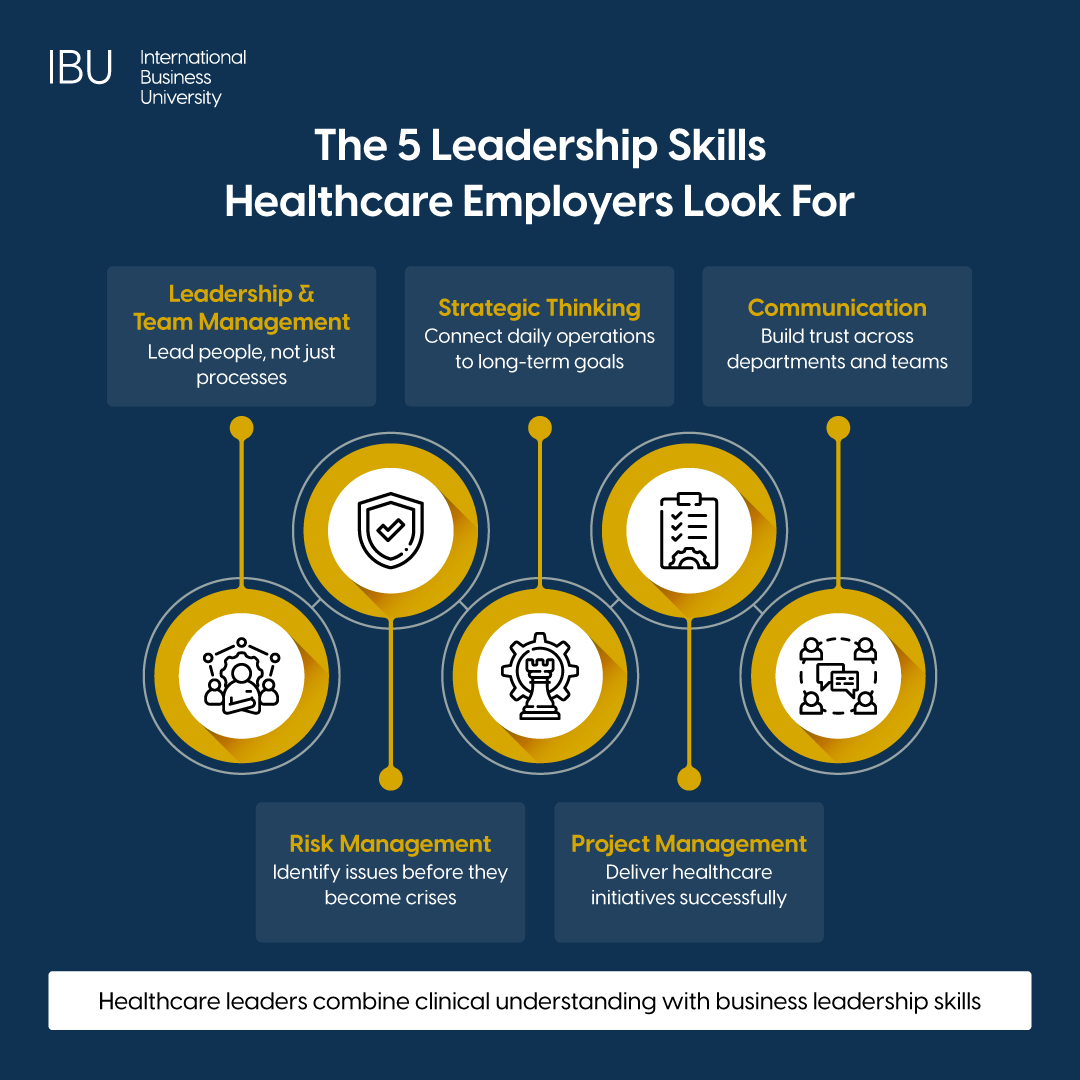
Leadership in Healthcare: The 5 Skills Employers Hire For
Canadian healthcare organizations evaluate management candidates against a consistent set of organizational competencies. Clinical credentials establish baseline credibility. These five skills determine who advances.
Leadership and Team Management
Leading a healthcare team is not an extension of clinical supervision. It requires managing professional dynamics, union relationships, performance accountability, and staff engagement across a workforce where regulatory obligations and licensing standards constrain every management decision.
- People over processes: effective healthcare managers lead individuals through complexity, not just workflows through systems
- Union and regulatory navigation: most clinical professionals have no formal exposure to the employment law and labor relations framework that governs every HR decision in healthcare
- Engagement under pressure: maintaining team cohesion during organizational change, staffing shortages, and service restructuring is a specific and learnable management competency
Strategic Thinking
Healthcare leaders who advance to director and executive levels connect daily operational decisions to long-term organizational goals. This requires a strategic framework that clinical training does not build.
- Organizational context: understanding how funding models, policy changes, and competitive pressures shape the decisions available to a healthcare organization
- Translating strategy to operations: converting board-level direction into service-level plans that frontline teams can execute
- Long-term planning: contributing to workforce planning, capital investment decisions, and service redesign at the department or system level
Communication
Trust across departments and teams does not develop from clinical authority. It is built through consistent, structured communication that connects policy to practice and aligns clinical and administrative staff toward shared outcomes.
- Cross-functional clarity: healthcare leaders communicate with finance, HR, clinical, and administrative teams simultaneously, each with different priorities and professional languages
- Change communication: organizations that manage change poorly lose staff; leaders who communicate change clearly maintain engagement and operational continuity
- Board and executive reporting: senior roles require communicating performance, risk, and strategic recommendations to governance bodies with precision
Risk Management
Identifying issues before they become crises is one of the highest-value competencies in healthcare leadership. This covers quality and patient safety, regulatory compliance, workforce sustainability, and financial performance.
- Proactive identification: Risk management at the leadership level means building systems that surface problems before they become incidents or regulatory findings
- Regulatory literacy: Canadian healthcare leaders operate within a complex framework of provincial legislation, accreditation standards, and professional licensing obligations
- Workforce risk: Nursing shortages, burnout, and succession gaps represent organizational risks that require active planning, not reactive response
Project Management
Healthcare organizations run multiple simultaneous initiatives across technology, care model redesign, compliance, and quality improvement. Most clinical professionals who move into management encounter formal project management requirements without any structured preparation.
- Scope and governance: Healthcare projects operate within approval structures and regulatory constraints that extend timelines and require disciplined scope management
- Clinical change resistance: Engaging clinical staff through organizational change requires specific approaches that differ from change management in other sectors
- Delivery accountability: Project outcomes in healthcare carry patient safety implications that raise the cost of poor project governance significantly
Advance Into Healthcare Leadership
IBU’s MBA in Healthcare Management prepares clinical professionals for executive career transitions.
The MBA Competencies That Separate Healthcare Managers From Healthcare Executives
The career ceiling most experienced healthcare managers encounter is not clinical. It is an organizational competency ceiling, the point at which advancing further requires strategic planning, financial management, board governance, and systems leadership capabilities that clinical careers do not build.
The LEADS in a Caring Environment framework, the primary competency model for healthcare leadership in Canada, identifies five leadership domains: Lead Self, Engage Others, Achieve Results, Develop Coalitions, and Systems Transformation. Clinical experience builds the first domain. The remaining four are built through organizational experience and graduate-level education focused on the organizational and systems dimensions of healthcare leadership.
Financial Management Competency
Healthcare MBA programs build the financial literacy that healthcare executives require:
- Financial statement analysis: reading and interpreting healthcare-specific financial reports
- Healthcare funding models: understanding provincial funding structures and their operational implications
- Capital investment cases: developing and defending business cases for major resource decisions
- Department-level performance: managing budget accountability at the service or unit level
This competency is directly tested in the first leadership role a clinical professional takes on and is one of the most common gaps that causes early-career healthcare leaders to struggle.
Organizational Strategy
Strategic thinking in healthcare requires understanding the competitive and regulatory environment, identifying investments that improve organizational capacity, and translating strategic direction into operational plans that frontline teams can execute. MBA programs build this framework through:
- Case analysis and applied strategic planning coursework
- Organizational behavior curriculum addressing how complex organizations make decisions
- Change management frameworks applicable to healthcare’s specific governance structures
Risk Management in Healthcare: The Skill Every Leadership Role Owns
Risk management in healthcare is the organizational discipline of identifying, assessing, and mitigating the full spectrum of risks healthcare organizations face: clinical quality, patient safety, regulatory compliance, workforce sustainability, technology implementation, and financial performance.
Quality and Patient Safety
Healthcare leaders at every level are accountable for quality and safety performance in their service areas. The relevant competencies include:
- Quality improvement methodologies: LEAN, Six Sigma, and the PDSA cycle application
- Accreditation compliance: quality improvement leadership is increasingly required for Canadian healthcare accreditation
- Incident analysis: structured approaches to patient safety events and systemic root cause identification
Regulatory and Compliance Risk
Canadian healthcare is governed by a complex web of provincial and federal regulations covering patient privacy (PHIPA in Ontario), professional licensing, accreditation standards, and employment law. Leaders who understand this regulatory environment and can identify compliance risks before they become incidents, protect their organizations and their own professional standing in ways that leaders without this awareness cannot.
Workforce Risk
Healthcare workforce sustainability is one of the most pressing risk concerns for Canadian health organizations. Nursing shortages, physician supply constraints, burnout and turnover in allied health professions, and the succession planning challenge of an aging leadership cohort all represent risks that healthcare leaders must understand and actively address as part of their organizational stewardship.
How an MBA in Healthcare Changes the Ceiling You Can Reach
The practical effect of an MBA in Healthcare Management on a clinical professional’s career is documented in Canadian healthcare hiring patterns: director, VP, and C-suite roles increasingly specify graduate business education as a required or strongly preferred qualification.
This is not credentialism for its own sake. It reflects the organizational reality that senior healthcare leadership requires capabilities that clinical education does not build. Healthcare organizations have learned to treat the MBA credential as a reliable proxy for those capabilities being present.
The healthcare professional who builds clinical excellence and then earns an MBA in Healthcare Management occupies a category most competitors cannot match: clinical credibility that separates them from MBA graduates without clinical backgrounds, and organizational and financial competency that separates them from clinical professionals without business education.
The LEADS Framework: What IBU Students Learn and Apply
IBU’s MBA in Healthcare Management uses the LEADS framework as its primary leadership development model, alongside coursework in healthcare systems, health policy, and organizational management. As IBU’s overview of healthcare leadership models outlines, LEADS provides both an assessment tool for identifying leadership gaps and a development roadmap for building the competencies healthcare organizations hire for.
Engage Others
This domain covers:
- Clinical team management: building effective teams within professional and union dynamics
- Staff engagement through change: maintaining engagement during organizational transitions
- Psychological safety: creating conditions where healthcare teams report concerns without fear of reprisal
Achieve Results
This is where MBA financial management and operational competencies connect most directly to healthcare leadership practice:
- Performance expectations: setting clear accountability standards within complex governance structures
- Budget performance: managing financial accountability at the department or service level
- Quality improvement delivery: leading measurable improvement initiatives within regulated environments
Systems Transformation
The most senior LEADS domain covers understanding the broader health system, identifying opportunities for transformational change, influencing health policy, and leading organizational transitions. MBA graduates with healthcare backgrounds are most differentiated from both clinical leaders without business education and MBA graduates without healthcare domain knowledge at this level.
Project Management in Healthcare: The Gap Most Clinical Leaders Never Fill
Healthcare organizations run dozens of major projects simultaneously: technology implementations, care model redesigns, facility planning, quality improvement, and regulatory compliance programs. Most clinical leaders who move into management encounter project management requirements for which they have no formal training.
Healthcare project management carries specific complexity factors:
- Patient safety stakes: project failure carries clinical risk implications absent in most other industries
- Clinical staff resistance: change management in healthcare requires specific approaches to clinician engagement
- Regulatory constraints: accreditation and compliance requirements shape project design and timelines
- Governance structures: approval processes in healthcare extend project timelines significantly beyond other sectors
MBA programs that integrate healthcare project management content produce graduates who are more effective in managing complex initiatives from the first month on the job.
Healthcare Consulting: A Growing Career Path for MBA Graduates
Healthcare consulting is one of the fastest-growing career destinations for MBA graduates with healthcare backgrounds in Canada. Consulting firms, from Big 4 practices with healthcare verticals to specialist advisory firms, serve hospital networks, health authorities, government health ministries, and health technology companies on strategy, operations, digital transformation, and organizational change mandates.
Healthcare consultants require a combination of business analytical skills and healthcare domain knowledge that most hiring managers struggle to find. MBA graduates who spent their pre-MBA careers in clinical or healthcare administrative roles are among the strongest candidates for these roles precisely because that combination is rare.
Compensation and Career Trajectory
Entry-level healthcare consulting roles at major firms in Toronto typically start at $90,000 to $120,000 for MBA graduates with relevant healthcare experience, which is significantly above compensation available for equivalent experience in direct healthcare employment.
The consulting pathway also offers accelerated exposure to strategy and senior organizational decisions that direct healthcare employment paths reach more slowly.
The Common Challenges That Define This Career Transition
As IBU’s analysis of leadership challenges in the healthcare industry outlines, the barriers clinical professionals face when moving into management are consistent and predictable. Understanding them in advance is the most direct path to navigating them effectively:
- Financial literacy gap: Most clinical professionals have never been accountable for budget performance before their first management role
- HR complexity underestimation: Managing other clinicians in unionized healthcare settings requires skills that clinical training does not address
- Strategic thinking deficit: Contributing to organizational strategy requires frameworks that clinical practice does not build
- Risk management exposure: Regulatory, workforce, and quality risks at the organizational level are different in kind from clinical risk management
- Project management formalization: Most clinical professionals have managed clinical workflows, but not formal organizational projects
Key Takeaways

Clinical experience is necessary but not sufficient for healthcare leadership: The competencies that differentiate healthcare executives from healthcare clinicians are organizational, financial, and strategic, built through education and deliberate development, not through patient care experience.
Financial management literacy is the most common gap in clinical-to-management transitions: Healthcare leaders who cannot read financial statements, manage budget performance, or build credible business cases are constrained in their first management roles in predictable ways.
The LEADS framework is the primary Canadian healthcare leadership competency model: Building toward LEADS competency across all five domains provides a structured development roadmap that healthcare leadership hiring panels are specifically looking for.
An MBA in Healthcare Management changes the career ceiling: Director, VP, and C-suite healthcare roles increasingly require or strongly prefer graduate business education, and the clinical-MBA combination is the most differentiated credential in Canadian healthcare leadership hiring.
Healthcare consulting offers the fastest compensation and career trajectory: For MBA graduates with healthcare backgrounds, consulting provides premium compensation and accelerated senior exposure relative to direct healthcare employment pathways.
Frequently Asked Questions
Do I need an MBA to become a healthcare executive in Canada?
Not technically required in all cases, but increasingly expected and often specified. Senior healthcare leadership roles at major Canadian health systems, hospital network executives, regional health authority leadership, and corporate healthcare management increasingly include MBA or equivalent graduate business education as a required or strongly preferred qualification.
The practical reality: clinical professionals without graduate business education often reach a promotion ceiling at the director level and find themselves competing against MBA-credentialed candidates for VP and above roles. Earning the MBA before that ceiling is reached allows continuous career progression rather than requiring an educational interruption at mid-career.
Can you do an MBA in healthcare management while working as a clinical professional?
Yes. IBU’s MBA in Healthcare Management is specifically designed for working professionals, with an online delivery format and a completion timeline as short as 16 months. Most students in the program maintain their clinical employment throughout, completing coursework in evenings and on weekends.
The IBU program’s online format also means that clinical professionals do not need to be physically located near the institution, a significant practical advantage for healthcare professionals in regional health centers, smaller Canadian cities, or northern communities where on-campus MBA programs are not accessible.
What is the salary range for healthcare leaders with an MBA in Canada?
Healthcare management salary ranges in Canada vary significantly by role level and organization type. Department managers and clinical coordinators with MBA credentials typically earn $85,000 to $110,000. Directors of clinical programs or administrative departments earn $110,000 to $150,000. VP-level and above positions at major health systems range from $150,000 to $300,000+.
Healthcare consulting roles for MBA graduates with clinical backgrounds start at $90,000 to $120,000 at the entry level and advance to $150,000 to $250,000+ at senior manager and principal levels, typically the highest-compensation pathway available to healthcare professionals with business credentials.
Healthcare Leadership Is Built, Not Just Earned
The clinical professionals who advance into senior healthcare leadership in Canada are not those who waited for their experience to be recognized, they are those who deliberately built the organizational, financial, and strategic competencies that healthcare executive roles require, alongside their clinical foundations.
An MBA in Healthcare Management is the most direct and most credentialed path to building those competencies. It does not replace clinical experience, it combines with it to create the profile that Canadian healthcare organizations are actively seeking to fill the leadership pipeline that retirement and organizational growth are opening.
Prepare for Healthcare Leadership Without Leaving Practice
Build healthcare management skills while continuing your career.