

Every business needs capital. How it sources that capital, and on what terms, shapes its ownership structure, its financial flexibility, and its ability to pursue growth.
Business school programs cover financing theory. What many graduates lack when they enter the workforce is a practical understanding of how financing decisions are actually made, which instruments fit which situations, what the trade-offs are, and how businesses evaluate options when multiple sources of capital are available simultaneously.
The five types of financing covered here represent the core toolkit that every corporate finance curriculum identifies as foundational: debt, equity, internal, short-term, and long-term financing.
Why Understanding Types of Financing Matters for Graduates
Finance graduates who can explain the trade-offs between financing options, not just define them, add immediate value in roles ranging from corporate finance and strategy to operations and general management.
The hiring manager who asks ‘how would you evaluate if a company should fund a new production line with debt or equity?’ is testing practical reasoning, not terminology recall. Graduates who can walk through the analysis, cash flow requirements, ownership implications, cost of capital, strategic flexibility, demonstrate the applied thinking that separates strong candidates from those who memorized the concepts without internalizing them.
5 Types of Financing Explained: A Quick Overview
The five types of financing address different capital needs, carry different costs, and impose different obligations on the businesses that use them.
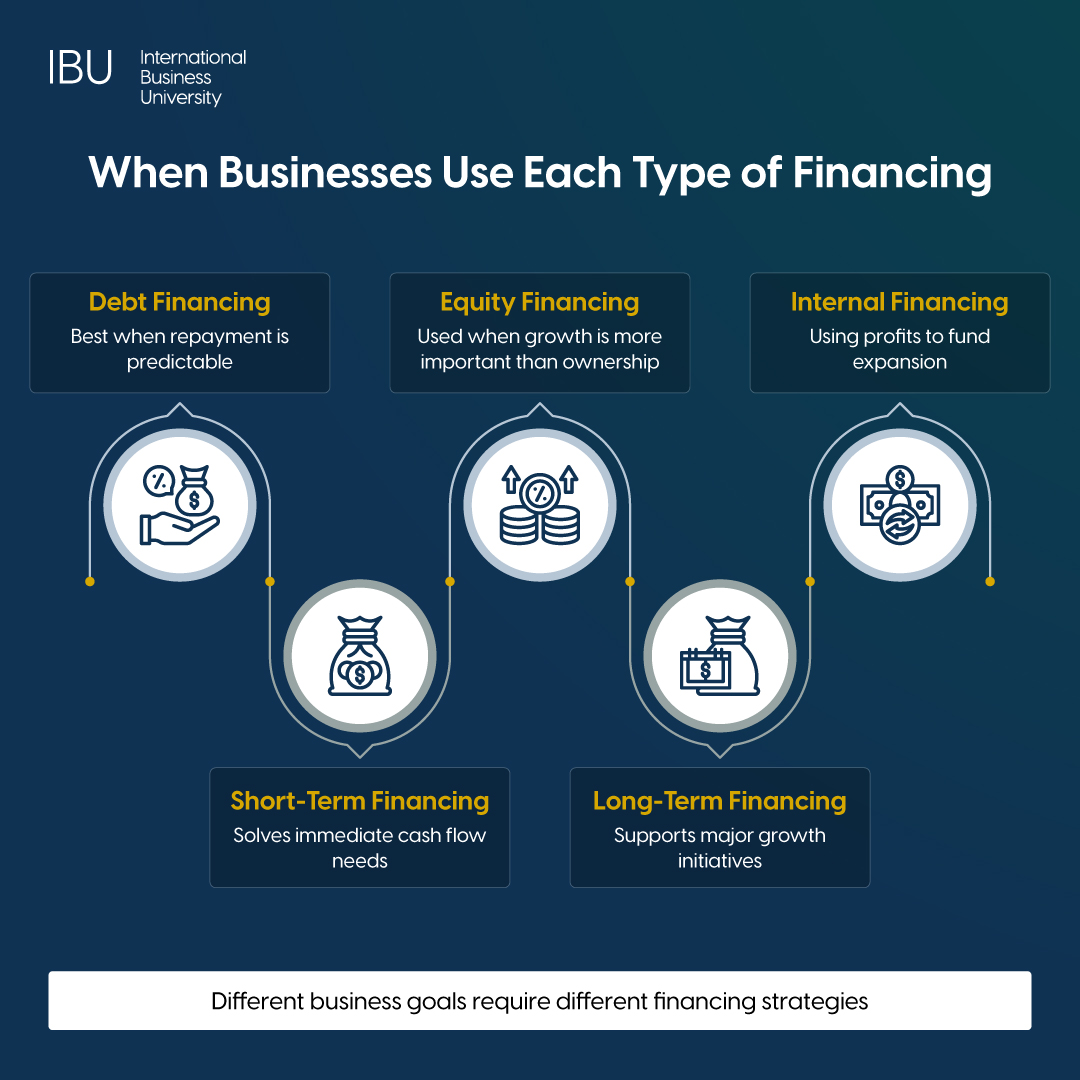
1. Debt Financing: How Businesses Use Borrowed Money
Debt financing is the most commonly used external financing instrument for established Canadian businesses.
How It Works
A business borrows a defined amount from a lender, a bank, credit union, or an alternative lender, and agrees to repay it over a defined schedule with interest. The principal and interest payments are predetermined, creating a predictable financial obligation. The lender has no ownership stake unless specific default provisions trigger equity conversion clauses.
When Businesses Choose Debt
Debt financing is appropriate when the business generates sufficient cash flow to service the debt comfortably, typically measured by a debt service coverage ratio above 1.25x. It is the preferred instrument for capital expenditure, equipment purchase, facility investment, and working capital support because it preserves ownership while providing defined capital at a known cost.
The Trade-Off
Debt creates fixed obligations regardless of business performance. In a period of revenue decline, debt service payments that were sustainable at full revenue can become a cash flow crisis. Businesses with volatile revenue should limit debt exposure relative to their cash flow cushion.
2. Equity Financing: Raising Capital Without Repayment
Equity financing provides capital in exchange for an ownership stake, no repayment obligation, but a permanent change in the ownership structure of the business.
How It Works
The business issues new shares to investors, angel investors, venture capital firms, private equity, or public markets, at a negotiated valuation. Investors become partial owners with rights defined by the shareholder agreement: economic rights (participation in profits and exit proceeds) and governance rights (board representation, approval rights over certain decisions).
When Businesses Choose Equity
Equity financing is appropriate when a business cannot service the cash flow requirements of debt, typically at pre-revenue or high-growth stages, or when the scale of capital required exceeds available debt capacity. It is also used when a strategic investor adds value beyond the capital itself, and a strong venture capitalist pitch is what earns that kind of partnership in the first place.
The Trade-Off
Equity is expensive in the long run. Investors who receive 20% of a company at a $5 million valuation receive 20% of all future value created, which may be worth tens or hundreds of millions of dollars at exit. The absence of a repayment obligation is offset by the permanent cost to future ownership value.
Develop Your Corporate Finance Skills
IBU’s MBA in Financial and Management Analytics builds practical financing decision capability.
3. Internal Financing: Using Business Profits and Personal Funds
Internal financing is the use of capital that is already within the business, such as retained earnings, owner contributions, or the liquidation of non-core assets.
How It Works
Retained earnings are profits that have not been distributed to owners. Instead of paying dividends or withdrawing profits, the business reinvests them into growth. For owner-operated businesses, personal capital contributions represent a form of equity investment by the owner without the governance complexity of external equity.
When Businesses Choose Internal Financing
Internal financing is the default first choice for most small and mid-market businesses because it involves no external obligation, no dilution, and no application process. When internal capital is sufficient to fund a growth initiative, most business owners prefer it to external instruments regardless of the cost differential.
The Trade-Off
Internal financing is limited by profitability. A business that is not yet profitable or that reinvests all profits in operations may have minimal internal capital available for growth initiatives. Over-reliance on internal financing can also slow growth below the pace the market opportunity supports.
4. Short-Term Financing: Managing Immediate Cash Needs
Short-term financing addresses capital needs with timelines under 12 months, working capital gaps, seasonal inventory buildups, and bridge financing between longer-term capital raises.
Common Instruments
- Lines of credit, revolving access to capital up to a defined limit, drawn and repaid as needed
- Trade credit, deferred payment terms from suppliers, effectively a short-term interest-free loan from the supply chain
- Invoice financing, capital advanced against outstanding receivables before they are paid
- Overdraft facilities, short-term borrowing against a business bank account, typically at high rates
When Businesses Choose Short-Term Financing
Short-term financing addresses timing mismatches, the gap between when costs are incurred and when revenue is received. Retail businesses managing seasonal inventory, manufacturers waiting on payment for delivered goods, and service businesses with slow-paying clients all use short-term instruments to smooth cash flow rather than fund long-term investments.
5. Long-Term Financing: Funding Growth and Expansion
Long-term financing provides capital for investment horizons extending beyond 12 months, capital expenditure, facility acquisition, major technology infrastructure, and sustained operational expansion.
Common Instruments
- Term loans, lump-sum borrowing repaid over 3 to 10+ years with scheduled principal and interest payments
- Mortgage financing, real estate secured borrowing for facility acquisition
- Equipment financing, capital specifically for equipment purchase, with the equipment as collateral
- Long-term equity, private equity or public market capital for major growth phases
When Businesses Choose Long-Term Financing
Long-term financing matches the capital commitment timeline to the investment benefit timeline. Equipment that will be used for seven years should be financed over seven years, not from working capital. Facilities with 20-year useful lives are financed with long-term instruments, not short-term credit that would require constant refinancing.
Debt vs Equity Financing: Key Differences Every Student Should Know
The debt versus equity decision is the most fundamental capital structure question in corporate finance.
- Cost: Debt is typically cheaper than equity in the long run because lenders require a return only on the loaned amount, while equity investors require a return on the full ownership value they hold.
- Obligation: Debt creates fixed cash flow obligations regardless of performance. Equity has no mandatory payment, dividends are discretionary, and investor returns are realized only at exit.
- Ownership: Debt preserves ownership. Equity dilutes it. This distinction matters more as the business grows in value.
- Risk: Excessive debt increases financial risk, the obligation to make payments even when revenue declines. Equity investors share the downside risk alongside the upside.
How Businesses Choose the Right Type of Financing
Financing decisions are made by evaluating three dimensions simultaneously: the purpose of the capital, the business’s capacity to service any obligations the instrument creates, and the ownership and governance implications of the instrument.
A profitable established business funding an equipment purchase will typically use debt. A pre-revenue startup funding product development will typically use equity. A cash-generative business with an inventory spike will use a line of credit. A company with strong retained earnings funding a small expansion will use internal capital.
None of these decisions are made in isolation, they are made in the context of the full capital structure the business already carries, the stage of the business, and the strategic objectives driving the capital need.
Key Takeaways

Debt preserves ownership; equity dilutes it: This is the most important distinction in any financing decision and the starting point for every capital structure analysis.
Short-term and long-term instruments serve different purposes: Matching the financing horizon to the investment timeline is a fundamental principle of sound capital structure management.
Internal financing is the default first choice: When retained earnings are sufficient, most businesses prefer internal capital over external instruments regardless of cost.
The choice is always contextual: The right financing type depends on the business’s stage, cash flow profile, ownership preferences, and the specific purpose of the capital.
Frequently Asked Questions
Is debt or equity financing better for a startup?
Most startups use equity financing at early stages because they cannot demonstrate the cash flow required to service debt. Equity investors accept the risk of loss in exchange for the potential of significant ownership value at exit. As startups become profitable and develop predictable cash flows, debt becomes increasingly accessible and may be preferred for specific capital needs that do not require the scale of an equity raise.
What is the cost of equity financing?
The cost of equity is the return investors expect for bearing the ownership risk, typically expressed as an expected return percentage. For venture capital investors, this expected return is very high (30%+ annually) to compensate for the high failure rate of early-stage investments. For public market investors in established companies, the expected return is lower.
Unlike interest on debt, the cost of equity is not a fixed cash outflow, it is realized only at exit or through dividends. This creates a common cognitive bias: founders underestimate the cost of equity because there is no monthly payment, even as the cumulative cost of dilution grows with the company’s value.
Can a business use multiple types of financing simultaneously?
Yes, and most established businesses do. A company might carry a term loan for equipment, a line of credit for working capital, retained earnings funding incremental operational investment, and equity from an early investor round, all simultaneously. Managing the balance across these instruments is the practical work of corporate finance and capital structure management.
Financing Knowledge Pays Off Immediately After Graduation
Business graduates who understand the types of financing, not just their definitions but the conditions under which each is appropriate and the trade-offs each creates, are immediately more useful in any finance, strategy, or general management role.
IBU’s financial and management analytics program builds this applied capital structure thinking alongside the analytical and accounting foundations that finance careers require.
Discuss Your MBA Fit With an IBU Advisor
Go beyond finance theory. Explore IBU MBA options that build practical skills in finance, analytics, and management.