

Every AI product that works in production has a data engineering layer underneath it. The AI model gets the credit. The data engineer built the infrastructure that the model runs on.
Without clean, structured, timely data flowing reliably through a pipeline that was designed, built, and maintained by someone with data engineering expertise, the most sophisticated machine learning model produces nothing useful. This is not a marginal point about operational efficiency, it is the most common reason AI projects fail in production after succeeding in research environments.
Key Takeaways
- Data engineering is the infrastructure layer beneath every AI product: Without reliable pipelines, data quality systems, and scalable architecture, machine learning models fail in production regardless of their research performance.
- Data engineering is distinct from data science and ML engineering: Data engineers build the systems that make data usable; data scientists use data to produce insights; ML engineers deploy models into production.
- Production failures are almost always data engineering failures: Training-serving skew, data quality degradation, and scaling failures are the most common causes of AI production failures, and all are data engineering problems.
- Every AI team operating at scale needs dedicated data engineering expertise: This is a structural demand driver, not a temporary trend, as AI adoption grows, data engineering capacity constraints are the most consistent bottleneck.
What Is Data Engineering: The Clearest Explanation That Actually Sticks
Data engineering is the discipline of building and maintaining the systems that collect, transform, store, and deliver data so it is usable by the people and systems that need it, on time, at the right quality, at scale.
According to Databricks’ data engineering glossary, data engineers design and build pipelines that transform raw data into a usable format and make it available for analysis and machine learning. They work at the infrastructure level of the data stack, below the data scientists and analysts who use the data, and below the AI engineers who train models on it.
In practical terms, data engineering is the work of answering questions like: How does raw transaction data from ten different source systems get consolidated into a single, clean dataset that a machine learning model can train on? How does a hospital make clinical data from five different EHR systems available to an analytics platform without creating data quality inconsistencies? How does a logistics company make real-time sensor data from 200 automated vehicles available to a routing optimization system with sub-second latency?
The answers to these questions require data engineering. The people who can build those answers reliably are data engineers.
Data Engineering vs Data Science vs Machine Learning: Where Each One Starts and Stops
The boundaries between data engineering, data science, and machine learning engineering are blurry in practice and frequently confused in job descriptions. Understanding where each discipline starts and stops helps professionals position themselves accurately and helps hiring managers write job requirements that attract the right candidates.
Data Engineering
Data engineers build and maintain the pipelines, storage systems, and data architecture that make data usable. They work primarily in infrastructure and systems. Their outputs are pipelines, databases, data warehouses, and data streams, not models, insights, or products.
Data Science
Data scientists use data to answer questions and produce insights. They work primarily in analysis, statistical modeling, and exploratory research. Their outputs are analyze, reports, predictive models, and recommendations, not production systems or infrastructure.
Machine Learning Engineering
ML engineers build the systems that take machine learning models from research environments into production, deploying, monitoring, and maintaining models at scale. They work at the intersection of software engineering and machine learning. Their outputs are deployed models running in production systems.
In practice, many organizations are too small to have dedicated professionals in all three roles. Data engineers often take on ML infrastructure work. Data scientists often do their own basic data engineering. But in organizations operating AI systems at any meaningful scale, the data engineering function is the most foundational and the hardest to replace when it breaks down.
Why Data Pipelines Explained Simply Are the Foundation of Every AI Product
A data pipeline is a sequence of automated processes that collect data from source systems, transform it into a usable structure, and deliver it to a destination, a database, a data warehouse, an analytics platform, or a machine learning model.
Without reliable pipelines, data systems fail in predictable ways.
- Models trained on stale data make outdated predictions that do not reflect current conditions
- Inconsistent data from multiple source systems produces models that perform well on some inputs and fail on others
- Data quality issues, duplicates, missing values, formatting inconsistencies, introduce errors that compound through every downstream system that consumes the data
- Systems without proper data architecture cannot scale, what works for 1,000 records per day breaks at 1,000,000 records per day
Data engineers prevent all of these failure modes through deliberate pipeline design, data quality monitoring, and scalable architecture choices. This is why every AI team that operates in production needs data engineering expertise, not as a nice-to-have, but as a prerequisite for reliability.
Why AI Projects Fail Without Data Engineering
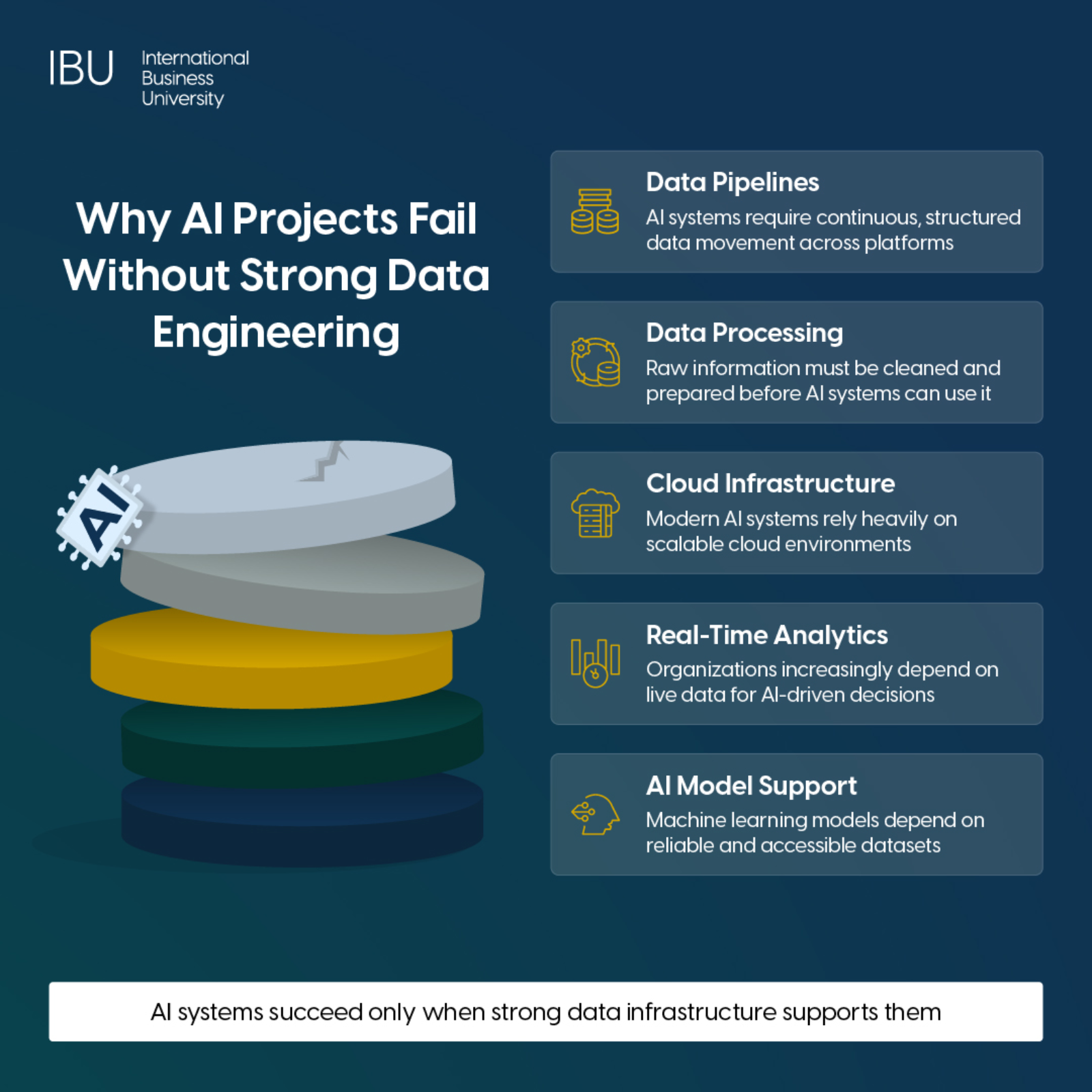
AI projects fail when data systems cannot supply clean, current, and usable information. Data engineering gives AI teams the pipelines, processing rules, storage systems, and model-ready datasets required for reliable results. Most AI failures are not model failures. They are infrastructure failures that show up only after deployment, when the gap between research conditions and production reality becomes visible.
Failed Data Pipelines
AI systems break down when data cannot move consistently between platforms. Weak pipelines create delays, missing records, and disconnected inputs that reduce model accuracy. In production environments, pipelines need to handle schema changes, upstream system failures, and volume spikes without breaking. A pipeline that works for 10,000 records per day frequently fails at 1,000,000. That failure surfaces at the worst possible moment, when the system is under real operational load.
Poor Data Processing
AI models produce unreliable outputs when raw information is not cleaned and prepared. Duplicate records, inconsistent formats, and incomplete fields make analysis less dependable. The problem compounds downstream. A model trained on poorly processed data learns incorrect patterns that persist through every prediction it makes. Fixing data quality after a model is already in production is significantly more expensive than building processing rules that enforce quality from the start.
Limited Cloud Infrastructure
AI projects struggle when infrastructure cannot support large data volumes or frequent model activity. Cloud systems provide the storage, computing capacity, and access controls needed for scalable AI work. Without the right infrastructure choices, teams hit capacity ceilings that block model retraining, slow batch processing, and introduce latency that makes real-time applications unusable. Infrastructure decisions made at the proof-of-concept stage frequently become the bottleneck at production scale.
Delayed Analytics
AI decisions lose value when organizations depend on outdated reports. Real-time analytics helps teams respond to live operational, customer, and market data. A fraud detection model running on data that is 24 hours old will miss patterns that developed overnight. A demand forecasting system fed weekly batch data cannot respond to intraday inventory signals. The gap between when data is generated and when it reaches the model directly determines whether the AI output is actionable or already obsolete.
Weak Model Support
Machine learning models fail when datasets are fragmented, inaccessible, or poorly governed. Reliable model support depends on structured data assets that teams can test, monitor, and update. Models degrade over time as the real world shifts away from the conditions they were trained on. This is called model drift. Without a data infrastructure that supports regular retraining, performance benchmarking, and version control for both models and their training datasets, that degradation goes undetected until the model’s outputs stop making sense to the people relying on them.
How IBU’s MSc in Applied AI (Data Engineering) Builds This From the Ground Up
IBU’s MSc in Applied AI with a Data Engineering specialization builds the pipeline engineering, data architecture, and systems design skills that AI teams at Canadian technology companies, financial services firms, and healthcare organizations are actively hiring for.
The curriculum covers the full data engineering stack: data ingestion and transformation tools, distributed processing frameworks, cloud data warehouse design, real-time streaming systems, data quality and monitoring, and MLOps, the operational practices that keep machine learning systems reliable in production.
Students apply these skills in applied projects and capstone work, building a portfolio of practical pipeline and architecture work that is the most effective differentiator in data engineering job applications. IBU’s blog on how to become a data engineer in Canada outlines the tools and pathways in more detail for students evaluating the field.

Build Data Engineering Skills
IBU’s MSc in Applied AI (Data Engineering) prepares graduates for pipeline engineering roles.
Frequently Asked Questions
Do data engineers need to know machine learning?
Data engineers benefit from understanding machine learning workflows well enough to build infrastructure that serves them effectively, specifically around feature engineering, model training, data preparation, and ML pipeline design. Deep machine learning expertise is not required for most data engineering roles, but enough familiarity to communicate effectively with data scientists and ML engineers is increasingly expected.
At the graduate level, programs like IBU’s MSc in Applied AI build both data engineering expertise and applied AI understanding, positioning graduates to work effectively across both disciplines.
What programming languages do data engineers use?
Python is the dominant language for data pipeline development and data transformation work. SQL is essential for database and data warehouse work and remains the most universally required data skill across the full data engineering stack. Scala is used in some Spark-heavy environments. Shell scripting is common for automation and orchestration tasks.
Cloud platform skills, AWS, Azure, or GCP, are increasingly expected for data engineers working on cloud-hosted data infrastructure, which encompasses the majority of modern production data systems.
Is data engineering a good career to pursue in Canada?
Yes. Demand for data engineers in Canada is strong across financial services, technology, healthcare, retail, and government sectors, the same applied AI industries where MSc graduates excel across the broader AI talent market. The combination of AI adoption acceleration and undersupply of qualified data engineers has created a favorable compensation and career development environment. According to IBU’s breakdown of data engineer salary in Canada, salaries start around $75,000 to $90,000 for entry-level positions and rise quickly with experience.
Data Engineering Is What Makes AI Work in the Real World
The AI revolution is real. Its success in any specific organization depends entirely on if the data infrastructure supporting it was built well.
Data engineers are the people who build that infrastructure. They are the reason machine learning models trained in research environments can actually run reliably in production, serve real users, and produce the outcomes that justify the AI investment.
Understanding what data engineering is, and why it is foundational rather than supplementary to every AI product, changes how you evaluate AI careers, AI organizations, and the education needed to contribute meaningfully to the field.

Start Building Your Data Engineering Career at IBU
IBU’s MSc in Applied AI gives students a graduate pathway into data pipelines, cloud data systems, and AI production infrastructure.