

Most students entering AI graduate programs use machine learning and deep learning interchangeably.
This creates a specific problem at the specialization selection stage: students choose a program track based on the assumption that the two terms describe the same thing, then discover mid-program that they have developed skills for a narrower set of applications than they intended, or that the roles they are targeting require a different technical foundation than they built.
Clarifying the relationship between machine learning and deep learning before choosing an MSc specialization produces better career alignment and more deliberate skill development.
Machine Learning and Deep Learning: Why the Distinction Shapes Your Entire MSc Track
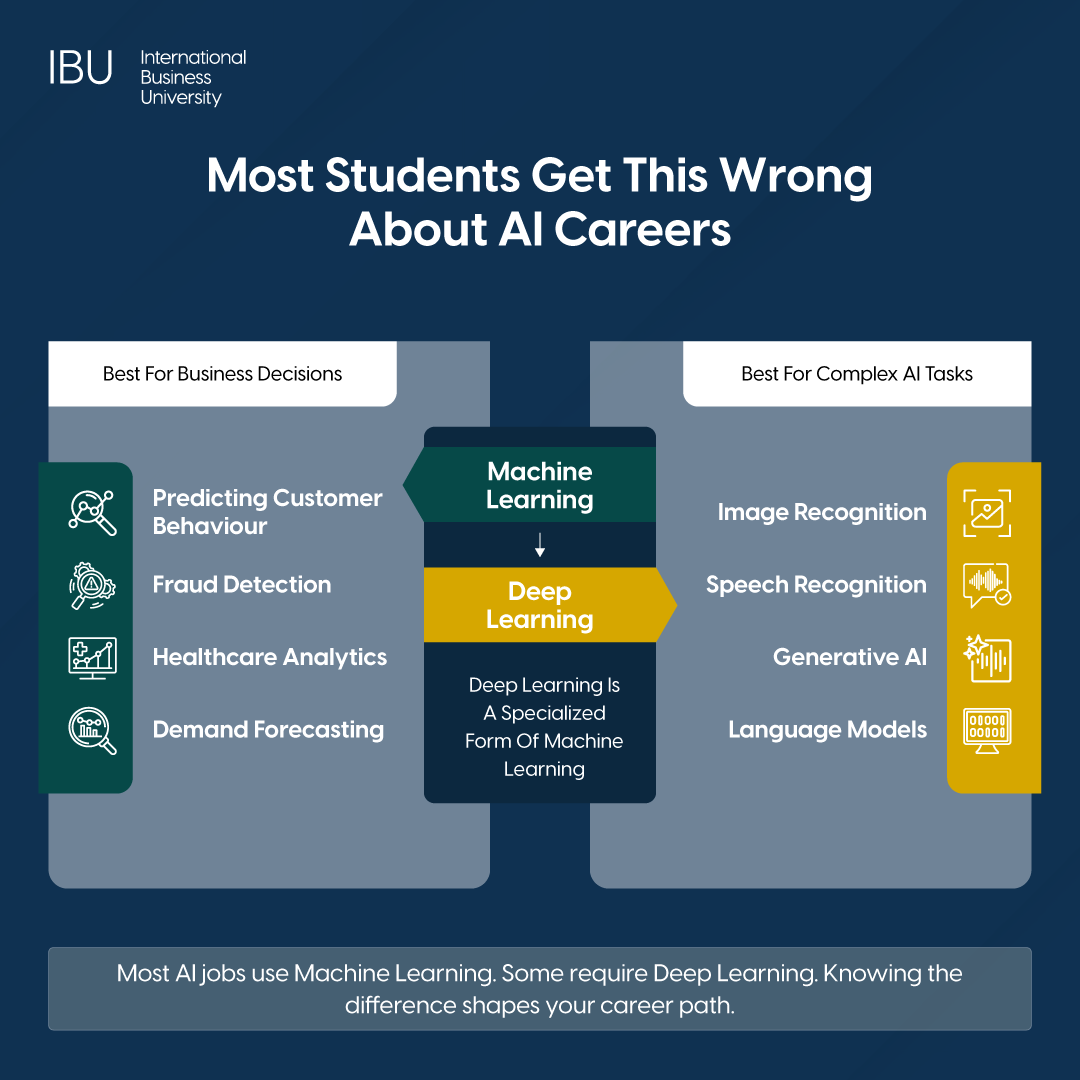
Machine learning is the broader discipline. Deep learning is a specific subset of it.
Machine learning has a wide range of algorithms and approaches: linear regression, decision trees, support vector machines, random forests, gradient boosting, and, as a specific category within it, neural networks, which are the foundation of deep learning.
The distinction that matters for career and specialization decisions is this: most machine learning applications do not require deep learning, and deep learning has specific requirements, large datasets, significant compute resources, and tolerance for reduced interpretability, which make it unsuitable for practical applications. Choosing a deep learning specialization because it sounds more advanced produces graduates who are less qualified for the majority of applied ML roles, not more.
What Machine Learning Actually Does Inside
In production AI systems at Canadian technology companies, financial services firms, and healthcare organizations, machine learning appears most commonly in forms that do not require deep neural networks.
Tabular Data Applications
The majority of business and operational AI applications involve tabular data, structured records with defined columns and rows. Credit scoring at a bank, customer churn prediction at a telecom company, demand forecasting at a retailer, and equipment failure prediction at a manufacturer. These applications typically perform better with gradient boosting algorithms, XGBoost, LightGBM, than with deep neural networks, because gradient boosting is better suited to tabular data structures and produces more interpretable outputs.
Recommendation and Ranking Systems
Product recommendations at e-commerce companies, content ranking at media platforms, and search result ordering all use machine learning. The algorithms range from collaborative filtering approaches to gradient boosting to neural network variants, depending on the data scale and the latency requirements of the application.
Natural Language Processing at Production Scale
Document classification, sentiment analysis, information extraction, and search relevance in enterprise applications use a spectrum of techniques from traditional statistical NLP approaches to transformer-based models, depending on accuracy requirements and compute budget. Not every NLP application requires a large language model.
How Deep Learning Explained Clearly Changes the Way You Choose a Specialization
Deep learning is machine learning using neural networks with many layers, hence ‘deep.’ IBM’s deep learning overview describes deep neural networks as systems that learn representations of data through successive transformations, enabling the model to capture increasingly abstract patterns in the input data.
Deep learning excels at specific problem types: image and video understanding, speech recognition, natural language generation, and complex pattern recognition in unstructured data. It requires large amounts of labeled training data, significant computing infrastructure, and extended training cycles. It produces models that are often harder to interpret than traditional ML models.
The decision to specialize in deep learning should be driven by the problem types you want to work on, not by a general preference for the most sophisticated-sounding technique. Computer vision, speech processing, and generative AI applications are genuinely best served by deep learning. Tabular data analytics, demand forecasting, and most operational prediction tasks are typically better served by traditional ML approaches.
Where Machine Learning Ends and Deep Learning Begins in the IBU Curriculum
IBU’s MSc in Applied AI covers both machine learning and deep learning as part of a comprehensive curriculum that positions graduates to make deliberate choices about which approaches to apply to which problems, not to default to the most computationally intensive method regardless of fit.
Core Machine Learning Foundation
The program builds foundational ML competency across the full algorithm spectrum: supervised and unsupervised learning, ensemble methods, model evaluation and validation, feature engineering, and the practical data engineering skills that production ML requires. This foundation is relevant regardless of which specialization track a student pursues.
Deep Learning Applications by Specialization
The Data Engineering track applies deep learning specifically in the contexts where it adds the most value: sequence modeling for time series and NLP applications, embedding representations for unstructured data, and neural architecture choices for applications that genuinely benefit from deep representation learning.
The Industrial Innovation track applies deep learning primarily through computer vision, convolutional neural network architectures for quality inspection, object detection, and visual anomaly detection in manufacturing and logistics environments.
Build the Data Systems That Power AI
Develop the technical foundation to design, manage, and deploy data infrastructure for intelligent systems.
The Industries in Canada Hiring for Machine Learning and Deep Learning Skills Right Now
The Canadian AI hiring market is distributed across several industries with distinct technical requirements, and the applied AI industries where MSc graduates excel most are worth a closer look.
Financial Services
Banks, insurance companies, and fintech firms are the largest employers of applied ML professionals in Canada. The applications are predominantly tabular data ML: credit risk, fraud detection, customer analytics, and algorithmic trading. Deep learning is less dominant here than traditional ML given the interpretability requirements of financial services regulation.
Healthcare and Life Sciences
Medical imaging AI, radiology, pathology, ophthalmology are strong deep learning application areas in Canadian healthcare. Clinical NLP for EHR processing and genomics applications are also active deep learning domains. Traditional ML is more prevalent in clinical analytics, population health management, and operational healthcare applications.
Technology and Software
Canadian technology companies, from Shopify and Wattpad to AI-specific firms, deploy the full spectrum of ML and deep learning. NLP and recommendation systems dominate consumer-facing applications. Operational ML, anomaly detection, forecasting, and optimization are most common in enterprise software.
Manufacturing and Resource Industries
Computer vision for quality inspection is the dominant deep learning application in Canadian manufacturing. Predictive maintenance and process optimization are predominantly traditional ML or statistical modeling applications. Resource industries, mining, oil and gas, are active in both categories with strong demand for engineers who can work in the industrial environment.
What an Artificial Intelligence Degree From IBU Covers That Online Courses Skip
Online ML and deep learning courses, on Coursera, Fast.ai, and DataCamp, teach tool skills and algorithm application effectively. They typically do not cover the full ML engineering stack required for production deployment: data pipeline design, model monitoring and retraining, feature store management, MLOps practices, and the organizational and communication skills that applied ML roles require.
IBU’s MSc program addresses the full stack, from data engineering through model development through production deployment and ongoing management, alongside the applied project experience that demonstrates these capabilities in context rather than in a structured course environment.
IBU’s guide to data engineering tools that power AI systems covers the infrastructure layer of the stack in detail, illustrating how the data engineering curriculum connects to the applied AI program.
Key Takeaways

Deep learning is a subset of machine learning: Most production AI applications use traditional ML, not deep neural networks. Understanding when each is appropriate is a core graduate-level competency.
Specialization choice should follow problem type, not prestige: Computer vision and speech applications benefit from deep learning. Tabular data analytics and operational forecasting typically perform better with traditional ML approaches.
IBU’s curriculum covers both: The MSc in Applied AI builds foundational ML competency alongside deep learning applications appropriate to each specialization track.
Financial services dominate Canadian ML hiring: The largest employer category for applied ML professionals in Canada is financial services, predominantly tabular data ML with strong interpretability requirements.
Frequently Asked Questions
Should I specialize in machine learning or deep learning for an AI career in Canada?
The more useful question is: what types of problems do you want to work on? For roles in financial services, healthcare analytics, manufacturing data analysis, and most enterprise AI applications, strong foundational ML skills are more relevant than deep learning specialization. For roles in computer vision, NLP, speech recognition, and generative AI, a deep learning specialization is directly required.
IBU’s program builds both, allowing graduates to make this determination based on their industry and role targets rather than being locked into a single technical approach before the application landscape becomes clear.
How long does it take to develop production-ready ML skills?
The combination of foundational ML competency, data engineering skills, and MLOps knowledge required for production ML roles takes approximately two years of structured study and applied project work to develop to the level expected by Canadian employers. An MSc in Applied AI provides this development in a credentialed, structured program that produces the portfolio of project work hiring managers expect.
Is a master's degree required for ML engineering roles in Canada?
Not universally, but increasingly preferred. Senior ML engineering roles at major Canadian technology companies and financial services firms consistently specify MSc-level education as a preferred qualification. Entry-level ML engineering and data analyst roles are accessible with strong tool skills and a portfolio of applied work, but the career ceiling without a graduate degree is typically lower and the advancement timeline longer than for candidates with MSc credentials.
The Distinction That Shapes Every Technical AI Decision
Understanding the relationship between machine learning and deep learning is not just about conceptual clarity for exam questions. It is the foundational technical judgment that separates AI practitioners who consistently choose the right tool for the problem from those who default to the most sophisticated-sounding technique regardless of fit.
That judgment is developed through the combination of rigorous curriculum and applied project work that IBU’s MSc in Applied AI is designed to produce, preparing graduates to work effectively across both the ML and deep learning dimensions of the Canadian AI job market.
Choose the Applied AI Path That Fits Your Goals
Compare IBU’s MSc options before selecting your specialization.