

Raising capital is often framed as a binary choice: take a bank loan or give up equity.
In practice, the capital structure toolkit available to Canadian businesses is significantly broader. Understanding the full range of options and the ownership implications of each is foundational knowledge for any finance or business graduate entering a role that touches corporate finance decisions.
This article covers how companies raise capital while preserving control, which mechanisms are genuinely non-dilutive, and when giving up equity becomes the rational choice despite the cost to ownership.
What It Means to Raise Capital Without Losing Control
Losing control in a capital context means one of two things: diluting ownership by issuing new equity to investors, or accepting debt covenants so restrictive that lenders effectively govern key operational decisions.
Non-dilutive capital is funding that does not require issuing new shares. The company raises money without reducing the percentage of ownership any existing shareholder holds. This is the category of capital that founders and owner-operators typically prefer, and one that the finance industry offers in multiple forms that most business graduates do not fully understand.
Why Founders Care About Ownership and Control
Ownership percentage directly determines economic outcome at the point of exit, sale, IPO, or acquisition. A founder who raises $5 million by issuing 25% of the company to an investor has reduced their eventual payout at exit by 25% relative to a scenario where they raised the same capital without dilution.
Control in private companies also extends beyond economics. Investors who receive equity typically receive governance rights, board seats, veto rights over specific decisions, and liquidation preferences that change how exit proceeds are distributed. Understanding what governance provisions are attached to any equity investment is as important as understanding the valuation at which the investment was made.
The BDC’s equity financing glossary notes that equity financing gives investors an ownership stake and typically some say in how the business is run. This governance dimension is what makes equity a more complex instrument than the headline valuation figure suggests.
Debt Financing as a Non-Dilutive Funding Option
Debt financing, borrowing money to be repaid with interest, preserves ownership entirely. The lender has no equity stake and, in most term loan structures, limited governance involvement beyond specific covenant requirements.
Term Loans
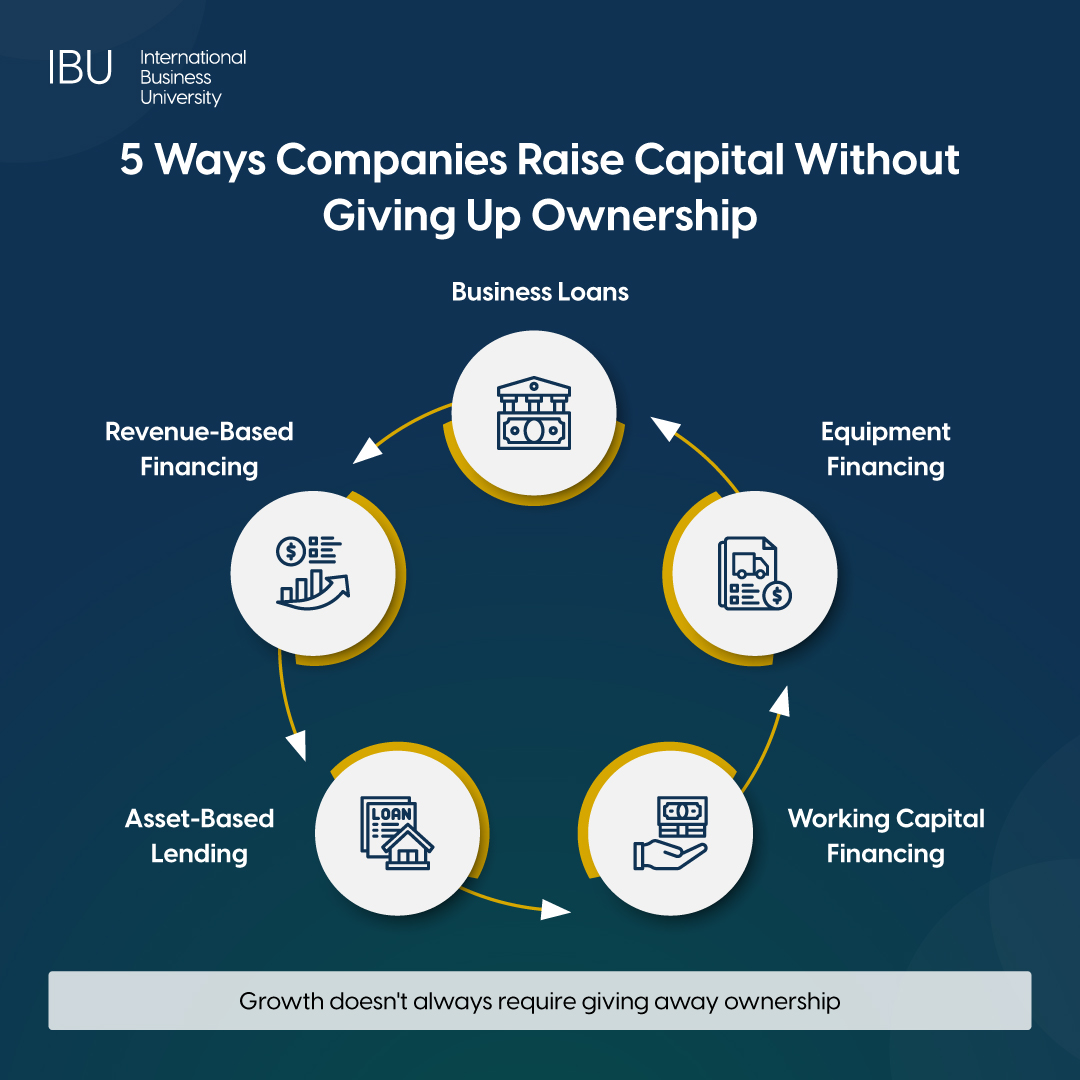
Term loans from Canadian chartered banks and credit unions provide lump-sum capital repaid over a defined schedule. They are the most straightforward non-dilutive option for established businesses with predictable cash flows and sufficient assets to serve as collateral. Interest rates vary based on creditworthiness, loan duration, and current market rates.
Lines of Credit
A revolving line of credit provides access to capital up to a defined limit, drawn down and repaid as needed. Lines of credit are particularly useful for managing working capital gaps, inventory purchases, payroll timing, and receivables delays, rather than funding long-term capital investment.
Government-Backed Business Financing
The Canada Small Business Financing Program (CSBFP) and BDC loan programs provide debt financing to Canadian businesses that may not qualify for conventional bank loans. These programs are specifically designed to make non-dilutive capital accessible to small and mid-market businesses, a segment that the Canadian Federation of Independent Business has consistently identified as underserved by conventional bank lending.
Build Corporate Finance Skills at IBU
IBU’s MBA in Financial and Management Analytics covers capital formation decisions in depth.
Asset-Based and Working Capital Financing
Asset-based financing uses the company’s own assets as the basis for capital access, non-dilutive by definition because no equity changes hands.
Equipment Financing
Equipment financing allows companies to purchase or lease capital equipment, manufacturing machinery, vehicles, and technology infrastructure, with the equipment itself serving as collateral. Monthly payments replace the lump-sum capital outlay, preserving cash flow for operations. Equipment financing is widely available from banks, credit unions, and specialized equipment lenders across Canada.
Invoice Financing and Factoring
Companies with outstanding receivables can access capital against those invoices before they are paid. Invoice financing (the company retains the receivable but borrows against it) and invoice factoring (the receivable is sold to a third party at a discount) both convert future cash into present capital without equity dilution. These instruments are particularly useful for businesses with long payment cycles, construction, professional services, and manufacturing, where the gap between work completion and cash receipt creates operational financing pressure.
Revenue-Based Financing
Revenue-based financing provides capital in exchange for a percentage of future revenue until a defined repayment cap is reached. There is no equity dilution and no fixed repayment schedule, payments scale with revenue. This instrument is common in SaaS and subscription-based businesses and has grown significantly in the Canadian fintech lending market over the past decade.
Alternative Funding Options That Preserve Control
Beyond traditional debt and asset-based instruments, several alternative funding mechanisms allow Canadian businesses to raise capital without dilution.
Government Grants and SR&ED Tax Credits
The Scientific Research and Experimental Development (SR&ED) tax credit program is one of the largest business incentive programs in Canada, providing tax credits for qualifying research and development expenditures. Unlike loans, grants and tax credits do not require repayment and involve no equity transfer. For technology companies and manufacturers with active development programs, SR&ED credits can represent millions of dollars of non-dilutive capital annually.
Venture Debt
Venture debt is a specialized form of term debt available to venture-backed companies, typically structured alongside an equity round. It provides additional capital beyond what the equity round delivers, without the dilution of a larger equity raise. Venture debt carries warrants, rights to purchase equity at a defined price, which represent a small amount of potential dilution, but significantly less than a comparably sized equity round.
When Giving Up Equity Becomes Necessary
Non-dilutive capital is not always sufficient or available. Three specific scenarios consistently push companies toward equity financing despite its dilution cost.
Pre-Revenue or Pre-Profitability Stages
Debt financing requires the ability to service debt, regular interest and principal payments. Companies that have not yet reached revenue or profitability typically cannot demonstrate the cash flow required to qualify for meaningful debt. Equity investors, by contrast, accept the risk of loss in exchange for the upside of ownership. For pre-revenue businesses seeking capital, equity is often the only accessible instrument.
Scale Financing That Exceeds Debt Capacity
Rapidly scaling businesses, technology companies with strong unit economics growing at 100%+ annually, often require capital that exceeds what their debt capacity can support. Equity raises provide the scale of capital that debt markets cannot at growth stages, where the business has not yet produced the cash flows that would support servicing large debt loads.
Strategic Investors Who Add More Than Money
Some equity investors bring more than capital: distribution access, industry relationships, technical expertise, or customer introductions that meaningfully accelerate the business, which is why knowing how to pitch like a venture capitalist matters long before the first meeting. In these cases, the governance cost of equity dilution is partially offset by the non-financial value the investor contributes. Evaluating investors on this dimension, not just valuation, is the analysis that separates sophisticated capital raises from purely financial transactions.
Key Takeaways

Non-dilutive capital preserves ownership percentage: Debt, asset-based financing, grants, and revenue-based instruments all provide capital without issuing new equity.
Equity involves governance costs beyond dilution: Board seats, veto rights, and liquidation preferences attached to equity investments affect control in ways that headline valuation figures do not capture.
The right capital formation depends on stage and cash flow: Pre-revenue businesses typically raise equity; profitable businesses with predictable cash flows have more non-dilutive options.
SR&ED credits are underutilized: Many Canadian technology and manufacturing companies leave significant non-dilutive government capital unclaimed because they do not evaluate SR&ED eligibility rigorously.
Frequently Asked Questions
What is the most common way Canadian small businesses raise capital?
According to the Canadian Federation of Independent Business, the most commonly used sources of external financing for Canadian small businesses are personal savings and bank loans. Bank term loans and lines of credit remain the dominant instruments for established businesses, while government programs like the CSBFP extend access to businesses that may not qualify for conventional bank financing.
What is the difference between dilutive and non-dilutive funding?
Dilutive funding involves issuing new equity, new shares, which reduces the percentage ownership of existing shareholders. Non-dilutive funding provides capital without any change to the ownership structure. Loans, grants, asset-based financing, and revenue-based financing are all non-dilutive. Equity raises, convertible notes at conversion, and SAFE agreements at conversion are all dilutive.
When should a company choose equity over debt financing?
Companies should choose equity financing when their cash flow cannot support debt service requirements, when the scale of capital needed exceeds available debt capacity, or when the strategic value of a specific investor materially outweighs the dilution cost. For most established businesses with predictable revenue, starting with non-dilutive options and reserving equity for capital needs that cannot be addressed otherwise is the conventional approach.
Capital Decisions Are Ownership Decisions
Every capital raise a company makes changes its ownership structure, its governance obligations, or both. Finance graduates who understand the full spectrum of options, from conventional bank debt through government grants to equity financing, are meaningfully more valuable to the organizations they join than those who default to the most visible instruments.
IBU’s MBA in Financial and Management Analytics builds exactly this kind of capital structure thinking, connecting financing theory to the practical decisions that Canadian businesses make every time they need to fund growth.
Turn Finance Strategy Into an MBA Application
IBU’s MBA builds skills in finance, capital structure, and management.