

Canada’s healthcare system is widely recognized for universal access, with most medical services publicly funded and available regardless of income. On paper, it functions well. In practice, it is under growing strain.
The problems with the Canadian healthcare system appear in daily life through long wait times in Canada, difficulty finding a family doctor, overcrowded emergency rooms, and out-of-pocket costs for prescriptions, dental, and mental health care. The Canadian healthcare crisis is straining patient outcomes, workforce stability, and public trust, raising serious concerns about the future of healthcare management in Canada.
Key Takeaways:
- The Canadian healthcare system faces systemic failures across access, staffing, and funding, with long wait times in Canada, emergency room overcrowding, and a shortage of doctors in Canada, creating barriers to timely care.
- Healthcare funding in Canada varies significantly by province, leading to unequal access, outdated infrastructure, and gaps in mental health, dental, vision, and prescription drug coverage.
- Solving Canadian healthcare challenges requires leadership in healthcare management in Canada, data-driven decision-making, and professionals equipped to navigate the Canadian healthcare crisis with strategic reform.
Problems with the Canadian Healthcare System
Canada’s healthcare system is publicly funded and universally accessible. That’s the promise. The reality is more complicated. Underfunding, aging infrastructure, workforce shortages, and a model built decades ago have all combined to create a system that hasn’t kept pace with the country it serves.
The problems aren’t isolated. They’re connected. One gap feeds the next, creating a chain of dysfunction that affects every level of care
How the System Is Structured
Canada uses a single-payer model. The federal government funds healthcare and sets national standards through the Canada Health Act. Provinces and territories manage and deliver care, which means what’s covered in Ontario may differ from what’s available in Alberta.
The Canada Health Act is built on five core principles:
- Public Administration
- Comprehensiveness
- Universality
- Portability
- Accessibility
In theory, these principles guarantee equal access for every Canadian. In practice, each province decides how to allocate its budget, staff hospitals, and prioritize services, so the experience varies significantly depending on where you live.
What’s Covered and What Isn’t
The system covers medically necessary services. Everything else tends to fall through the cracks.
| COVERED | NOT UNIVERSALLY COVERED |
|
|
These gaps leave millions of Canadians paying out-of-pocket, relying on private insurance, or going without care entirely. And it shows a funding problem:
- $300B+ Annual healthcare spending in Canada
- Lower per capita spending vs. Germany, Switzerland, and the Netherlands
- Longer wait times compared to those same countries
Canada spends more than $300 billion on healthcare annually, yet per-capita investment still trails countries with shorter wait times and broader access. The federal government transfers money to provinces through the Canada Health Transfer. Provinces add their own funding on top. But the model hasn’t adapted to match the realities of today’s population.
A Chain Reaction of Dysfunction
Each breakdown in the system makes the next problem worse. The cascade looks like this:
- Shortage of family doctors
leads to…
- Patients using emergency rooms for non-urgent issues
leads to…
- Emergency room overcrowding
leads to…
- Hospital bed shortages and delayed surgeries
leads to…
- Worse outcomes for patients who needed timely care
Family doctors act as the system’s gatekeepers. When you have one, you see them first, and they refer you to specialists as needed. When you don’t, the emergency room becomes your only option. Millions of Canadians have no family doctor, and that number is growing.
Built for a Different Canada
The system was designed around assumptions that no longer hold. It expected stable populations, predictable demand, and manageable growth. Canada’s reality today looks very different: an aging population, rising rates of chronic disease, rapid immigration growth, an understaffed healthcare workforce, and outdated infrastructure.
None of the pressures is going away. In fact, most are accelerating.
Too Many Problems. Not Enough People Trained to Fix Them.
Canada’s healthcare challenges don’t have simple solutions. They require a new generation of professionals who understand the system deeply: clinicians, administrators, policy analysts, and data specialists who know what’s broken and how to start fixing it.
That’s where we come in. Our programs train students to step directly into these gaps, equipped with the knowledge, skills, and practical experience to manage real healthcare challenges and build a stronger system for every Canadian.
If you’re pursuing a career in healthcare, these problems are your problems. Learning to address them is where your work begins.
1. Long Wait Times for Surgeries and Specialist Appointments
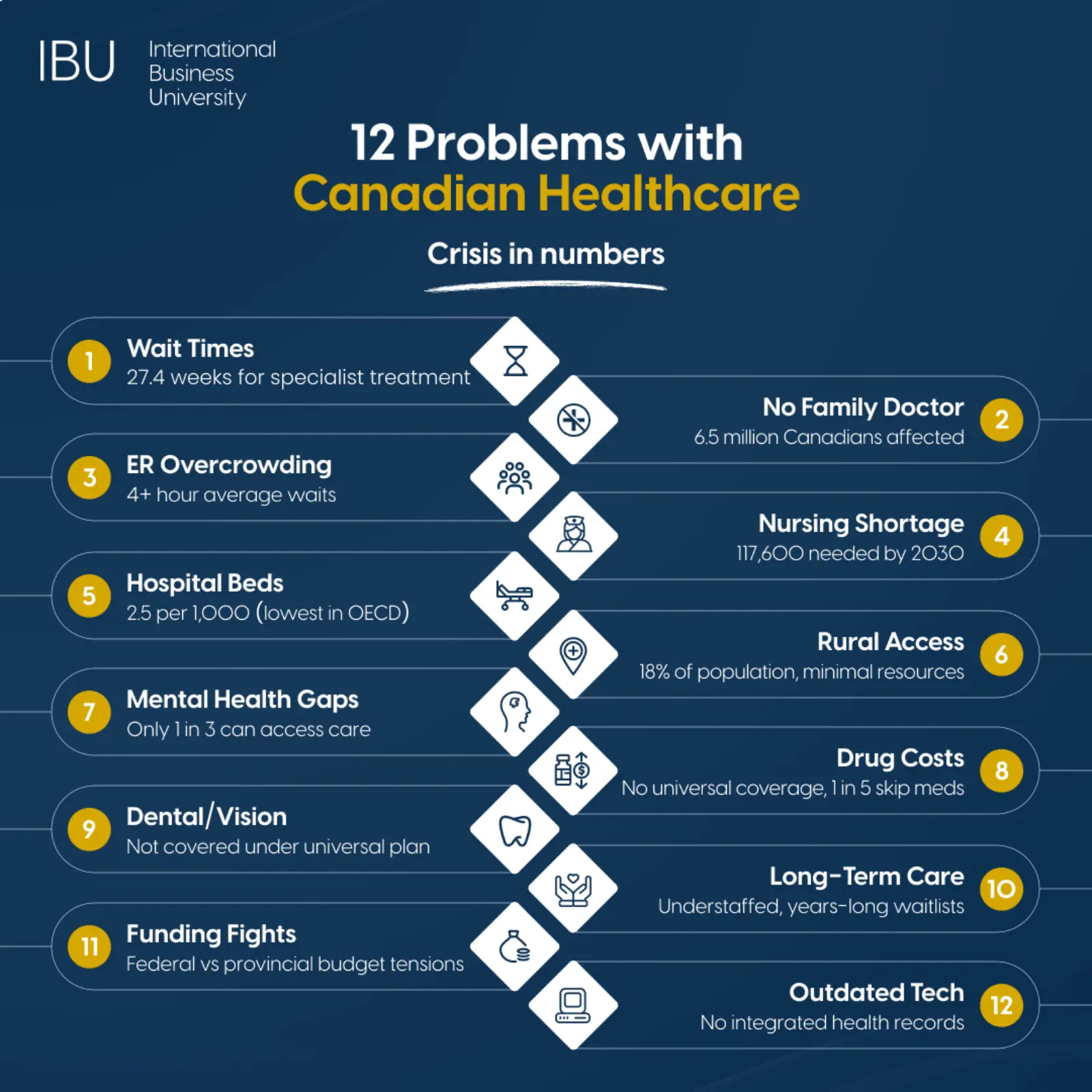
Long wait times in Canada are one of the most visible symptoms of a struggling healthcare system. Canadians wait longer than patients in most comparable countries. According to the Fraser Institute, the median wait time from GP referral to specialist treatment was 27.7 weeks in 2023, the longest ever recorded.
Wait times vary by procedure and province. Hip replacements can take eight to twelve months. Knee replacements take just as long. Cataract surgeries, MRIs, CT scans; all involve waits that would be considered unacceptable in peer nations. A patient in Germany can get an MRI within days. In Canada, you might wait weeks to months.
These delays aren’t just inconvenient. They’re dangerous. A cancer diagnosis delayed by months can reduce survival rates. A herniated disc left untreated for a year can lead to permanent nerve damage. Joint replacements delay leave patients in chronic pain, reducing quality of life and productivity.
Why do wait times persist? Several factors converge:
- Insufficient capacity. Canada has fewer hospital beds, MRI machines, and CT scanners per capita than most OECD countries. Limited resources mean limited throughput.
- Physician shortages. Fewer specialists mean fewer appointments. A cardiologist can only see so many patients per week. When demand outstrips supply, waitlists grow.
- Inefficient processes. Administrative bottlenecks, scheduling inefficiencies, and outdated referral systems slow care delivery. Patients fall through cracks. Appointments get missed. Communication between primary care and specialists breaks down.
- Lack of prioritization tools. Not all cases are equally urgent. Yet, many systems lack robust triage mechanisms to ensure the sickest patients get care first.
The consequences ripple beyond individual patients. Long wait times erode public trust. They force patients to seek care abroad (medical tourism). They increase costs as conditions worsen without treatment. They demoralize healthcare workers who see patients suffering while they lack the resources to help.
Solving wait times requires more than throwing money at the problem. It requires strategic capacity expansion, workforce planning, process optimization, and data-driven prioritization; skills taught in programs focused on healthcare management in Canada.
2. Shortage of Family Doctors and Primary Care Access
The shortage of doctors in Canada is a crisis within a crisis. Over 6.5 million Canadians, roughly one in five, do not have a family doctor or nurse practitioner they see regularly. This number is growing. Family doctors are retiring faster than new graduates are entering family medicine. Medical students are choosing specialties over primary care. The gap is widening.
Without a family doctor, accessing care becomes exponentially harder. You can’t get routine checkups. You can’t manage chronic conditions effectively. You can’t get referrals to specialists. Your only option for non-emergency care is walk-in clinics, which lack continuity and comprehensive records, leading to fragmented care.
The shortage isn’t evenly distributed. Urban centers have more doctors than rural areas. Toronto has a higher physician-to-patient ratio than northern Ontario. Vancouver has better access than remote British Columbia communities. Rural and remote Canadians are disproportionately affected, compounding issues with the Canadian healthcare system.
Why is family medicine struggling?
- Lower compensation. Family doctors earn less than specialists. Medical school graduates carry significant debt. Choosing family medicine means lower lifetime earnings compared to cardiology, orthopedics, and anesthesiology.
- Higher administrative burden. Family doctors manage complex paperwork, insurance claims, and patient records. Administrative tasks consume time that could be spent with patients.
- Family doctors face long hours, high patient loads, and emotional exhaustion. The pandemic accelerated burnout. Many doctors reduced hours, retired early, or left medicine altogether.
- Limited support. Family practices often lack allied health professionals; nurse practitioners, pharmacists, and social workers; who could share workload and improve patient outcomes.
- Medical school enrollment caps. Canada produces fewer medical graduates per capita than needed. Residency spots for family medicine are limited. International medical graduates face barriers to licensure.
The consequences are severe. Patients delay care. Preventable conditions become emergencies. Chronic diseases go unmanaged. Emergency rooms become de facto primary care, straining already overburdened systems.
Addressing the shortage of doctors in Canada requires multi-pronged solutions: increase medical school enrollment, expand residency positions, improve family doctor compensation, reduce administrative burden, create team-based care models, streamline licensure for international graduates, and incentivize rural practice.
3. Emergency Room Overcrowding and Hallway Medicine
Emergency room overcrowding has become the public face of Canadian healthcare system problems. Patients wait hours; sometimes more than 24 hours; to be seen. Hallway medicine, where patients receive care in corridors due to a lack of beds, is routine in many hospitals. This isn’t an occasional occurrence. It’s a daily reality.
The Canadian Institute for Health Information reports emergency department wait times averaging over four hours for non-urgent cases. Urgent cases fare better, yet still face delays. During peak periods, flu season, respiratory illness surges; wait times balloon. Emergency rooms operate at 100%+ capacity, turning hallways into makeshift wards.
Why are emergency rooms overwhelmed?
- Primary care access gap: Without family doctors, Canadians use emergency rooms for non-urgent care. A sore throat, a sprained ankle, a prescription refill; issues that should be handled in primary care; end up in emergency departments.
- Hospital bed shortages: Patients admitted through emergency rooms can’t move to inpatient beds because those beds are full. They remain in emergency, blocking space for new arrivals. This phenomenon, called “bed blocking,” creates cascading delays.
- Aging population: Older patients have more complex medical needs, require longer assessments, need more diagnostic tests. As Canada’s population ages, emergency room visits increase.
- Mental health and addiction crises: Emergency rooms have become de facto mental health and addiction treatment centers. Patients in crisis have nowhere else to go. Emergency departments aren’t equipped for this volume of psychiatric care.
- Ambulance offload delays: Ambulances can’t unload patients because emergency rooms lack capacity. Paramedics wait with patients on gurneys, sometimes for hours, removing ambulances from circulation and delaying response to new emergencies.
The human cost is staggering. Patients in pain wait in plastic chairs. Seniors lie on stretchers in hallways. Privacy is nonexistent. Dignity is lost. Medical errors increase in chaotic, overcrowded environments. Staff burn out. Morale collapses.
Emergency room overcrowding isn’t solvable by expanding emergency departments alone. It requires systemic fixes: better primary care access, more hospital beds, improved patient flow, mental health service expansion, and discharge planning to free up beds faster.
4. Nurse and Healthcare Worker Shortages
The nursing shortage Canada faces is one of the most pressing workforce crises in the system. Canada needs an estimated 117,600 more nurses by 2030 to meet demand. Current shortages already strain hospitals, long-term care facilities, and home care services. Nurses are overworked, underpaid relative to workload, and are burning out at alarming rates.
Nursing isn’t alone. Respiratory therapists, medical lab technologists, personal support workers, pharmacists, physiotherapists all face shortages. The pandemic accelerated departures. Healthcare workers left due to burnout, trauma, inadequate support, and better opportunities elsewhere.
Why are healthcare workers leaving?
- Burnout: Long shifts, high patient ratios, emotional exhaustion. Nurses routinely work 12+ hour shifts with minimal breaks. They’re responsible for more patients than safe staffing allows. Mistakes happen. Guilt compounds stress.
- Inadequate compensation: Nurses in Canada earn less than their counterparts in the United States, Australia, and parts of Europe. Travel nursing offers higher pay, yet provincial health systems rely on expensive agency nurses to fill gaps; a short-term fix that doesn’t address root causes.
- Lack of respect and support: Healthcare workers faced abuse during the pandemic, from patients, families, and even policymakers. Promised wage increases and support didn’t materialize. Many felt betrayed.
- Limited career advancement: Nurses with advanced training often lack opportunities to use their skills fully. Hierarchical systems, rigid roles, and bureaucratic barriers prevent nurses from practicing at the top of their license.
- Aging workforce: A significant portion of Canada’s nursing workforce is nearing retirement. Baby boomer nurses are leaving faster than millennials, and Gen Z can replace them.
The consequences of the nursing shortage Canada experiences are severe. Hospitals close beds despite physical space because they lack staff. Surgeries get canceled. Patient-to-nurse ratios climb to unsafe levels. Quality of care declines. Patient outcomes worsen.
Solving this requires comprehensive workforce strategies: competitive compensation, improved working conditions, mental health support, career advancement pathways, increased nursing school enrollment, streamlined immigration for internationally trained nurses, and retention programs targeting experienced workers.
Canadian Healthcare Crisis Needs Leaders
Use data to solve real problems. Lead healthcare into the future. Make decisions that save lives.
5. Hospital Bed Shortages and Capacity Challenges
Canada has one of the lowest hospital bed ratios among OECD countries. OECD data shows Canada has approximately 2.5–2.6 hospital beds per 1,000 people (2.58 in 2021; 2.5 in the 2025 OECD report), well below the OECD average of 4.2. Germany (~8.0), Japan (~13.0), and the US (~2.9) figures are consistent with OECD data. This deficit creates bottlenecks throughout the healthcare system.
Bed shortages manifest in multiple ways:
- Emergency room backlog: Admitted patients can’t move to inpatient units because beds are full. They remain in emergency departments, blocking new arrivals and creating wait times.
- Surgical delays: Elective surgeries get canceled when post-operative beds aren’t available. Patients who’ve prepared for surgery; taken time off work, arranged childcare; get last-minute cancellations.
- Alternate level of care patients: Thousands of hospital beds are occupied by patients who no longer need hospital care, yet have nowhere else to go. They’re medically stable, yet can’t be discharged because long-term care facilities, home care, and rehabilitation centers lack capacity. These patients, classified as alternate level of care (ALC), block beds needed for acute patients.
- Reduced admission thresholds: Doctors discharge patients earlier than ideal to free beds. This increases readmission rates as patients return with complications that could have been prevented by longer initial stays.
Why does Canada have so few hospital beds?
- Decades of cuts: Throughout the 1990s and early 2000s, governments reduced hospital capacity to control costs. Beds were eliminated. Hospitals were closed. The assumption was that community care and shorter hospital stays would compensate. It didn’t work as planned.
- Population growth: Canada’s population has grown significantly. Hospital bed capacity hasn’t kept pace. More people competing for the same number of beds means longer waits and higher occupancy rates.
- Aging population: Older patients require more hospital care and longer stays. As the population ages, demand for beds increases without a corresponding supply increases.
- Lack of downstream capacity: Patients can’t leave hospitals without somewhere to go. Insufficient long-term care beds, home care services, and rehabilitation facilities keep patients in hospitals longer than necessary.
Expanding hospital capacity requires more than building beds. It requires staff to operate those beds, funding to maintain them, and downstream services to facilitate patient flow. Without integrated planning, adding beds alone won’t solve capacity challenges.
6. Unequal Healthcare Access in Rural and Remote Communities
Canadian healthcare challenges are most acute in rural and remote areas. Indigenous communities in northern Canada, small towns across the prairies, and coastal fishing villages; these populations face healthcare access barriers that urban Canadians rarely encounter.
Rural Canadians make up about 18% of the population, yet have access to far fewer healthcare resources. Fewer family doctors practice in rural areas. Specialists rarely visit. Diagnostic imaging requires traveling hours. Emergency services may be limited to small clinics with basic equipment. For serious conditions, patients must travel to urban centers, a trip that can take hours by car or require expensive air transport.
Specific challenges include:
Physician recruitment and retention. Doctors prefer urban centers for family reasons, career opportunities, and lifestyle. Rural communities struggle to attract and keep physicians. When a rural doctor retires, finding a replacement can take years.
- Limited specialist access: Rural areas lack specialists entirely. A cardiologist visit means a trip to the nearest city. For patients without transportation, this is prohibitive. For those with jobs and families, it’s a significant burden.
- Facility limitations: Rural hospitals and clinics lack advanced equipment. MRIs, CT scanners, and specialized surgical tools; these are concentrated in urban centers. Patients needing advanced diagnostics must travel.
- Emergency response gaps: Rural areas have fewer ambulances, longer response times, and limited trauma care capacity. A heart attack in downtown Toronto gets immediate attention. The same heart attack in a remote community might face delays that prove fatal.
- Indigenous health disparities: Indigenous communities face compounded barriers: geographic isolation, underfunded health services, inadequate infrastructure, cultural disconnects with mainstream healthcare, and historical trauma from the healthcare system. Health outcomes for Indigenous Canadians lag behind national averages across nearly every metric.
- Internet and technology gaps: Telehealth could mitigate some rural access issues. Yet, many rural areas lack reliable high-speed internet. Virtual care isn’t an option without connectivity.
Addressing rural healthcare access requires targeted strategies: financial incentives for rural practice, loan forgiveness for doctors serving rural communities, mobile specialist clinics, expanded telehealth infrastructure, culturally appropriate care for Indigenous populations, and investments in rural hospital capacity.
7. Mental Health Services Gaps in Canada
Mental health is technically covered under Canada’s healthcare system when provided by psychiatrists in hospitals. Yet, most mental health services fall outside public coverage. Psychologists, therapists, counsellors, and social workers; these services require out-of-pocket payment unless you have private insurance. This creates massive access gaps.
According to the Canadian Mental Health Association, one in three Canadians who will experience a mental illness, only a third can access the services they need. Wait times for publicly funded psychiatry appointments can stretch months. Private therapy costs $150-$300 per session, putting it out of reach for many Canadians.
The gaps are especially harmful for:
Youth and students
Mental health issues often emerge in adolescence and young adulthood. Students face stress, anxiety, and depression related to academic pressure, social dynamics, identity formation, and financial strain. Most post-secondary institutions offer limited counseling, often just a few sessions per year. Off-campus private care is unaffordable for most students.
Low-income Canadians
Mental health struggles correlate with poverty, yet low-income Canadians are least able to afford private therapy. They rely on overextended public services with long waitlists, leaving them without support during crises.
Emergency room misuse
People in mental health crisis often end up in emergency rooms, the only place they can get immediate, free mental health care. Emergency departments aren’t designed for mental health treatment. They provide short-term crisis intervention, yet lack resources for ongoing care. Patients get stabilized and released without follow-up, leading to repeated crisis visits.
Addiction services
Addiction treatment is similarly underfunded. Publicly funded detox beds are scarce. Rehabilitation programs have long waitlists. Harm reduction services face political resistance. Canada’s opioid crisis has claimed tens of thousands of lives, yet treatment infrastructure remains inadequate.
Workplace mental health
Many Canadians rely on employer-provided benefits for mental health coverage. Those benefits often cap at a few thousand dollars per year; enough for limited therapy, inadequate for serious ongoing treatment. Employees without benefits have no coverage at all.
The system’s failure to adequately cover mental health perpetuates stigma, worsens outcomes, and increases long-term costs. Untreated mental health conditions lead to lost productivity, disability claims, emergency room visits, hospitalizations, homelessness, substance use, and suicide.
Integrating mental health into universal coverage, expanding publicly funded therapy and counseling, reducing wait times, training more psychiatrists and psychologists, and implementing school-based mental health programs would address these gaps. Yet, progress remains slow.
8. Prescription Drug Coverage and Cost Issues
Canada is the only country with universal healthcare that doesn’t include universal prescription drug coverage. Prescription medications are covered in hospitals and through some provincial programs, yet outpatient prescriptions require private insurance, out-of-pocket payment, provincial drug plans with income testing, and eligibility restrictions.
The result is a patchwork system with massive gaps. Nearly one in five Canadians reports not filling prescriptions due to cost. Patients skip doses to make medications last longer. They cut pills in half. They choose between medication and food. These behaviors compromise treatment effectiveness and worsen health outcomes.
Provincial drug programs vary widely. Some provinces cover more medications. Some have lower co-pays. Some impose strict income thresholds. Moving from one province to another can mean losing access to previously covered medications.
The cost burden falls heavily on:
- Chronic disease patients: Diabetes, heart disease, asthma, and arthritis; these conditions require ongoing medication. Annual costs can reach thousands of dollars. Patients on multiple medications face even higher bills.
- Seniors: Many provinces offer better drug coverage for seniors, yet gaps remain. Co-pays and deductibles add up. Seniors on fixed incomes face tough choices between medications and other necessities.
- Workers without benefits: Many Canadians lack employer-provided drug coverage. They pay full price for prescriptions. A single medication can cost hundreds of dollars monthly.
- Rare disease patients: Medications for rare diseases often cost tens of thousands annually. Provincial coverage for these drugs is inconsistent. Patients fight for access while their conditions progress.
The lack of universal pharmacare creates inefficiencies. Canadians pay higher drug prices than many peer countries. Bulk purchasing power, one advantage of universal systems, is lost when drug purchases are fragmented across provinces, insurers, and individuals.
National pharmacare has been debated for years. Proponents argue it would reduce costs, improve access, and enhance health outcomes. Opponents cite fiscal constraints and provincial jurisdiction. Progress has been incremental, with recent federal commitments to cover diabetes medications and contraceptives; a small step toward broader coverage.
9. Dental and Vision Care Not Fully Covered
Dental and vision care fall outside Canada’s universal healthcare system. Basic dental cleanings, fillings, root canals, and crowns; none are covered unless performed in hospitals for specific medical conditions. Eye exams and glasses similarly require private insurance or out-of-pocket payment.
The gaps in dental coverage have serious health consequences. Oral health affects overall health. Untreated dental infections can lead to heart disease, diabetes complications, and sepsis. Poor oral health correlates with malnutrition, pain, and reduced quality of life.
Yet, many Canadians forgo dental care due to cost. A routine cleaning costs $150-$300. A filling costs $200-$400. Root canals, crowns, dentures; these run into thousands. Without insurance, dental care becomes unaffordable.
Low-income Canadians suffer the most. They’re least likely to have private insurance and least able to afford out-of-pocket costs. Children in low-income families experience higher rates of tooth decay and dental pain. Seniors on fixed incomes delay needed dental work, leading to tooth loss and nutritional problems.
Vision care faces similar gaps. Eye exams aren’t covered for most adults. Glasses and contact lenses require out-of-pocket payment. Canadians with vision problems must budget hundreds of dollars every few years for exams and corrective lenses. Those who can’t afford it live with impaired vision, affecting work, education, and safety.
Recent federal initiatives aim to expand coverage. The Canadian Dental Care Plan, launched in phases starting in 2023, covers dental care for uninsured Canadians with household incomes under $90,000. While this helps, implementation is gradual and coverage limits exist.
Full integration of dental and vision care into universal coverage would prevent health complications, reduce long-term costs, and eliminate access barriers. Yet, expansion requires funding commitments and provincial cooperation; both are challenging in Canada’s fiscal and political environment.
10. Long-Term Care Problems and Senior Care Challenges
Canada’s long-term care system is broken. The pandemic exposed conditions many had suspected, yet few had confirmed: understaffing, substandard facilities, inadequate infection control, resident neglect. Thousands of long-term care residents died from COVID-19, many preventable deaths resulting from system failures.
Long-term care in Canada is primarily privately operated, yet publicly funded. Standards vary by province. Profit-driven models often prioritize cost-cutting over quality care. Staff-to-resident ratios are inadequate. Personal support workers are underpaid, overworked, and undertrained. Facilities are outdated. Residents wait months to years for placement in better facilities.
Specific problems include:
- Insufficient capacity: Canada doesn’t have enough long-term care beds. Seniors who need placement wait in hospitals, blocking acute care beds (the ALC problem discussed earlier). Waitlists for long-term care stretch months, sometimes years.
- Poor quality of care: Many facilities provide substandard care. Residents don’t receive adequate assistance with meals, hygiene, or mobility. Social isolation is rampant. Activities and engagement are minimal. Residents languish in undignified conditions.
- Staffing shortages: Long-term care facilities can’t attract and retain staff. Personal support workers earn low wages for difficult, physically demanding, emotionally exhausting work. Turnover is high. The remaining staff are stretched thin, unable to provide adequate care.
- Lack of regulation and oversight: Enforcement of long-term care standards is weak. Facilities violate regulations with minimal consequences. Residents and families have limited recourse when care falls short.
- Home care gaps: Many seniors prefer aging at home. Home care services could support this, yet funding is insufficient. Home care workers face similar challenges as long-term care staff: low pay, high workload, limited support. Families often provide unpaid care, leading to caregiver burnout.
- Dementia care deficits: Canada’s aging population includes rising numbers of dementia patients. Long-term care facilities often lack specialized dementia care training, secure units, and programming to support these residents effectively.
Fixing long-term care requires significant investment: more beds, better staff ratios, higher wages for care workers, stronger regulations, improved oversight, expanded home care, and purpose-built facilities designed for modern senior care needs. Some provinces are beginning reforms, yet progress is uneven.
11. Healthcare Funding Issues and Provincial Differences
Healthcare funding in Canada is a constant source of tension between federal and provincial governments. The federal government provides roughly 22% of total healthcare funding through the Canada Health Transfer. Provinces cover the rest from their own revenues. This split creates disputes over who should pay more.
Provinces argue that federal contributions are insufficient. They point to rising costs from aging populations, expensive new treatments, and infrastructure needs. They want the federal government to cover 35% of costs, the historical share from decades ago.
The federal government argues it provides stable, predictable funding increases. It points to provinces’ control over healthcare delivery and accuses some of mismanaging resources.
This political back-and-forth delays solutions while the system deteriorates. Funding challenges manifest as:
- Insufficient total spending: Canada spends about 12% of GDP on healthcare, comparable to peer nations. Yet, outcomes lag. This suggests inefficiency and misallocated resources, not just underfunding.
- Provincial variation: Each province sets its own healthcare priorities and funding levels. This creates inequalities. Residents of one province may have better access to certain services than residents of another. Portability; one of the five Canada Health Act principles, becomes compromised when coverage varies significantly.
- Infrastructure decay: Hospitals built decades ago require upgrades. Medical equipment needs replacement. IT systems need modernization. Deferred maintenance and capital investment shortfalls leave facilities outdated and unsafe.
- Inability to plan long-term: Short-term budget cycles prevent strategic long-term planning. Healthcare requires investments that pay off over years, yet political and fiscal realities favor short-term spending.
- Competition for resources: Healthcare competes with education, infrastructure, social services for provincial budgets. When economic downturns hit, healthcare often faces cuts despite being the largest provincial expenditure.
Solving funding challenges requires federal-provincial cooperation, long-term fiscal commitments, efficiency improvements, and a willingness to explore alternative funding mechanisms. Some suggest dedicated healthcare taxes, expanded private options, and user fees for non-essential services. Others argue for increased public spending and better resource allocation. The debate continues while the system strains.
12. Technology, Data, and Outdated Healthcare Systems
Canada’s healthcare system lags behind in technology adoption. Electronic health records exist, yet aren’t fully integrated across provinces. A patient in Ontario can’t easily share records with a specialist in British Columbia. Data systems don’t talk to each other. Information gets lost, duplicated, and delayed.
This technological backwardness creates inefficiencies:
Lack of interoperability
Different hospitals use different electronic health record systems. These systems often can’t exchange data. Patients visiting multiple providers must repeat their medical history every time. Tests get duplicated because previous results aren’t accessible. Medication lists aren’t current because pharmacies, doctors, and hospitals use separate systems.
Paper-based processes
Many healthcare settings still rely on paper charts, faxed referrals, and physical mail for test results. This is slow, error-prone, and inefficient. Lost paperwork delays care. Illegible handwriting causes medication errors.
Limited data analytics
Canada generates massive healthcare data, yet lacks systems to analyze it effectively. Data-driven decision making could optimize resource allocation, predict demand, identify trends, and improve outcomes. Yet, fragmented data systems prevent this.
Telehealth limitations
The pandemic accelerated telehealth adoption, yet infrastructure gaps remain. Rural areas lack broadband. Privacy and security concerns persist. Reimbursement policies vary. Telehealth could expand access and reduce costs, yet systemic barriers slow adoption.
Outdated equipment
Many hospitals operate aging diagnostic equipment; MRI machines, CT scanners, X-ray units, decades old. Newer equipment is faster, more accurate, and exposes patients to less radiation. Yet, capital constraints delay upgrades.
Insufficient IT investment
Healthcare IT receives less investment than other sectors. Hospitals can’t afford enterprise software, cybersecurity measures, or training programs. This leaves systems vulnerable to cyberattacks and inefficiencies.
Resistance to change
Healthcare culture often resists technological change. Clinicians trained on paper systems resist electronic workflows. Administrators fear implementation costs and disruptions. Change management is weak, leading to failed implementations and wasted investments.
Modernizing healthcare technology requires substantial investment, leadership committed to change, interoperability standards, data governance frameworks, and workforce training. The payoff: improved efficiency, better outcomes, reduced errors, and enhanced patient experience, justifies the cost. Yet, progress is slow.
FAQ
What is the biggest problem with Canada’s healthcare system?
The biggest problem is access, specifically, timely access to care. Long wait times in Canada for specialists, surgeries, and diagnostic procedures create barriers that delay treatment, worsen outcomes, and erode patient trust. This access crisis stems from interconnected issues: the shortage of doctors in Canada, the nursing shortage Canada faces, hospital bed shortages, emergency room overcrowding, and healthcare funding in Canada that hasn’t kept pace with demand. Solving access requires addressing workforce shortages, expanding capacity, improving efficiency, and modernizing technology; all areas where healthcare management in Canada plays a critical role.
Why are wait times so long in Canadian healthcare?
Wait times result from insufficient capacity relative to demand. Canada has fewer hospital beds, diagnostic machines, and specialists per capita than most comparable countries. The shortage of doctors in Canada means fewer appointments are available. The nursing shortage Canada experiences reduces hospital capacity since beds can’t operate without staff. Emergency room overcrowding and alternate level of care patients blocking beds compound delays. Inefficient processes, outdated referral systems, and a lack of data-driven prioritization further slow care delivery. Reducing wait times requires capacity expansion, workforce growth, process optimization, and better resource allocation; challenges that require skilled healthcare management in Canada.
Is Canada’s healthcare system really free?
No. While Canadians don’t pay out-of-pocket for most doctor visits and hospital stays, the system isn’t free; it’s publicly funded through taxes. Many services fall outside public coverage: prescription drugs (unless in hospital), dental care, vision care, mental health therapy, physiotherapy, home care, and long-term care. Canadians either pay out-of-pocket for these services and access them through private insurance. This creates access gaps where cost prevents people from getting needed care. Understanding these coverage limitations is important for anyone writing a cover letter for healthcare positions and entering the field.
The Future of the Canadian Healthcare System
The problems with the Canadian healthcare system are clear and increasingly unsustainable, with rising wait times, deepening workforce shortages, escalating costs, and declining patient satisfaction demanding structural reform, sustained investment, workforce transformation, and technological modernization. At the same time, meaningful change is possible as provinces test team-based primary care, expand virtual services, strengthen integrated networks, and accelerate data-driven decision-making, while national conversations around pharmacare and funding continue.
If you are considering a future in healthcare management in Canada, you are entering at a pivotal moment that requires strategic thinking, financial acumen, change leadership, and technological literacy to navigate complex stakeholder environments and drive reform. Canada’s healthcare system remains grounded in universal access and equity, yet its future depends on capable leaders who understand its systemic challenges and are prepared to solve them with clarity, competence, and long-term vision.
Healthcare systems need leaders
Step into the role healthcare needs. Drive real change. Lead with strategy and heart.