
The way you think shapes how you learn, solve problems, and make decisions throughout your academic career and beyond. Understanding the different types of thinking gives you a real advantage in school, group work, and any field you eventually work in. In the Bachelor of Commerce (Honours) programs at IBU, for example, students are regularly tested on more than their ability to recall information; they are asked to analyze, strategize, evaluate, and reflect. Knowing which type of thinking a situation calls for, and practicing each one deliberately, is one of the most practical things you can do as a student.
Key Takeaways
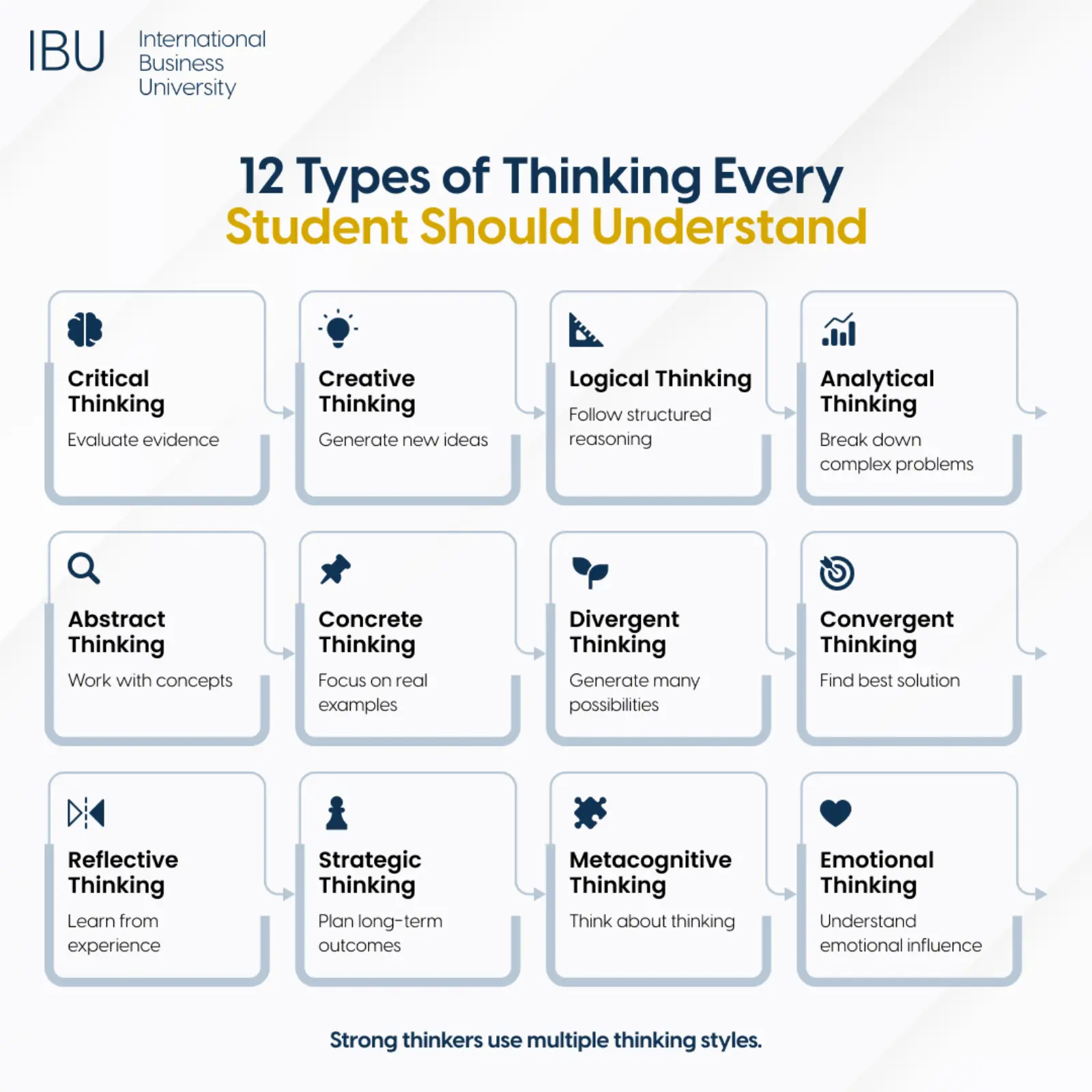
- There are 12 core types of thinking students should know: Each type serves a distinct purpose, from analyzing data and solving logic problems to generating ideas and regulating their emotions.
- Critical thinking is the most in-demand skill employers look for: A survey by Hart Research Associates found that 78% of hiring managers ranked critical thinking as one of the most important learning outcomes, yet only 34% felt college graduates were well prepared in it.
- Practicing multiple types of thinking improves academic performance: Research consistently shows that students who develop metacognitive thinking alongside other cognitive skills earn higher grades and perform better on complex problem-solving tasks.
What Are the Types of Thinking?
The types of thinking are distinct cognitive approaches we use to process information, solve problems, and make decisions. Each type operates differently in the brain and serves a specific purpose depending on the task at hand. Some types of thinking are systematic and rule-based, such as logical thinking, while others are open-ended and imaginative, like creative thinking. Most academic disciplines and professional roles require you to switch between multiple types of thinking, often within the same assignment or project.
Why Understanding Different Types of Thinking Matters for Students
Students who understand the different types of thinking are better equipped to adapt to what a specific task requires. A 2018 survey by Hart Research Associates found that 78% of employers identified critical thinking as the most important skill they want in new hires, but only 34% of college graduates arrived adequately prepared. The gap between what students know and what employers need often comes down to practice across multiple types of thinking, not just absorbing course content.
At IBU, programs like the MBA in Technology, Innovation, and Entrepreneurship are built around applied problem-solving that draws on strategic, analytical, and creative types of thinking simultaneously. Even if you are in an undergraduate or graduate program, learning to identify and intentionally use different types of thinking will make your academic experience and your career outcomes significantly stronger.
1. Critical Thinking
Critical thinking is the process of analyzing information objectively, identifying assumptions, evaluating evidence, and forming well-reasoned conclusions. It is arguably the most universally valued of all the types of thinking in academic and professional settings.
What It Looks Like in Practice
- Evaluating sources: Before citing a study or article, a critical thinker asks if the source is credible, if the sample size is sufficient, and if the conclusion actually follows from the data.
- Challenging your own assumptions: Critical thinking involves recognizing when your position is based on incomplete information and being willing to revise it when presented with stronger evidence.
- Identifying logical gaps: In essays, debates, or case analyze, critical thinkers spot where an argument jumps from evidence to conclusion without sufficient justification.
2. Creative Thinking
Creative thinking involves generating original ideas, making unexpected connections, and approaching problems from angles that others might overlook. It is not limited to the arts; it plays a significant role in business innovation, product development, and academic research.
What It Looks Like in Practice
- Brainstorming without filtering: Creative thinkers generate as many ideas as possible in an early phase before evaluating any of them, which produces a wider range of options to work from.
- Cross-domain thinking: Applying principles from one field to solve a problem in another, such as using behavioural economics concepts in a marketing strategy, is a key form of creative thinking.
- Reframing the problem: Instead of asking how to reduce customer complaints, a creative thinker might ask what changes would make customers want to share positive experiences instead.
Start Thinking Like a Business Leader
Develop the skills top employers expect from day one.
3. Logical Thinking
Logical thinking follows structured rules of reasoning to move from premises to conclusions. It underpins mathematics, computer science, law, and philosophy, and it is the foundation for constructing sound arguments in any discipline.
What It Looks Like in Practice
- If-then reasoning: Logical thinkers frame problems conditionally: if variable A changes, then outcome B follows, and they test this chain before accepting it as valid.
- Avoiding logical fallacies: Recognizing common errors in reasoning, such as circular arguments or false dichotomies, is a direct application of logical thinking in academic writing and debate.
- Structured problem-solving: Breaking a complex problem into sequential, rule-based steps, where each step depends on the one before it, is how logical thinking works in practice.
4. Analytical Thinking
Analytical thinking breaks a subject, problem, or situation into its component parts and examines how those parts relate to each other and to the whole. It is closely associated with data analysis, research, and evidence-based decision-making.
What It Looks Like in Practice
- Data interpretation: An analytical thinker does not just read a chart; they identify patterns, compare categories, and draw conclusions about what the numbers mean in context.
- Root cause analysis: When something goes wrong in a project, analytical thinking looks past the surface symptom to identify the underlying cause driving the problem.
- Comparative evaluation: Weighing two business models, two research methodologies, or two policy options against a defined set of criteria is a standard analytical thinking task.
5. Abstract Thinking
Abstract thinking involves working with ideas, concepts, and principles that are not tied to a specific physical object or concrete experience. It allows students to understand theories, form generalizations, and think symbolically.
What It Looks Like in Practice
- Understanding theoretical models: Supply and demand curves, Maslow’s hierarchy, or the concept of opportunity cost all require abstract thinking because they represent real phenomena through generalized principles.
- Drawing wider implications: Abstract thinkers can take a case study result and identify what broader principle it illustrates, rather than treating it as an isolated instance.
- Working with metaphor and analogy: Comparing a company’s growth strategy to a biological ecosystem, for example, is abstract thinking applied to business communication.
6. Concrete Thinking
Concrete thinking focuses on specific, observable, and tangible information rather than abstract ideas. It is the counterpart to abstract thinking and is essential for translating theories into practical applications and measurable outcomes.
What It Looks Like in Practice
- Applying theory to real cases: After studying a management framework in class, a concrete thinker immediately asks how it would work in a specific industry or company they know.
- Focusing on observable evidence: Instead of debating if a strategy could work in principle, a concrete thinker wants to see actual numbers, examples, or demonstrations.
- Step-by-step execution: Concrete thinking drives the implementation phase of projects, translating plans and strategies into specific, assigned, time-bound tasks.
7. Divergent Thinking
Divergent thinking is the ability to generate multiple possible solutions or ideas from a single starting point. It is closely related to creative thinking but specifically emphasizes quantity and variety of options before any evaluation takes place.
What It Looks Like in Practice
- Free association exercises: Starting from a single concept and generating as many related ideas as possible within a time limit is a direct divergent thinking exercise used in design and business courses.
- Exploring alternative interpretations: A divergent thinker reading a business case will generate several possible explanations for why a company failed, not just the most obvious one.
- Resisting premature closure: Divergent thinking requires staying in the generative phase longer than feels comfortable, because the most valuable ideas often appear later in the process.
8. Convergent Thinking
Convergent thinking works in the opposite direction from divergent thinking. It takes multiple options, data points, or ideas and narrows them down to the single best answer or solution. It is what most standardized testing and structured problem-solving require.
What It Looks Like in Practice
- Multiple-choice decision frameworks: When choosing between four business strategies, convergent thinking applies consistent criteria to each option and identifies which one best satisfies the requirements.
- Synthesis in research: A literature review that draws together findings from many studies and arrives at a single, coherent conclusion is convergent thinking applied to academic writing.
- Decision-making under constraints: In project management, convergent thinking determines which solution is most feasible given budget, time, and resource limitations.
9. Reflective Thinking
Reflective thinking involves stepping back to examine your own thought processes, experiences, and actions in order to understand what worked, what did not, and what you would do differently. It is a core component of professional development and lifelong learning.
What It Looks Like in Practice
- Post-project review: After completing a group assignment, a reflective thinker asks not just what grade they received but what decisions and processes led to that outcome.
- Learning journal practice: Writing regularly about what you learned in class, what confused you, and how it connects to prior knowledge is a structured reflective thinking exercise.
- Feedback integration: Reflective thinking turns professor’s feedback from a comment on one assignment into an actionable change in your approach for the next one.
10. Strategic Thinking
Strategic thinking involves setting long-term goals, anticipating obstacles, and making decisions that position you or an organization for success over time. It is one of the most explicitly developed types of thinking in IBU’s MBA programs, where curriculum design incorporates strategic management, competitive analysis, and leadership decision-making.
What It Looks Like in Practice
- Prioritizing high-impact actions: A strategic thinker asks which tasks, if completed, would have the greatest downstream effect on their goals, rather than treating all tasks as equally important.
- Scenario planning: Anticipating multiple possible futures and preparing responses to each is a strategic thinking skill used in business strategy courses and executive decision-making.
- Connecting short-term decisions to long-term goals: A strategic thinker taking on a particular project or course elective can articulate precisely how it advances a specific career objective.
11. Metacognitive Thinking
Metacognitive thinking is thinking about your own thinking. It involves monitoring your understanding, evaluating your learning strategies, and adjusting your approach when something is not working. Research published in ScienceDirect found that metacognition had a significant positive correlation with academic performance in mathematics across 147 studies and nearly 700,000 participants, with stronger effects as students moved from elementary to higher education.
What It Looks Like in Practice
- Self-testing before exams: Rather than re-reading notes, a metacognitive thinker tests themselves to identify exactly which concepts they do not yet understand, then focuses study time on those gaps.
- Monitoring comprehension in real time: During a lecture or reading, a metacognitive thinker pauses to check even if they genuinely understood the last section or just read the words.
- Adjusting study strategies: If a particular method, such as passive highlighting, is not producing results, metacognitive thinking leads the student to switch to a more active technique.
12. Emotional Thinking
Emotional thinking refers to how emotions influence cognitive processes, including judgment, decision-making, motivation, and interpersonal understanding. This type of thinking is closely linked to emotional intelligence, which has become a recognized driver of professional and academic success.
What It Looks Like in Practice
- Recognizing emotional bias in decisions: A student who understands emotional thinking can identify when stress, excitement, or frustration is coloring their judgment and adjust accordingly.
- Using emotional states productively: Mild anxiety before a presentation can sharpen focus; emotional thinking means knowing how to work with that state rather than fighting it.
- Empathy in team settings: Understanding how teammates are feeling and adjusting communication or task delegation accordingly is emotional thinking applied to collaboration.
How Students Can Improve Their Thinking Skills
Improving across the different types of thinking is not a passive process. It takes deliberate practice, varied learning experiences, and a willingness to notice when your default thinking patterns are limiting your results.
Practical Strategies
- Read across disciplines: Exposure to philosophy, psychology, data science, and business simultaneously forces you to practice multiple types of thinking and see how they connect.
- Argue multiple sides of an issue: Before settling on a position in any debate or analysis, deliberately build the strongest possible case for the opposing view. This develops critical thinking, abstract thinking, and reflective thinking at the same time.
- Seek feedback on your reasoning, not just your conclusions: Ask professors and peers to evaluate your thought process, not just your final answer. Understanding where your reasoning went wrong develops metacognitive and analytical thinking faster than reviewing grades alone.
- Use structured problem-solving frameworks: Decision matrices, SWOT analyze, and root cause diagrams are tools that externalize different types of thinking and make them easier to practice consciously.
- Journal regularly on what and how you learned: Reflective writing after lectures, projects, and feedback sessions builds metacognitive awareness and reinforces the learning from every other type of thinking you practiced.
Think Strategically. Lead Globally
Build decision-making skills that stand out in international markets.
Frequently Asked Questions
What is the most important type of thinking for students to develop?
There is no single most important type; different academic and professional tasks require different types of thinking. That said, critical thinking consistently ranks as the skill most valued by employers and educators, and it also reinforces other types of thinking because it helps you evaluate when to use each approach. A student who develops strong critical thinking alongside metacognitive thinking, which involves monitoring and adjusting how they learn, tends to perform better across every subject and assignment type.
Can you develop multiple types of thinking at the same time?
Yes, and most complex academic tasks naturally engage several types of thinking simultaneously. Writing a business case analysis, for instance, requires analytical thinking to interpret data, strategic thinking to frame recommendations, critical thinking to evaluate assumptions, and reflective thinking to revise your draft. The key is to become deliberate about which type of thinking a particular phase of a task demands, so you can apply the right cognitive approach rather than defaulting to one style for everything.
How do IBU programs develop these types of thinking in students?
IBU’s programs are built around applied, case-based learning that requires students to move between analytical, strategic, creative, and critical types of thinking within individual courses. The MBA in Global Business Management, for example, incorporates cross-border case analysis, leadership decision-making frameworks, and collaborative projects that develop convergent and divergent thinking alongside strategic and reflective thinking. At the undergraduate level, the BCOM in Business Management introduces these cognitive frameworks early through coursework in organizational behavior, business strategy, and applied research methods.
Think Better, Perform Better: A Practical Framework for Students
The 12 types of thinking covered here are not abstract concepts; they are practical skills you can identify, practice, and improve. Critical thinking helps you evaluate evidence rigorously. Creative and divergent thinking expand the range of solutions available to you. Analytical and logical thinking give structure to your problem-solving. Reflective and metacognitive thinking make every learning experience more efficient. Strategic and convergent thinking drive decisions that hold up under pressure. Abstract and concrete thinking let you move between theory and application. Emotional thinking connects your cognitive work to your interpersonal effectiveness.
The students who perform best in extensive programs, it doesn’t matter if they are at the undergraduate level through the Bachelor of Commerce (Honours) or in graduate study through an MBA program at IBU, are not necessarily the ones who know the most. They are the ones who have learned to think in multiple modes and to deploy the right type of thinking when a situation calls for it. That skill is learnable, and it starts with knowing what the options are.
Sources
Hart Research Associates. (2018). Fulfilling the American Dream: Liberal Education and the Future of Work. Association of American Colleges and Universities. https://pmc.ncbi.nlm.nih.gov/articles/PMC10607682/
Dominguez, C., & Payan-Carreira, R. (2023). Critical Thinking: Creating Job-Proof Skills for the Future of Work. International Journal of Environmental Research and Public Health, 20(19). https://pmc.ncbi.nlm.nih.gov/articles/PMC10607682/
Qin, Y., & Li, X. (2024). A meta-analysis of the relationship between metacognition and academic achievement in mathematics: From preschool to university. Acta Psychologica, 246. https://www.sciencedirect.com/science/article/pii/S0001691824003639
Reboot Foundation. (2018). The State of Critical Thinking: A New Look at Reasoning at Home, School, and Work. https://reboot-foundation.org/the-state-of-critical-thinking/
Council for Aid to Education. (2015). CLA+ National Results 2014-2015 (cited in Belkin, D.). Wall Street Journal. Cited in: Cultivating Critical Thinking Skills: A Pedagogical Study in a Business Statistics Course. https://www.tandfonline.com/doi/full/10.1080/26939169.2024.2394534