
Emotional thinking refers to the way your emotions actively shape how you process information, make decisions, and engage with your studies, and it has a measurable effect on academic performance. When you sit down to study or walk into an exam, you do not leave your emotional state at the door; it travels with you and influences everything from your focus and concentration to how well you retain what you have studied.
Research published in BMC Psychology found that emotional intelligence was positively related to both psychological well-being and academic achievement across undergraduate and postgraduate students, with stronger effects observed at the postgraduate level. Understanding how emotional thinking works is not just relevant for student mental health; it is one of the most practical things you can do to improve how you learn and perform.
Key Takeaways
- Emotional thinking directly affects academic performance: Your emotional state shapes memory encoding, attention span, and decision-making, all of which determine how much you learn and how well you perform on assessments.
- Test anxiety and exam stress are among the most common barriers to student success: A cross-sectional study of university students found that test anxiety prevalence ranged from 13.3% to 71% across undergraduate populations, with exam stress frequently cited as a top factor in underperformance (PMC).
- Emotional intelligence for students is a learnable skill: Students who deliberately build emotional awareness and regulation consistently report higher engagement, better grades, and stronger resilience under pressure and performance situations.
What Is Emotional Thinking?
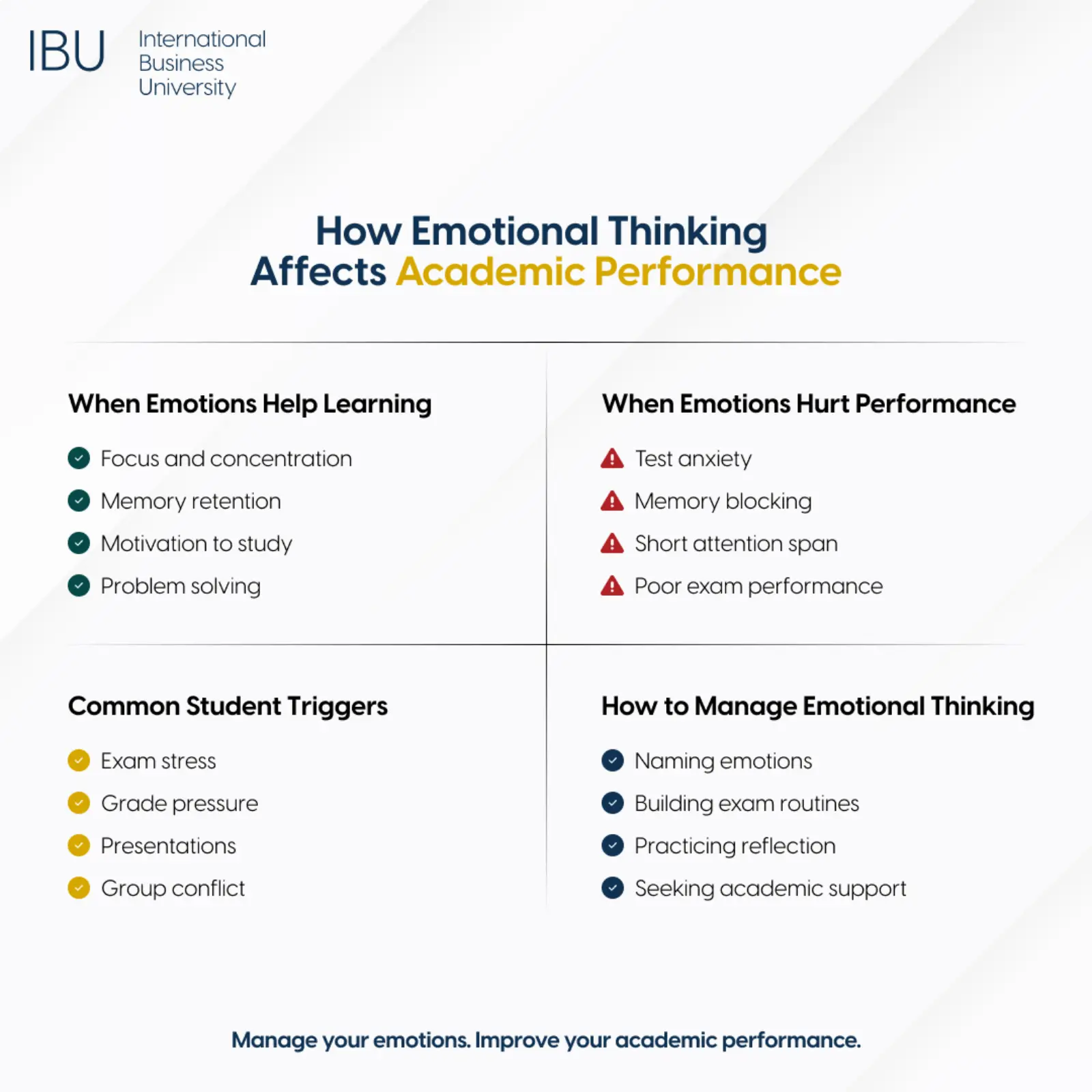
Emotional thinking is the cognitive process through which emotions influence how you interpret, respond to, and act on information. It is not the same as being emotional; it describes the automatic and continuous way that your current emotional state colors every thought you have. When you are calm and motivated, emotional thinking supports focus and concentration, deepens understanding, and strengthens memory. When you are anxious, frustrated, or overwhelmed, emotional thinking works against you, narrowing your attention, fragmenting your recall, and making complex tasks feel impossible.
Emotional Thinking vs. Rational Thinking
- They are not opposites: Emotional thinking and rational thinking operate simultaneously; the question is which one has more influence at any given moment, and that depends on how regulated your emotional state is.
- Emotions always precede judgment: Before your rational brain evaluates a situation, your emotional brain has already tagged it as safe, threatening, interesting, or boring, which means emotional thinking shapes every decision from the start.
- Regulation changes the outcome: Students who learn to recognize and manage their emotional thinking do not eliminate emotion from their decision-making; they develop the ability to direct it productively rather than letting it derail them.
Why Emotional Thinking Affects Academic Performance
Emotional thinking affects academic performance through several concrete mechanisms that operate at the level of brain chemistry and cognitive function. Stress hormones released during high-pressure situations, such as exams or deadlines, directly impair the prefrontal cortex, the part of the brain responsible for planning, reasoning, and problem-solving. A 2025 systematic review in Discover Education found that emotional intelligence significantly predicted academic performance through academic self-regulation, meaning students who managed their emotions effectively also managed their study behaviours, effort, and persistence more effectively.
The Academic Consequences of Poor Emotional Regulation
- Avoidance behaviour: Students whose emotional thinking generates high anxiety around exams or assessments frequently begin avoiding study materials, which compounds the problem they are trying to escape.
- Grade inconsistency: A student who understands the material in a calm environment but underperforms during the actual exam is experiencing emotional thinking interference, not a knowledge gap.
- Reduced engagement: When stress and learning intersect negatively, students disengage from lectures, participation, and group work, which reduces the depth of learning that accumulates over a semester.
How Emotional Thinking Impacts Focus and Concentration
Focus and concentration are directly regulated by emotional state. When emotional thinking is in a productive state, characterized by moderate arousal, genuine interest, and a sense of control, attention is sharp and sustained. When emotional thinking is dysregulated, even if going through anxiety, boredom, frustration, or low motivation, concentration breaks down at the cognitive level, not just as a matter of willpower.
What Poor Emotional Regulation Does to Attention
- Intrusive thoughts: Worry and rumination generated by negative emotional thinking occupy working memory, leaving less cognitive capacity for the actual task in front of you.
- Short attention windows: Emotional dysregulation reduces the ability to sustain focus, causing students to read the same paragraph repeatedly without retaining it or to lose their place during lectures.
- Decision fatigue: When emotional thinking is not regulated, small academic decisions, such as what to study next or how to structure an essay, feel disproportionately draining, which reduces total productive study time.
Explore IBU Programs
Build emotional intelligence through applied business education.
Emotional Thinking During Exams and High-Pressure Situations
Exam stress is one of the most common forms of emotional thinking interference that students face, and its effects extend beyond discomfort. A large-scale study published in Psychological Injury and Law involving 2,773 college students found that more than half reported feeling “often” or “almost always” very uneasy before receiving exam results back, and most test anxiety symptoms were experienced by at least 25% of participants. Pressure and performance are closely linked: a moderate level of stress can sharpen focus, but high test anxiety consistently predicts lower scores, even among students who are well-prepared.
How Exam Stress Changes Thinking
- Memory blocking: High exam stress triggers a cortisol response that temporarily impairs retrieval from long-term memory, which is why students sometimes go blank on material they studied thoroughly.
- Catastrophizing: Emotional thinking under pressure tends to amplify the perceived consequences of failure, which increases anxiety and further degrades performance in a self-reinforcing cycle.
- Time distortion: Students with high emotional reactivity during exams frequently report that time feels compressed or erratic, disrupting their ability to pace themselves across questions.
How Stress and Anxiety Affect Learning and Memory
Stress and learning have a complex relationship: acute, manageable stress can consolidate memory and sharpen attention, while chronic or overwhelming stress does the opposite. The brain encodes memory differently under emotional conditions, and the type of emotional state present during learning influences what gets stored and how accessible it becomes during recall.
What Research Shows About Stress and Memory
- Cortisol and the hippocampus: Elevated cortisol from prolonged exam stress reduces activity in the hippocampus, the primary brain region for forming new memories, which means students studying under high distress retain less, even if they spend more time on material.
- State-dependent recall: Information encoded in a calm, focused state is more reliably retrieved in a calm state; if a student studies in a high-anxiety environment and then takes an exam in that same state, the emotional mismatch can interfere with access to that information.
- Sleep and emotional consolidation: Stress-driven poor sleep disrupts overnight memory consolidation, meaning that students who experience high emotional thinking pressure before exams often arrive at the test with fragmented recall, regardless of how hard they studied.
Emotional Thinking in Presentations and Classroom Participation
Presentations and class participation require students to manage emotional thinking in real time, in front of others, while simultaneously performing an intellectual task. This is one of the most demanding emotional thinking situations students face, and the ways emotions affect learning in these contexts are underappreciated compared to the attention given to exam stress.
The Emotional Demands of Visible Performance
- Fear of negative evaluation: The anticipation of being judged, criticized, or appearing unintelligent triggers the same stress response as exam anxiety, which constricts verbal fluency and reduces the quality of spoken reasoning.
- Audience awareness overload: Students who are highly reactive to social feedback spend cognitive resources monitoring the room rather than communicating their ideas, which reduces the apparent quality of their thinking.
- Post-presentation rumination: Emotional thinking does not stop when the presentation ends; students who replay perceived mistakes afterward accumulate anxiety about future participation, which compounds the original problem.
Emotional Thinking in Group Assessments and Peer Conflict
Group assessments test academic knowledge and emotional thinking simultaneously. When peer conflict arises, such as unequal contributions, communication breakdowns, or differing working styles, emotional thinking determines how effectively a student can continue to perform academically without being derailed by the interpersonal dimension of the task.
Where Emotional Thinking Shows Up in Groups
- Attribution errors: Under stress, emotional thinking causes students to interpret a peer’s delay or poor contribution as a personal slight rather than a practical problem, which escalates conflict and reduces group output.
- Withdrawal and disengagement: Students with low emotional intelligence for handling peer friction often withdraw from group tasks entirely to avoid the emotional discomfort, sacrificing their own academic contribution.
- Communication breakdown: Negative emotional thinking in group settings reduces the quality of feedback exchange; students become less direct, less honest, and less willing to address problems before they affect the final submission.
Signs Emotional Thinking Is Hurting Your School Results
Students do not always recognize that emotional thinking is the source of their academic difficulties. The pattern is often misread as a lack of effort, poor time management, or insufficient intelligence, when the actual driver is an unmanaged emotional response that is disrupting the cognitive processes behind learning and performance.
Common Warning Signs
- Performing below your preparation level: If you consistently know the material in practice but underperform on the actual assessment, emotional thinking interference is the most likely explanation.
- Avoidance of difficult subjects or tasks: Procrastinating on specific types of work, such as presentations, high-stakes essays, or exams in a subject that previously went poorly, is a behavioural signal of negative emotional thinking patterns.
- Disproportionate reaction to grades: A single poor result that triggers extended distress, loss of motivation, or a major shift in study behaviour suggests that emotional thinking has an outsized influence on your academic identity.
- Difficulty concentrating across multiple sessions: If focus and concentration consistently break down regardless of environment or time of day, accumulated emotional stress is likely the underlying cause rather than distraction or disorganization.
How Students Can Manage Emotional Thinking and Improve Performance
Managing emotional thinking is a skill, and like all academic skills, it improves with deliberate practice. IBU’s MBA programs and undergraduate programs are built around applied, collaborative learning environments that help students develop this capacity alongside their academic knowledge. The strategies below address the root causes of disruptive emotional thinking rather than just managing symptoms.
Practical Strategies
- Name the emotion before trying to manage it: Research on affect labeling shows that simply identifying what you are feeling, such as anxiety, frustration, or dread, reduces its intensity and restores access to rational thinking.
- Separate preparation anxiety from performance anxiety: Exam stress before an exam and during an exam are different emotional experiences that require different management approaches; confusing them leads students to use ineffective strategies at the wrong time.
- Build a pre-exam emotional routine: Consistent physical and mental preparation rituals before assessments, such as a brief walk, controlled breathing, or reviewing a personal wins list, anchor the nervous system and counteract the stress response before it peaks.
- Debrief after high-pressure situations: Reflective journaling or structured self-review after exams, presentations, and group conflicts interrupts rumination and converts the emotional experience into useful data for improving future performance.
- Seek academic and emotional support proactively: Student mental health resources, tutoring, and academic advising all work better when accessed before a crisis; using them early prevents the accumulation of emotional pressure that eventually disrupts academic performance.
Advance With an MBA
Develop emotional and strategic intelligence for your career.
Frequently Asked Questions
Is emotional thinking the same as emotional intelligence?
Emotional thinking refers to the process through which emotions influence cognition in real time; it happens automatically and continuously. Emotional intelligence for students is the developed ability to recognize, understand, manage, and apply emotional information intentionally. Emotional thinking is the raw process; emotional intelligence is the skill set that allows you to work with that process rather than being controlled by it. A student with high emotional intelligence does not stop experiencing emotional thinking; they become better at noticing it quickly and redirecting it toward productive outcomes rather than letting it disrupt their focus and concentration.
Can you improve academic performance just by managing your emotions better?
Yes, to a significant degree. A 2025 study published in Discover Education found that emotional intelligence improved academic performance through the mediating role of academic self-regulation, meaning that students who managed their emotional thinking more effectively also showed better study habits, greater persistence, and higher grades. This does not mean that emotional management replaces subject knowledge, but it does mean that two students with equal knowledge can perform very differently depending on how well each manages emotional thinking under pressure and performance conditions.
What is the best way to deal with test anxiety on the day of an exam?
The most effective same-day strategies address the physiological stress response directly rather than trying to reason with it. Slow, controlled breathing activates the parasympathetic nervous system and lowers the cortisol response that drives exam stress. Arriving early to the exam environment reduces novelty stress. Avoiding comparison conversations with peers immediately before an exam prevents last-minute anxiety escalation. Once inside the exam, reading the entire paper before answering any question helps reestablish a sense of control, which is the core emotional need driving test anxiety. These strategies do not eliminate exam stress entirely, but they bring emotional thinking back within a range where cognitive performance can function effectively.
Manage Your Emotions, and Your Grades Follow
Emotional thinking is not a soft topic; it is one of the most concrete influences on academic performance that students can actually do something about. How emotions affect learning operates through measurable neurological and behavioural mechanisms: attention narrows under stress, memory retrieval degrades under high cortisol, and engagement drops when emotional thinking is unmanaged. The students who perform consistently well are not those who feel no pressure; they are the ones who have developed enough emotional awareness to keep that pressure working for them rather than against them.
Managing emotional thinking is part of what makes a strong student and a capable professional. In programs like the Bachelor of Commerce (Honours) at IBU, and at the graduate level through IBU’s MBA programs, students regularly face high-stakes group work, presentations, and assessments that demand both intellectual and emotional competence. The students who come in already practicing emotional regulation hit the ground running. The earlier you start treating emotional thinking as a skill worth developing, the more it pays back across every academic task you face.
Sources
Shengyao, Y., Xuefen, L., Jenatabadi, H. S., Samsudin, N., Chunchun, K., & Ishak, Z. (2024). Emotional intelligence impact on academic achievement and psychological well-being among university students: the mediating role of positive psychological characteristics. BMC Psychology, 12(1), 389. https://link.springer.com/article/10.1186/s40359-024-01886-4
Kheyami, D., Jaradat, A., Al-Rahbi, K., & Al-Adawi, S. (2024). Test anxiety and coping strategies among university students: An exploratory study in the UAE. Scientific Reports, 14(1). https://www.nature.com/articles/s41598-024-59739-4
Lovett, B. J., & Jordan, A. H. (2024). Test anxiety symptoms in college students: Base rates and statistical deviance. Psychological Injury and Law. https://link.springer.com/article/10.1007/s12207-023-09494-0
Kouchaki, Z., Asadi, J., & Bayazi, M. H. (2025). The effect of emotional intelligence on academic performance with the mediating role of academic self-regulation: Evidence from college students. Discover Education. https://link.springer.com/article/10.1007/s44217-025-00952-2
Alemu, A., Shiferaw, S., & Aga, F. (2020). Test anxiety and associated factors among first-year health science students of University of Gondar. PubMed Central. https://pmc.ncbi.nlm.nih.gov/articles/PMC7646484/
Quílez-Robres, A., Usán, P., Lozano-Blasco, R., & Salavera, C. (2023). Emotional intelligence and academic performance: A systematic review and meta-analysis. Thinking Skills and Creativity, 49. https://www.sciencedirect.com/science/article/pii/S1871187123001244