
Predictive analytics in healthcare applies statistical models and machine learning to clinical, operational, and financial data to anticipate outcomes such as patient readmission risk, staffing demand, or equipment failure. The shift it enables is fundamental: from reviewing what already happened to preparing for what is about to happen.
Healthcare leaders do not need to build these models themselves. Their role is to identify where prediction adds the most value, secure the resources to implement it, and translate the model’s output into a decision the organization can act on.
Key Takeaways
Here is what defines predictive analytics in a healthcare leadership context.

Predictive analytics in healthcare forecasts outcomes before they happen, shifting decisions from reactive response to proactive planning.
It differs from traditional healthcare reporting by focusing on what is likely to happen next, rather than summarizing what already occurred.
MBA-trained leaders bring healthcare data analytics into the boardroom by building the business case, not by building the underlying technical models themselves
What Predictive Analytics in Healthcare Actually Does in Practice
In practice, predictive analytics takes existing data, patient history, admission patterns, staffing records, and applies statistical models to estimate future outcomes with a defined level of confidence. A hospital might use it to flag which discharged patients carry the highest risk of readmission within thirty days, allowing care teams to schedule follow-up before a problem escalates.
The scale of the underlying data matters as much as the model itself. The Public Health Agency of Canada reports that 44 percent of Canadian adults aged 20 and older live with at least one of ten common chronic conditions, tracked through the Canadian Chronic Disease Surveillance System in partnership with every province and territory. That volume of longitudinal health data is what makes prediction possible in the first place, since a model needs years of comparable records across a large population before it can estimate risk with any confidence.
- Input data: Models draw on patient history, admission and discharge records, medication data, and staffing records rather than a single data point collected at one visit.
- Statistical method: Models apply regression, classification, or machine learning techniques trained on historical outcomes to estimate the likelihood of a future event, not to predict it with certainty.
- Output format: Results are typically expressed as a risk score or probability, such as a seventy percent likelihood of readmission, rather than a yes-or-no answer.
- Clinical action: The score feeds directly into a care team’s workflow, prioritizing which patients receive a follow-up call, a home visit, or an earlier appointment.
Clinical analytics output is always probabilistic, not certain, and leaders need to understand that distinction to use predictive tools responsibly rather than treating model output as a definitive answer.
How It Differs From Traditional Retrospective Healthcare Reporting
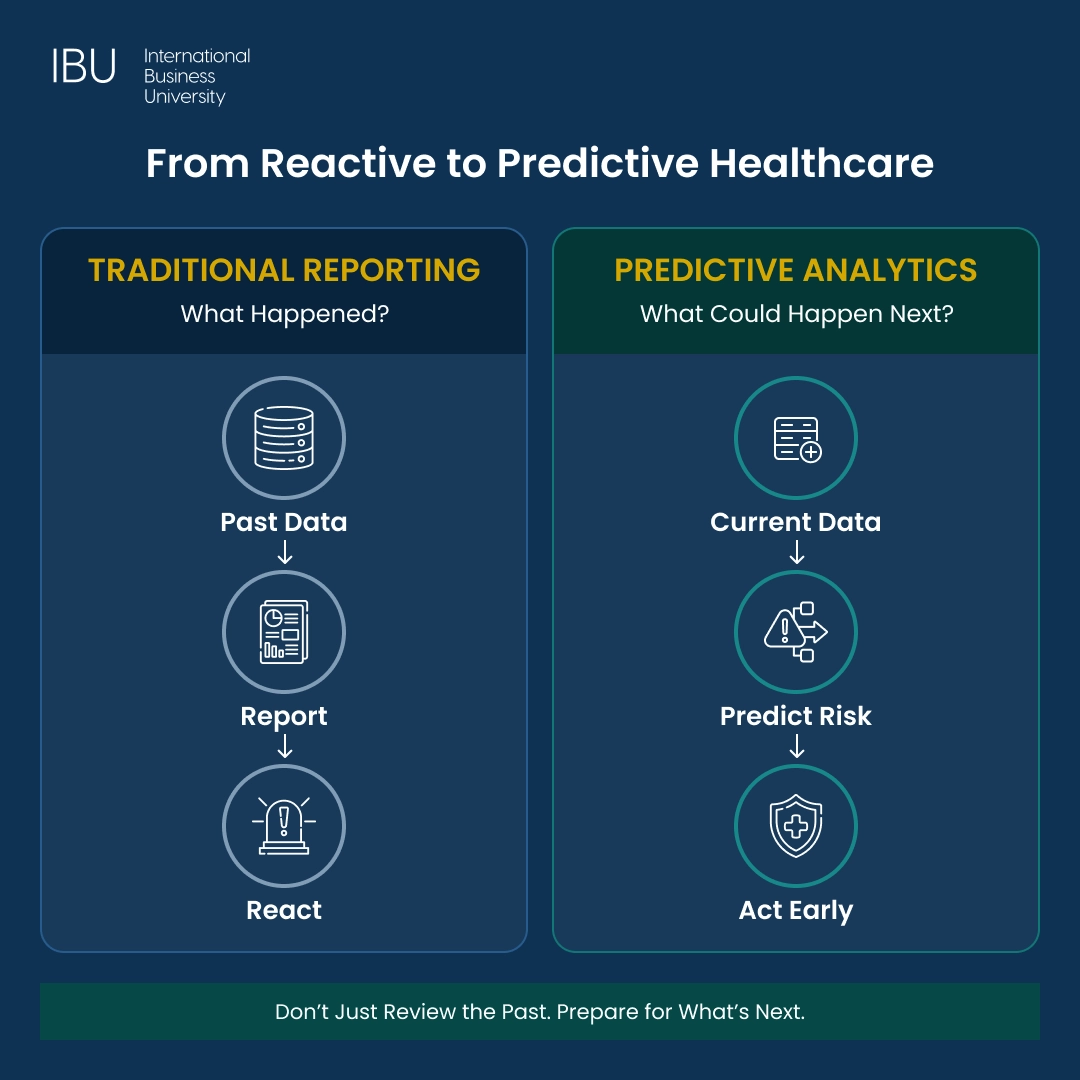
Traditional healthcare reporting answers questions about the past: how many patients were readmitted last quarter, what did average wait times look like last month, where did costs run over budget last year. This information is valuable for accountability but arrives too late to change the outcome it describes.
- Time orientation: Retrospective reporting describes what already happened. Predictive analytics estimates what is likely to happen next.
- Decision window: Retrospective reporting supports decisions for the next reporting period. Predictive analytics supports decisions for the current patient or the current staffing shift.
- Data requirement: Retrospective reporting can run on a single period of data. Machine learning in healthcare depends on years of comparable historical data to train a reliable model.
- System value: Retrospective reporting supports accountability and audit. Predictive analytics supports earlier intervention, before the outcome it is estimating has already occurred.
Predictive analytics answers a forward-looking question instead: given current patterns, what is likely to happen next, and where should attention go now to change that outcome. This shift from retrospective to forward-looking analysis is the core value proposition healthcare leaders need to understand before investing in these tools.
Three Healthcare Settings Where Predictive Analytics Is Changing Outcomes
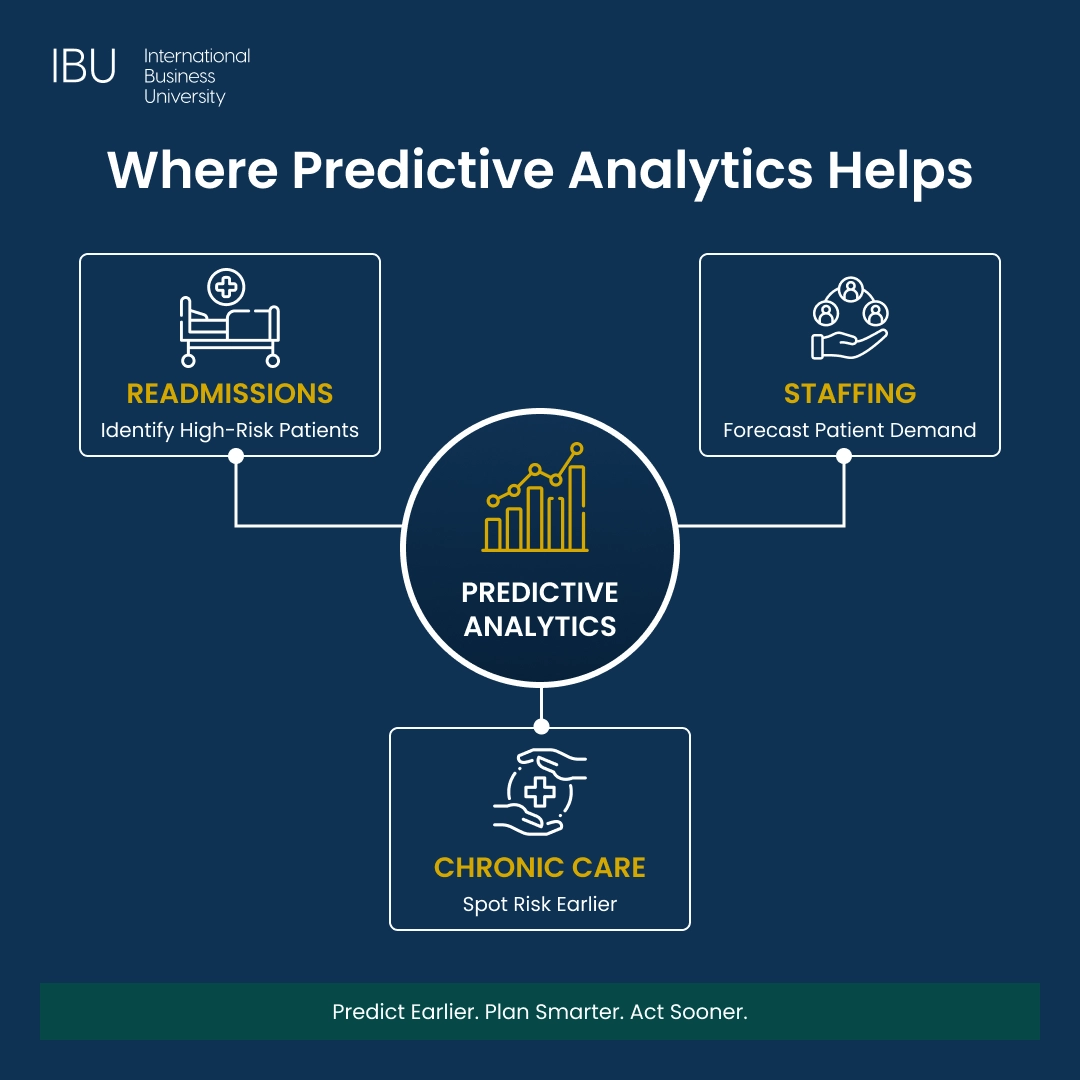
Predictive analytics has moved from theoretical to operational in several specific healthcare settings.
- Hospital readmission prevention: Models flag high-risk patients at discharge so care teams can intervene early, using the same admission and discharge data hospitals already collect for retrospective reporting.
- Staffing and capacity planning: Models forecast patient volume to help managers schedule staff more accurately, reducing both understaffing and unnecessary overtime, directly addressing the access gaps and burnout Health Canada has identified as a national workforce problem.
- Chronic disease management: Models identify patients at risk of disease progression, enabling earlier intervention in primary care settings, a use case with a large addressable population given that 44 percent of Canadian adults live with at least one chronic condition.
Each of these predictive modeling healthcare applications shares a common structure. The model identifies risk earlier than a human reviewing the same data manually would, giving the care team more time to respond
Lead Data-Driven Healthcare Decisions
Build analytics and management skills for digital health leadership.
The Business Case MBA Graduates Make for Predictive Analytics Adoption
Adopting predictive analytics requires more than technical capability. It requires an internal champion who can translate the potential benefit into a financial and operational case that leadership will fund. This is precisely the skill an MBA is built to develop.
An effective business case for predictive analytics adoption typically covers the cost of implementation, the projected reduction in a specific negative outcome such as readmissions or overtime costs, and a realistic timeline for measuring results. MBA-trained leaders are prepared to build this case because their training combines healthcare context with financial and strategic analysis, rather than treating the technology as a standalone IT project.
How IBU’s MBA in Digital Health and Data Analytics Trains for This Role
IBU’s MBA in Digital Health and Data Analytics combines healthcare systems knowledge with applied data analytics training, so graduates can question and evaluate a predictive model’s output and translate it into an operational decision. This connects directly to the broader skill of risk management in healthcare, since predictive analytics is one of the most effective tools available for identifying clinical and operational risk before it becomes a costly event.
Graduates leave the program able to work alongside data science teams without needing to build the models themselves, similar to how professionals explore digital health jobs Canadian employers want across a range of technical and leadership functions.
Move Into Healthcare Analytics Leadership
Prepare to connect clinical data, operations, and business decisions.
Frequently Asked Questions
How is predictive analytics used in hospital settings in Canada?
Canadian hospitals use predictive analytics primarily for readmission risk scoring, staffing forecasts, and identifying patients likely to need escalated care. Adoption varies significantly by institution size and available data infrastructure. Larger academic hospitals tend to lead AI in healthcare Canada adoption, with smaller facilities following as tools become more accessible.
Do healthcare managers need technical skills to use predictive analytics?
Managers do not need to build predictive models themselves, but they do need enough data literacy to interpret model output and question its assumptions. The most effective healthcare leaders in this space understand the business and clinical implications of a prediction, then work closely with technical teams on implementation. An MBA with a data analytics focus builds exactly this level of fluency.
What is the difference between predictive and prescriptive analytics in healthcare?
Predictive analytics forecasts what is likely to happen, such as a patient’s readmission risk. Prescriptive analytics goes a step further and recommends a specific action to take in response to that forecast. Many healthcare organizations start with predictive tools and add prescriptive capability once the predictive model is trusted and validated.
Can clinicians with an MBA transition into healthcare analytics leadership?
Clinical experience combined with an MBA in a data analytics-focused specialization is a strong foundation for this transition. Clinicians bring credibility and practical context that purely technical hires often lack. The MBA adds the financial, strategic, and data fluency needed to lead analytics initiatives at an organizational level.
Leading the Shift From Reactive to Proactive Healthcare Decisions
Predictive analytics in healthcare only creates value when a leader translates model output into a specific operational change, not when the technology sits unused after implementation. Leaders considering this path should start by identifying one high-cost, high-frequency problem, such as readmissions or staffing gaps, where even a modest improvement in prediction accuracy would justify the investment. Build the financial case around that single problem before expanding to broader analytics initiatives across the organization. The leaders who succeed in this space are the ones who treat predictive analytics as a decision-support tool they must actively manage, not a technology they can simply install.
Start Leading Smarter Healthcare Decisions
Apply to IBU and build skills for analytics-driven healthcare roles.