

Data analytics trends now shape how healthcare organizations control cost, manage risk, and improve outcomes at scale. Leaders who understand where analytics is moving gain decision clarity, operational confidence, and long-term competitiveness. This article explains the data analytics trends that matter most for healthcare leaders and how to act on them with discipline.
Key Takeaways
- Healthcare data analytics now demands governance, interoperability, and real-time execution rather than static reporting.
- Leaders must pair advanced analytics capability with organizational literacy and execution structure.
- Strategic investment in analytics leadership separates scalable systems from stalled transformation.
Leadership Implementation for Data Analytics Industry Trends
Understanding trends alone does not create value. Leadership implementation determines whether analytics improves outcomes or stalls inside reports. Healthcare leaders must build systems, teams, and literacy that translate data into action.
This section explains how to operationalize current trends in data analytics inside healthcare organizations.
Building Healthcare Data Analytics Center of Excellence
A Center of Excellence centralizes standards, governance, and expertise. It prevents fragmentation and duplication across departments. This structure aligns analytics with organizational priorities.
A Center of Excellence strengthens execution through:
- Standardized practices: Ensuring consistent analytics methods across teams.
- Central governance: Managing model risk, compliance, and performance.
- Talent concentration: Building deep expertise rather than scattered capability.
This approach supports scalable healthcare data analytics.
Data Literacy Training Programs in Canada
Analytics fails without understanding. Leaders must ensure that teams can interpret, question, and act on data responsibly. Training programs develop this capability across roles.
Data literacy initiatives improve outcomes by:
- Improving decision quality: Enabling leaders to interpret analytics correctly.
- Reducing misuse: Preventing misinterpretation of models and dashboards.
- Supporting adoption: Increasing trust in analytics outputs.
Healthcare data analytics courses in Canada increasingly focus on applied leadership skills.
Prepare for leadership in healthcare data analytics
Advanced analytics leadership requires structured training in healthcare systems, data governance, and decision execution.
Cross-Functional Teams for Big Data Analytics in Healthcare
Healthcare analytics requires collaboration across clinical, IT, compliance, and finance teams. Cross-functional structures prevent analytics from becoming siloed.
Cross-functional analytics teams succeed through:
- Shared accountability: Aligning technical and clinical responsibility.
- Faster deployment: Reducing handoffs and approval delays.
- Balanced perspective: Integrating operational reality with technical capability.
This structure supports big data analytics in healthcare execution.
Executive Dashboards for Current Trends Monitoring
Dashboards translate analytics into leadership insight. Executives require visibility into performance, risk, and trajectory without technical complexity.
Effective dashboards support leadership by:
- Summarizing key signals: Highlighting trends that require action.
- Reducing noise: Filtering metrics to what matters most.
- Supporting accountability: Linking performance to ownership.
Dashboards anchor monitoring of current trends in data analytics.
Change Management for Healthcare Data Analytics Adoption
Analytics adoption disrupts habits and decision authority. Structured change management protects momentum and trust. Leaders must guide the transition deliberately.
Change management supports analytics success through:
- Clear communication: Explaining how analytics supports outcomes.
- Role alignment: Clarifying how decisions change with data insight.
- Ongoing reinforcement: Sustaining adoption beyond launch.
Leadership behavior determines analytics impact.
Current Data Analytics Trends for Healthcare Leaders
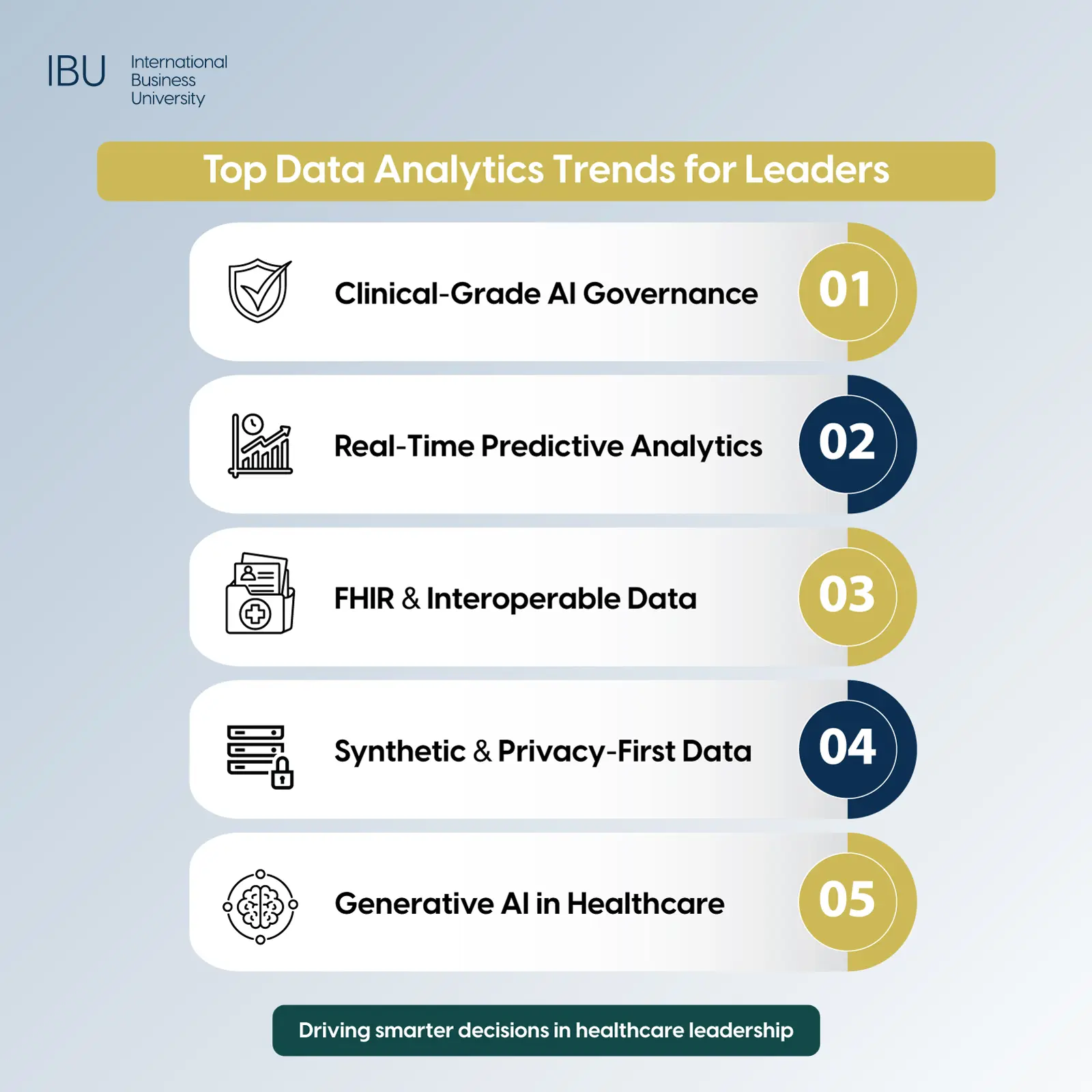
Current data analytics trends reflect a shift away from retrospective reporting toward systems that guide decisions as conditions change. Healthcare leaders now manage data environments that affect patient safety, compliance posture, and financial performance simultaneously. Understanding how these trends function operationally allows leadership to invest with clarity rather than reacting to vendor narratives.
These data analytics industry trends influence how healthcare organizations plan, execute, and scale analytics capability.
1. Clinical-Grade AI Governance Frameworks in Healthcare Data Analytics
AI now operates inside clinical and operational decision flows rather than remaining experimental. Governance frameworks define how models are trained, validated, deployed, and monitored in real environments. Without governance, analytics becomes a risk rather than an advantage.
Clinical-grade AI governance supports analytics maturity through:
- Model accountability: Ensuring predictions remain explainable, auditable, and clinically defensible.
- Data provenance control: Tracking where data originates, how it changes, and who accesses it.
- Operational oversight: Aligning analytics output with clinical safety and regulatory expectations.
This trend reflects a move toward disciplined analytics leadership rather than isolated innovation.
2. Real-Time Predictive Analytics Operations in Healthcare
Healthcare analytics now operates in real time rather than quarterly review cycles. Predictive systems monitor capacity, patient flow, staffing demand, and resource utilization continuously. This shift enables leaders to respond before performance degrades.
Real-time analytics strengthens healthcare operations by:
- Early risk detection: Identifying emerging bottlenecks before they affect care delivery.
- Dynamic resource allocation: Adjusting staffing and assets based on live demand signals.
- Performance visibility: Providing leaders with up-to-date operational insight rather than lagging reports.
This represents one of the most impactful new trends in data analytics for healthcare systems.
3. FHIR and Interoperability Acceleration in Data Analytics
Interoperability now defines analytics value. Fast Healthcare Interoperability Resources standards enable data movement across systems without custom integration. Analytics platforms increasingly depend on FHIR to deliver system-wide insight.
FHIR-driven analytics supports healthcare organizations through:
- Unified data views: Combining clinical, operational, and financial data sources.
- Reduced integration friction: Lowering the cost and time required for analytics deployment.
- Scalable analytics architecture: Supporting future system expansion without rebuilds.
Interoperability now underpins big data analytics in the healthcare industry strategy.
- Synthetic Data and Privacy Innovation in Healthcare Analytics
Privacy constraints limit how healthcare data can be used for modeling and testing. Synthetic data replicates statistical properties of real data without exposing patient information. This enables analytics development without compliance exposure.
Synthetic data innovation improves analytics execution by:
- Expanding model training: Allowing teams to test scenarios without real patient data.
- Reducing compliance risk: Limiting exposure of protected health information.
- Accelerating development cycles: Supporting faster experimentation and iteration.
This trend balances privacy protection with analytical advancement.
5. Generative AI for Clinical Workflows and Data Analytics
Generative AI now supports documentation, summarization, and workflow optimization across healthcare environments. These tools assist rather than replace clinical judgment. Analytics integrates with generative systems to reduce cognitive burden.
Generative analytics supports healthcare leaders through:
- Workflow efficiency: Reducing manual documentation effort.
- Decision support: Summarizing complex data into actionable insight.
- Operational consistency: Standardizing outputs across teams and locations.
This trend reflects the convergence of analytics and productivity systems.
FAQ
How do data analytics trends affect healthcare leadership decisions
Data analytics trends shift leadership from reactive oversight to proactive management. Leaders gain early insight into performance risk, resource strain, and quality outcomes. This improves confidence and accountability.
Why is data analytics in healthcare different from other industries
Healthcare data analytics operates under strict privacy, safety, and regulatory constraints. Decisions affect patient outcomes directly. This increases the need for governance and discipline.
What skills matter most for analytics leaders in healthcare
Analytics leaders need technical literacy, operational understanding, and change leadership capability. Communication matters as much as modeling. Trust drives adoption.
Strategic Roadmap for Healthcare Data Analytics Leadership Success
Data analytics trends continue to reshape healthcare leadership expectations. Organizations that succeed treat analytics as an operating system rather than a reporting function. This requires governance, literacy, and execution discipline. Leaders who align strategy, systems, and people position analytics as a source of durable advantage. The future of healthcare leadership belongs to those who understand data analytics trends and act on them with intent.
Build advanced analytics leadership capability
Strategic analytics leadership requires strong management systems, financial insight, and enterprise-level decision discipline.