

Your ability to improve your communication skills is one of the most direct investments you can make in your professional future, and frameworks like the 7Cs of communication skills give professionals a clear, proven structure to do exactly that, and frameworks like the 7Cs of communication skills give professionals a clear, proven structure to do exactly that.
Because workplace communication skills determine not just how well you perform your role but how visible, trusted, and promotable you become across every stage of your career. Communication skills at work cover everything from how clearly you speak in meetings to how you write an email, how you listen during a performance review, and how your body language reads during a client conversation. These are not fixed traits; they are skills, and like every skill, they respond to deliberate practice and the right strategies.
Understanding which areas to work on and how to approach them systematically is what separates professionals who improve their communication at work quickly from those who develop slowly through trial and error.
Key Takeaways
- Communication is the top skill employers want: According to High5Test’s 2024 to 2025 workplace communication statistics, 57% of global employers rank communication as the single most desirable skill in a new hire, outranking technical ability and all other competencies, which means the effort you put into improving your communication skills directly affects your employability.
- Poor communication has measurable career consequences: Research shows that 18% of employees have missed a promotion or career opportunity specifically because of poor communication, and 41% say unclear directions from supervisors prevented them from completing their work effectively, making strong professional communication skills a genuine competitive advantage.
- The eight steps in this article address both verbal and nonverbal communication: Effective communication in the workplace requires both spoken clarity and the physical signals you send when you are not speaking, and the most successful communicators develop both dimensions deliberately rather than leaving either one to chance.
Why Communication Skills Matter for Students at Work
Communication skills at work matter more than most students realize before they enter the workforce, because academic success and professional communication skills require two genuinely different sets of abilities. In a university or college setting, clear thinking expressed in a well-written paper is usually enough; in a workplace, that same thinking needs to be communicated verbally in real time, adapted to an audience that has different priorities than a professor, and delivered with the kind of confidence and professionalism that builds credibility from the first interaction.
The programs at International Business University are specifically structured to develop the business communication skills that close this gap before graduates enter the job market.
- Verbal confidence at work: Students who develop verbal communication at work through presentations, case discussions, and professional simulations arrive in their first role with the spoken authority that first impressions require.
- Written clarity matters immediately: Business communication skills include professional writing, and a new employee who produces clear, direct email and reports signals competence from day one.
- Nonverbal communication in the workplace: Body language, eye contact, and tone are evaluated continuously by colleagues and managers, and students who have practiced these signals perform better in interviews, meetings, and performance reviews.
Improve Your Communication Skills in 8 Steps
The eight approaches below address the full range of communication skills for professionals, from how you listen and speak to how you write, adapt your style, and build the feedback habits that accelerate long-term professional growth. Each one targets a specific dimension of effective communication in the workplace, and each can be practiced starting today without waiting for formal training or a new job role. IBU’s Bachelor of Commerce programs and MBA programs incorporate each of these workplace communication tips into course design, case work, and professional development activities throughout the academic program.
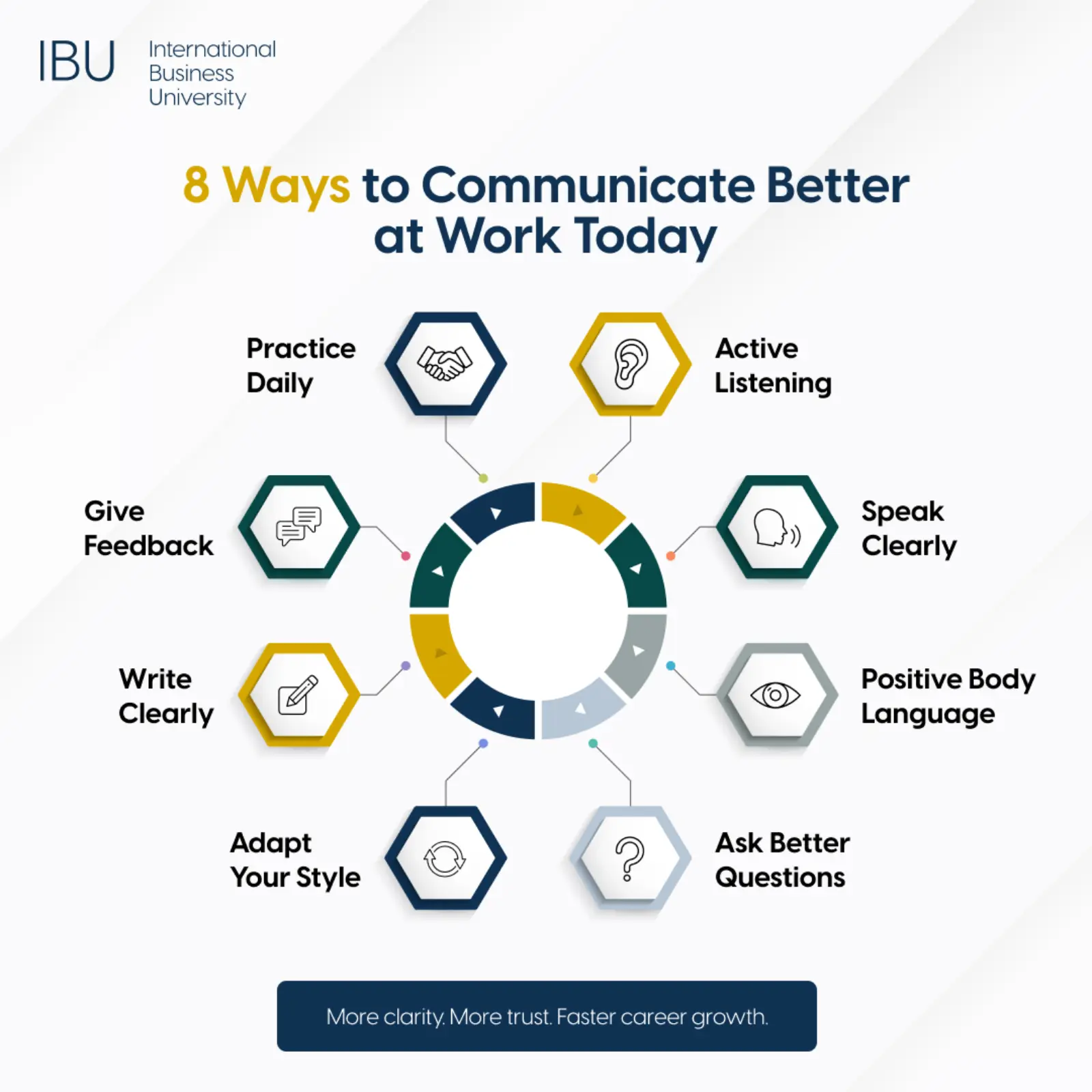
1. Practice Active Listening to Understand Others Better
Good communication begins with active listening, and Communication 101 covers the full set of habits that make this skill sustainable across every leadership role. Many people are already thinking about what to say next instead of focusing on what’s being said, which leads to mistakes and confusion.
Slow down, give your full attention, and make sure you understand what you heard before responding. A quick “So what you’re saying is…” can go a long way in avoiding miscommunication.
2. Improve Clarity by Speaking Simply and Directly
For example, at work, clarity beats being clever. If your message is buried under extra words, people will miss the point that you are trying to make.
Say what matters first and keep it short, specific, and easy to follow. The more direct you are, the more confident and professional you will sound.
3. Strengthen Communication with Positive Body Language
People don’t just listen to your words; they read your body language too. Eye contact, posture, and facial expressions all shape how your message is received.
Try to look engaged; sit up straight, maintain eye contact, and avoid distractions. Small changes here can make you look more confident and trustworthy right away.
4. Ask Thoughtful Questions to Avoid Misunderstandings
If something isn’t clear, ask. It is better to clarify early than fix mistakes later. This will cost you too much time and energy.
Focus on questions that bring out details like “What does success look like for this?” or “Is there anything that I should prioritize?” This shows you’re paying close attention, and it can help you get things right the first time.
Your Career Starts Here
BCOM grads who communicate well get hired first.
5. Adapt Your Communication Style to Different Colleagues
Not everyone communicates the same way. Some people want quick summaries while others prefer more detail.
Pay attention to what works for each person and adjust. Being more flexible makes conversations smoother and helps you build better working relationships.
6. Develop Better Written Communication for Workplace Messages
A lot of workplace communication happens in writing, and unclear messages slow everything down.
Get to the point straight away, use simple language, and break up long text. Before you send anything important, read it once to make sure it is easy to understand.
7. Learn to Give and Receive Constructive Feedback
Feedback is part of every job, even if it is positive or negative in type. The key is to handle it in a way that helps, not hurts.
When giving feedback, focus on what can be improved and be specific. When receiving it, listen first, ask questions if needed, and avoid getting defensive.
8. Practice Communication Skills Regularly in Meetings and Teamwork
You don’t improve communication by just reading about it; you improve by doing it.
Use meetings and team projects as practice. Speak up, don’t be shy, and ask the right questions. Always pay close attention to how others respond, and you will see small improvements over time.
Why Communication Skills Are Essential for Students Entering the Workplace
The eight steps described in this article are each more naturally developed in educational environments that prioritize active discussion, collaborative projects, presentation, and peer feedback than in those that rely primarily on solo written assessment. IBU’s MBA program and technology-focused MBA are built to develop exactly these capabilities through case-based learning, team projects, and industry-integrated coursework that put business communication skills into practice throughout the degree rather than treating them as a supplementary module.
- Career mobility depends on it: Professionals with strong workplace communication skills are promoted faster, assigned to higher-visibility projects, and given leadership responsibilities earlier than peers with equivalent technical knowledge.
- Collaborative work environments require it: Modern workplaces are team-based by design, and the ability to communicate effectively within a team, across functions, and with external stakeholders is a daily professional requirement, not an occasional one.
Lead Every Conversation
MBA grads who communicate clearly move up faster.
Frequently Asked Questions
How long does it take to noticeably improve your communication skills at work?
Most professionals see meaningful improvement in four to eight weeks of deliberate practice, since communication is a behavioural skill that improves quickly with consistent effort. The fastest gains come from active listening and clear speech, because these are immediately noticed by colleagues and managers through daily interactions. Practice frequency matters more than duration; small improvements in every meeting add up more than occasional intensive effort. IBU’s programs provide this kind of frequent, structured practice throughout the academic year.
What is the most important communication skill to develop first?
How do MBA and business programs help students improve communication at work?
Every Conversation Is a Chance to Communicate Better
The ability to improve your communication skills is not reserved for those who are naturally outgoing or verbally gifted; it is available to every professional willing to approach each conversation, meeting, and message as a deliberate practice opportunity. The eight approaches in this article cover the full spectrum of effective communication in the workplace. From the foundational habit of active listening to the advanced skill of style adaptation, and each one can be developed through consistent practice in the everyday interactions that already fill your professional week. If you want to develop your professional communication skills within a structured academic environment that integrates them into every dimension of the curriculum, explore the IBU MBA programs and the Bachelor of Commerce programs to find the program that aligns with your career goals.