

Healthcare analytics and business analytics are two of the fastest-growing fields for data-focused graduates. Both involve working with data to support better decisions, but they operate in different industries and require different domain knowledge. Choosing between them is not about which is more valuable; it is about which fits your interests and career direction. This article breaks down both paths clearly so you can make an informed choice.
Key Takeaways
- Healthcare analytics is sector-specific and growing fast: The market for healthcare analytics is expanding rapidly, making it one of the strongest specialized career paths for MBA graduates entering the data field.
- Both paths offer strong salaries and career progression in Canada: Healthcare data analysts and business analysts in Canada both earn well above the national median, with senior roles in both tracks reaching six figures.
- Your industry interest matters more than your technical starting point: The analytical tools used in both tracks overlap significantly; what separates the paths is the domain knowledge and the type of decisions your work will support.
What Healthcare Analytics Means in Healthcare
Healthcare analytics is the process of analyzing health-related data to improve patient and organizational outcomes. What is analytics in healthcare, specifically? It is the use of statistical methods, data tools, and predictive models to support clinical and operational decisions. Hospitals, insurers, public health agencies, and pharmaceutical companies all depend on this type of work.
What Is Data Analytics in Healthcare, Practically Speaking?
In practice, healthcare data analytics covers a wide range of activities. Analysts clean and interpret data from electronic health records and billing systems. They track patient outcomes, monitor readmission rates, and identify cost inefficiencies.
They also build models that help clinicians predict patient deterioration before it occurs. The data comes from patient records, insurance claims, lab results, and wearable devices. Analysts translate all of that raw information into decisions that affect patient care directly.
AI Predictive Analytics in Healthcare
AI predictive analytics in healthcare is one of the fastest-growing specializations within the field, and it is exactly what MBA leaders in this space are being asked to manage. Machine learning models now flag sepsis risk, predict readmissions, and detect imaging anomalies. These systems do not replace clinical judgment; they give clinicians better information to act on.
Analysts who understand both data science and health system operations are the professionals who build and maintain these tools. The market is growing to match: according to a December 2025 global healthcare analytics market report, the sector was valued at USD 53.2 billion in 2024 and is projected to reach USD 363.9 billion by 2034 at a CAGR of 21.2%.
Why Healthcare Analytics Requires Domain Knowledge
Healthcare data follows strict regulatory and ethical frameworks that do not exist in other industries. Analysts must understand PHIPA, HIPAA, and data governance principles specific to health information.
A technically strong analyst without healthcare domain knowledge makes costly interpretation errors. Clinical terminology, billing codes like ICD-10, and health system structure are all part of the job. Programs that combine analytics training with a healthcare management context produce the strongest graduates for this path.
What Business Analytics Means in Different Industries
Business analytics refers to using data to support strategic and operational business decisions. It covers financial modelling, market analysis, operational performance, and customer behaviour. Unlike healthcare analytics, business analytics applies across virtually every industry sector. Finance, retail, logistics, technology, and consulting all employ business analytics professionals at scale.
How Business Analytics Differs from Data Science
Business analytics focuses on interpreting data to support business strategy and execution. Data science focuses more on building the models and systems that produce that data. A business analyst works more closely with the decision-maker; a data scientist works more closely with the algorithm.
In practice, the two roles overlap significantly, but the business analytics career path stays more connected to the organizational context. MBA graduates often enter this space because the combination of analytical and management skills is exactly what the role requires.
The Role of Market Insights in Business Analytics
Business data and market insights are the primary outputs of a business analytics function. Analysts answer questions like: which markets should we enter, where is revenue being lost, and what do customers want next?
These questions require both quantitative skills and strategic thinking. A business analytics career rewards professionals who understand both numbers and business context. Strategy is not a soft skill in this field; it is a core competency that separates useful analysts from technical ones.
Healthcare Analytics vs Business Analytics: What Sets Them Apart
Healthcare analytics vs business analytics comes down to domain, data type, and end purpose. Both require strong analytical skills and comfort with large datasets. What separates them is the industry knowledge required and the type of decision being supported.
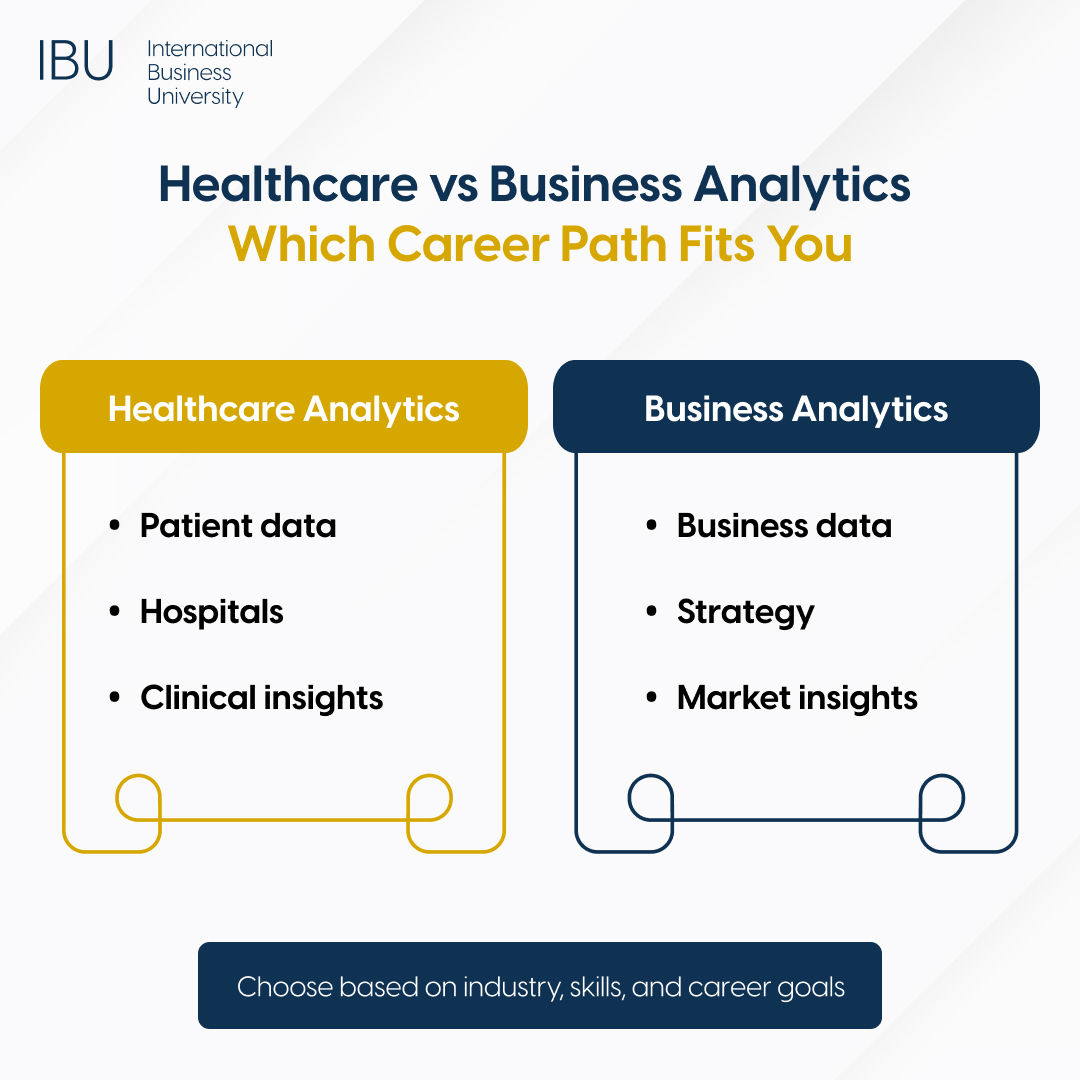
The comparison above shows two clearly distinct analytical worlds.
On the left, healthcare analytics works with patient data, hospitals, and clinical insights. The data sources are medical records, lab results, imaging, and claims. The decisions supported affect patient safety, quality of care, and hospital operations.
On the right, business analytics works with business data, strategy, and market insights. The data sources are financial records, sales systems, customer databases, and market research. The decisions supported affect revenue, market share, operational efficiency, and growth strategy.
Both paths use similar analytical tools and methods. The difference is what you are analyzing, who the end user of your findings is, and what the consequences of a poor analysis might be.
Data Sources and Sensitivity
Healthcare data involves patient records governed by strict privacy laws, which is why privacy is tracked as its own distinct risk category separate from general clinical incident reporting. Business data involves financial and commercial information governed by corporate policy. Errors in healthcare data analysis can directly affect patient outcomes. Errors in business analysis affect revenue or strategy.
Both are serious, but healthcare carries an additional layer of ethical responsibility. This is why healthcare analytics roles typically require more specialized domain training alongside analytical skills.
The Role of Strategy in Each Path
Business analytics is heavily focused on strategy. Analysts in this path regularly present findings to senior leadership and recommend strategic actions. Healthcare analytics is more operationally focused, connecting data to care delivery and system performance. Senior healthcare analytics roles do involve strategic planning, but the first years are typically more technical.
Students who enjoy connecting data to business growth tend toward business analytics. Students who want their analysis to affect patient care directly tend toward healthcare analytics.
Skills You Build in Each Path
Skills for business analytics and healthcare analytics overlap significantly at the foundational level. Both require statistical analysis, data visualization, and the ability to communicate findings to non-technical stakeholders. Where they diverge is in domain-specific knowledge and the regulatory environment each analyst must navigate.
Shared Analytical Skills
Both paths develop proficiency in SQL, Excel, and data visualization platforms like Tableau or Power BI. Statistical modelling and hypothesis testing are foundational in both tracks. Communication skills are equally critical; an analyst who cannot explain findings clearly loses impact. Project management, stakeholder coordination, and report writing appear in both roles routinely. Graduates who build strong fundamentals in these areas can move between industries more easily later in their careers.
Healthcare-Specific Skills
Healthcare analytics requires working knowledge of EHR systems like Epic and Cerner. Analysts must understand health data standards, including HL7, FHIR, and SNOMED. Population health analysis, clinical outcome tracking, and care pathway modelling are common responsibilities. An understanding of health economics and value-based care models is increasingly expected. Privacy and governance training, specifically PHIPA and PIPEDA, is non-negotiable in Canadian healthcare settings.
Business Analytics-Specific Skills
Business analytics develops stronger skills in financial modelling and market analysis. Forecasting, demand planning, and competitive intelligence are core competencies. Analysts in this track work more heavily with CRM systems, ERP platforms, and marketing data. Scenario modelling and cost-benefit analysis are central to how business analysts add value. Strategy skills, including how to frame a business problem before analyzing it, are developed more deliberately here.
Choose Your Analytics Path
IBU’s MBA programs prepare you for both analytics career paths.
Tools You Learn to Use
Tools used in business analytics and healthcare analytics share a common foundation. The platforms and software diverge when you get into industry-specific systems. Understanding which tools dominate each track helps you plan your technical learning before and during your program.
- SQL: Used in both tracks to query large databases and extract structured datasets for analysis.
- Python and R: Statistical languages used for modelling, data cleaning, and building analytical scripts across both paths.
- Tableau and Power BI: Visualization platforms used by analysts in both fields to present findings to stakeholders clearly.
- Epic and Cerner: EHR platforms used specifically in healthcare analytics to extract and interpret clinical patient data.
- SAS: A statistical platform widely used in pharmaceutical research, clinical trials, and health data analysis.
- Salesforce and SAP: CRM and ERP platforms are more common in business analytics for customer and operational data.
- Excel and Power Query: Foundational tools used in both paths for data organization, pivot analysis, and reporting.
Career Paths in Healthcare Analytics vs Business Analytics
A business analytics career and a healthcare analytics career both offer strong progression paths. The entry points, progression timelines, and senior roles differ by track. Knowing what the path looks like helps students set practical expectations and plan their education accordingly.
Healthcare Analytics Career Progression
Entry-level healthcare data analytics jobs include roles like health data analyst and clinical reporting analyst. With two to five years of experience, professionals move into senior analyst and health informatics specialist roles. Senior roles include population health manager, analytics director, and chief data officer within health organizations. The most senior roles typically require both strong technical credentials and demonstrated healthcare management experience. An MBA in Healthcare Management from IBU builds exactly this combination.
Business Analytics Career Progression
Entry-level business analytics roles include junior data analyst, reporting analyst, and business intelligence associate. Mid-level roles include senior analyst, strategy analyst, and financial analyst.
Senior professionals move into analytics manager, director of business intelligence, or VP of strategy roles. The business analytics career path frequently leads to general management for professionals who develop strong communication alongside technical skills. IBU’s MBA in Financial and Management Analytics is structured to develop this dual capability directly.
Salary and Job Opportunities
Healthcare data analytics salary and business analytics salary are both competitive in Canada. Both tracks offer stronger earnings than the national median for all occupations. The difference in salary tends to emerge with specialization and seniority rather than at the entry level.
Healthcare Data Analytics Salary in Canada
According to Glassdoor’s 2025 healthcare data analyst salary data, the average healthcare data analyst in Canada earns CA$69,922 per year. Top earners in the 90th percentile reach CA$110,588 annually. In Ontario specifically, healthcare data analytics salaries average CA$91,437 per year as of 2026.
Senior roles in hospital systems, pharmaceutical companies, and government health agencies pay at the higher end. Graduate-level education, including a healthcare management MBA, consistently positions professionals in the higher salary bands.
Business Analytics Salary in Canada
Business analysts in Canada typically earn between CA$70,000 and CA$110,000, depending on sector and experience. Finance and technology roles pay the highest, followed by consulting and healthcare.
Job Bank Canada projects the business analyst role to grow 14% through 2030, per The Career Accelerators’ 2025 outlook report. Professionals with an MBA and strong analytics credentials regularly land at the higher end of the range. Salary growth in this track is tied closely to industry specialization, with finance and tech commanding the highest premiums.
Where You Might Work After Graduation
Where you work depends on which track you choose and which specialization you develop within it. Healthcare analytics graduates enter hospitals, insurers, public health agencies, and health tech companies. Business analytics graduates enter banks, consulting firms, technology companies, and retail corporations.
- Hospitals and health systems: Healthcare analytics professionals in these settings track patient outcomes and support operational efficiency.
- Pharmaceutical companies: Analysts in pharma work with clinical trial data, drug safety records, and market access strategy.
- Health insurance companies: Insurers use healthcare analytics to assess risk, manage claims, and develop pricing models.
- Government health agencies: Public health departments at provincial and federal levels employ analytics professionals for population health programs.
- Management consulting firms: Business analytics professionals in consulting advise multiple clients across industries on data strategy.
- Financial institutions: Banks and investment firms use business analytics for credit risk, fraud detection, and market modelling.
- Technology companies: Tech companies use business analytics for product performance, user behaviour, and revenue forecasting.
Which Path Fits You Better
Choosing between healthcare analytics and business analytics comes down to three things. The industry you want to work in, the type of impact you want your work to have, and the domain knowledge you are willing to build. Neither path is better in absolute terms; each is better for a specific kind of professional.
Signs Healthcare Analytics Is the Right Fit
You are drawn to healthcare analytics if patient outcomes interest you beyond the technical work. If you are motivated by improving care delivery or reducing clinical errors, this path aligns with that motivation. Students who want their analysis to carry a direct human impact consistently find healthcare analytics more meaningful.
It also suits professionals with existing healthcare work experience who want to add analytical depth. The privacy requirements and regulatory environment appeal to analysts who value structure and ethics alongside technical skill.
Signs Business Analytics Is the Right Fit
Business analytics suits you if your interests lean toward market strategy and organizational performance. If you are energized by connecting data to revenue, market position, or competitive advantage, this is the stronger fit.
Students who want flexibility to move across industries often choose business analytics for its broader applicability. It also suits professionals who want a faster path into general management or executive roles. The business analytics career path tends to produce strong financial and strategic thinkers alongside capable data analysts.
How to Choose Between Healthcare Analytics and Business Analytics
Making the choice between healthcare analytics and business analytics does not require certainty. It requires a clear answer to a few practical questions about your background and goals. The framework below helps narrow the decision without overcomplicating it.
- Prior work experience: Students with clinical or health sector backgrounds typically have a faster path to credibility in healthcare analytics.
- Industry interest: Genuine interest in the healthcare system makes domain learning easier and the work more sustainable long-term.
- Salary ceiling goals: Both tracks offer strong salaries; healthcare analytics in Ontario currently averages higher in senior roles.
- Career flexibility preference: Business analytics provides more cross-industry mobility; healthcare analytics is more specialized but in high demand.
- AI and predictive interest: Students interested in AI predictive analytics in healthcare will find the healthcare track offers more direct application.
- Program alignment: Choosing a program that explicitly connects analytics to either health management or financial strategy accelerates your career start.
How IBU Prepares You for Analytics Careers
IBU prepares students for analytics careers through programs that combine data skills with management context. Two MBA specializations address both tracks covered in this article directly. Each is built around what employers in those industries actually need graduates to know and do on arrival.
MBA in Healthcare Management
IBU’s MBA in Healthcare Management covers health systems, health data analytics, and the governance frameworks that shape how healthcare organizations use data. Students develop both technical analytical skills and strategic health management competencies. Graduates enter healthcare data analytics jobs in hospitals, insurers, and government health agencies.
The program suits students from both clinical and non-clinical backgrounds who want to lead analytics work in health settings. It is specifically built for the intersection of data competency and healthcare management, not one at the expense of the other.
MBA in Financial and Management Analytics
IBU’s MBA in Financial and Management Analytics develops the financial modelling, strategic analysis, and data interpretation skills that business analytics careers require. The curriculum covers quantitative methods, performance analytics, and the application of data to organizational strategy. Graduates pursue roles in consulting, financial services, technology companies, and corporate strategy functions.
This program is structured for students who want to connect strong analytical skills directly to business leadership. The business analytics meaning of this program is practical: it builds professionals who can both analyze data and act on it.
Frequently Asked Questions
Can I switch from business analytics to healthcare analytics later in my career?
Yes, switching is possible, and it happens more often than most students expect. Business analytics professionals who develop healthcare domain knowledge through additional training or work experience regularly transition into healthcare data analytics roles. Starting with a program that covers healthcare management context, like IBU’s MBA in Healthcare Management, gives you both analytical skills and the domain foundation needed to move into healthcare analytics directly without needing a second degree.
Is healthcare analytics harder to get into than business analytics?
Healthcare analytics is not harder to enter, but it requires more specific preparation. The combination of technical skills and healthcare domain knowledge is the barrier, not the competition for roles. Students who complete a program that integrates both, rather than treating them separately, typically find that entry-level healthcare data analytics jobs become accessible within six to twelve months of graduation with the right credentials.
Which analytics path offers better long-term career growth?
Both paths offer strong long-term growth for professionals who continue developing. Healthcare analytics is growing faster by market size and has fewer trained professionals relative to demand. Business analytics offers more cross-industry mobility and tends to lead to general management roles at a higher rate, making long-term growth dependent less on which path you choose and more on how far you develop within it.
Choose the Path That Matches Where You Want to Work
Healthcare analytics and business analytics are both strong career choices for data-focused MBA graduates. The decision comes down to industry preference, domain interest, and how you want your analytical work to create value for the organizations you serve. IBU’s MBA programs in Healthcare Management and Financial and Management Analytics are built to prepare you for both paths with the depth each career requires.
Start Your Analytics MBA
IBU’s MBA programs launch analytics careers in both sectors.