

AI systems do not run on algorithms alone; they run on clean, structured, accessible data. The tools that prepare that data are called data engineering tools, and they sit beneath every AI product you have ever used. Choosing the right ones determines how fast, how reliable, and how scalable an AI system can be. This article covers seven of the most widely used tools and explains what each one actually does.
Key Takeaways
- Data engineering tools are the infrastructure layer under every AI system: Without them, raw data cannot be converted into the structured inputs that AI models require to function.
- Different tools handle different jobs: Processing, streaming, storage, orchestration, and integration. Each requires a different tool, and professionals need to know when to use which.
- Demand for these skills is growing fast: Familiarity with data engineering technologies is becoming a baseline expectation for data, analytics, and technology management roles.
What Makes a Data Engineering Tool Work Well with AI
A good data engineering tool for AI handles volume, speed, and consistency without manual intervention. AI models are only as accurate as the data fed into them. Tools that allow errors, duplication, or latency to pass through produce unreliable model outputs. The right data pipeline tools keep data clean, timely, and in the right format at every step.
- Scalability: Tools that scale horizontally handle growing data volumes without requiring complete system rebuilds.
- Integration compatibility: Data engineering technologies that connect with cloud platforms reduce friction in AI deployment.
- Fault tolerance: Tools that recover from failures automatically are critical in production AI environments where downtime has its costs.
- Latency performance: Live AI applications require data processing tools that deliver results in milliseconds, not minutes.
- Schema flexibility: AI pipelines frequently receive data in varied formats; tools that handle schema changes gracefully reduce pipeline breakdowns.
Why Data Engineering Tools Are Important for AI Systems
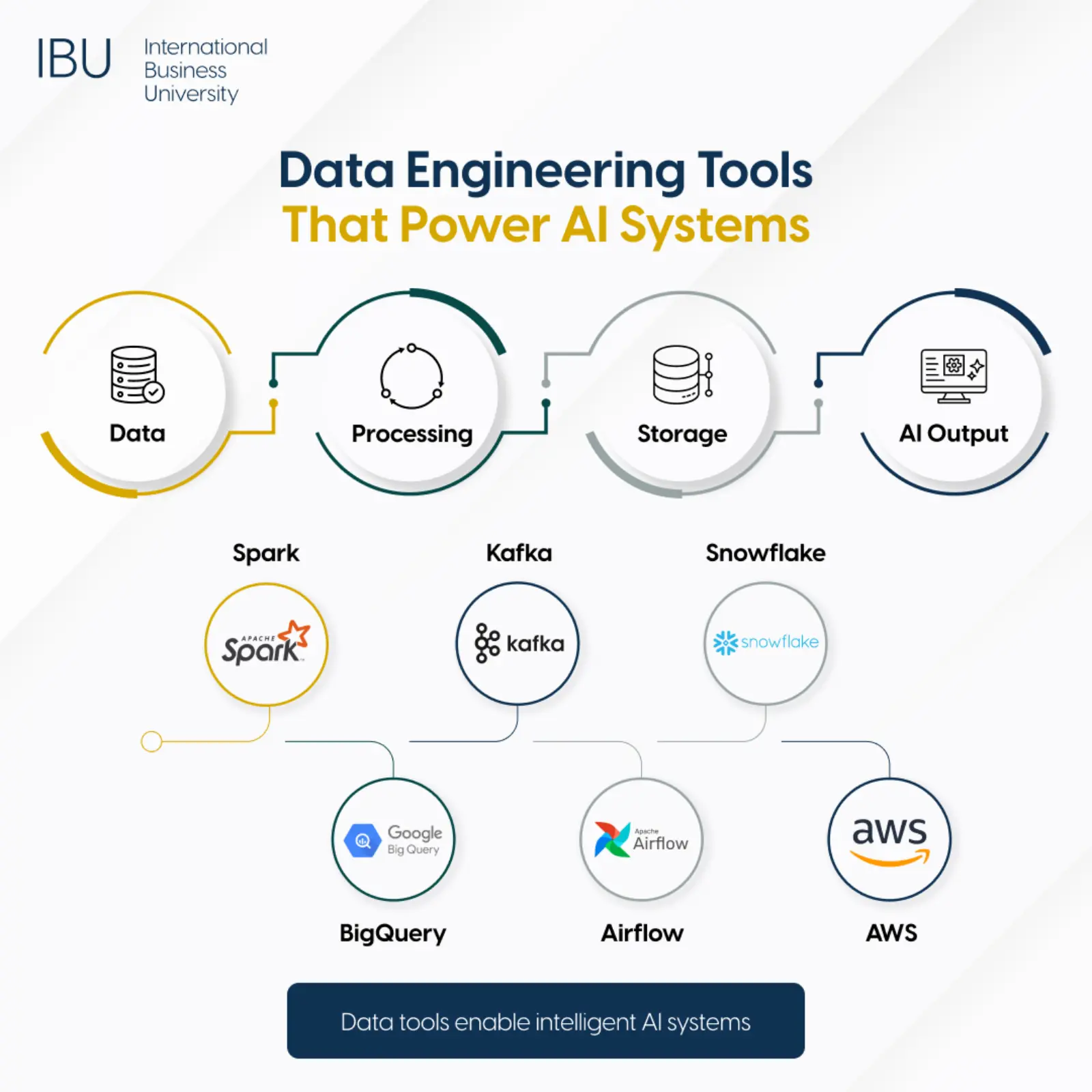
Raw data enters on the left and moves through four connected stages. First it is collected, then processed, then stored, and finally used to produce AI output. Sitting beneath those stages are the tools that make each one possible. Apache Spark handles large-scale processing. Apache Kafka manages the movement of data in real time. Snowflake sits in the storage layer, holding structured data ready for querying. Google BigQuery, Apache Airflow, and AWS each play their own role in keeping the pipeline running.
According to Mordor Intelligence’s 2026 market report, the big data and data engineering services market reached USD 91.54 billion in 2025 and is projected to reach USD 187.19 billion by 2030 at a CAGR of 15.38%. AI adoption is the primary driver behind that growth. Every organization expanding its AI capability needs the data infrastructure to support it. Tools used by data engineers are no longer a back-end concern; they are a strategic business asset.
Data Processing Tools for AI Systems
Data processing tools sit at the core of every AI data pipeline. They take raw, unstructured, or semi-structured data and prepare it for storage and modeling. Two tools dominate this category in enterprise and cloud AI environments.
Apache Spark
Apache Spark is one of the most widely used data processing tools for large-scale analytics. It processes data in memory rather than writing to disk between each step. This makes it significantly faster than older batch-processing frameworks for AI workloads. Spark supports Python, Java, Scala, and R, which makes it accessible across engineering teams. It is a standard tool in machine learning pipelines where feature engineering and data preparation happen at scale.
Databricks
Databricks is a cloud-based platform built on top of Apache Spark. It adds a collaborative environment for data engineers, scientists, and analysts to work together. Notebooks in Databricks allow teams to write, test, and run data engineering code in a shared workspace. It integrates directly with Azure, AWS, and Google Cloud, which makes it one of the most commonly used tools for data engineering in enterprise AI projects. For students entering roles that involve AI and cloud infrastructure, Databricks proficiency is increasingly expected.
Tools for Immediate Data Streaming for AI Applications
Immediate AI applications need data to arrive continuously, not in batches. Fraud detection, recommendation engines, and live monitoring systems all require instant data availability. One tool has become the standard for this type of data movement.
Apache Kafka
Apache Kafka is a distributed event streaming platform used to move data between systems in real time. It works by publishing messages to topics that consumers read from at their own pace. This decouples the data source from the data consumer, which prevents bottlenecks in high-volume pipelines. Kafka handles trillions of events per day across organizations like LinkedIn, Netflix, and Uber. For AI systems that need live input, Kafka is the most reliable data pipeline tool available at scale.
Data Storage and Warehousing Tools for AI Systems
Processed data needs a home that is both queryable and scalable. Data warehouses store structured data in formats that AI models and analysts can access quickly. Two cloud-native options lead the market for AI-oriented storage.
Snowflake
Snowflake is a cloud data warehouse that separates storage and compute for flexible scaling. This means you pay only for the processing you use, not for a fixed server. Snowflake handles structured and semi-structured data and integrates with most modern AI platforms. Its data sharing features let teams across an organization query the same dataset without copying it. For analytics-heavy AI environments, Snowflake is one of the most widely adopted storage layers available.
Google BigQuery
Google BigQuery is a serverless data warehouse built for very large analytical workloads. Users run SQL queries across petabytes of data without managing any underlying infrastructure. BigQuery integrates directly with Google’s AI and machine learning services, including Vertex AI. This tight integration makes it a natural storage choice for teams building AI products within the Google Cloud ecosystem. It also supports ML model training directly within the warehouse using BigQuery ML, which reduces the steps between data and prediction.
Learn Data Engineering Tools
IBU’s MBA programs build the skills AI employers need.
Workflow Orchestration Tools for AI Pipelines
AI pipelines involve many steps that must run in a specific order and on a schedule. Orchestration tools manage that sequence automatically, triggering each task when the prior one completes. Without orchestration, data engineers manually manage dependencies, which does not scale.
Apache Airflow
Apache Airflow is the most widely used workflow orchestration tool in data engineering. Pipelines are written as directed acyclic graphs, or DAGs, in Python code. Each DAG defines the tasks to run, in what order, and under what conditions. Airflow provides a visual interface showing the status of each task across all active pipelines. For teams managing multiple AI models with separate data requirements, Airflow keeps the entire system coordinated and auditable.
Data Integration Tools for AI Systems
Data for AI systems rarely comes from one source. Organizations pull from databases, APIs, SaaS platforms, and file systems simultaneously. Data integration tools connect these sources and move data into centralized pipelines for AI use.
AWS Glue
AWS Glue is a fully managed extract, transform, and load service from Amazon Web Services. It automatically discovers data schemas and catalogs metadata from connected sources. This means engineers spend less time documenting data structure and more time building pipelines. Glue integrates natively with Amazon S3, Redshift, and other AWS services used in AI workflows. For teams already operating within the AWS ecosystem, it is one of the most efficient tools for data engineering available.
Azure Data Factory
Azure Data Factory is Microsoft’s cloud integration service for building data pipelines. It connects to over 90 data sources without requiring custom connectors. Visual pipeline authoring makes it accessible to team members who are not writing code daily. ADF integrates with Azure Machine Learning, making it a natural fit for AI workflows running on Microsoft infrastructure. According to Motion Recruitment’s 2025 data engineering trends report, approximately 150,000 data engineering professionals are employed across North America, with over 20,000 new hires in the past year alone, reflecting nearly 23% growth in demand for exactly these kinds of integration skills.
Data Reliability and Lakehouse Tools
AI models trained on unreliable data produce unreliable predictions. Data reliability tools add versioning, transaction support, and audit trails to data lakes. This category has grown significantly as organizations move from traditional warehouses to lakehouse architectures.
Delta Lake
Delta Lake is an open-source storage layer that adds ACID transactions to data lakes. ACID compliance means data changes are atomic, consistent, isolated, and durable. For AI systems, this guarantees that training data has not been partially written or corrupted. Delta Lake also supports time travel, allowing engineers to query data as it existed at any past point. This is particularly useful for debugging AI models or tracing when a data issue was introduced into a pipeline.
How to Choose the Right Data Engineering Tools for AI
Choosing the right data engineering technologies depends on your use case, your team, and your cloud environment. No single tool does everything well. Most production AI systems use several of the tools covered in this article together.
A useful insight from Business Research Insights’ 2025 market analysis shows that 78% of organizations now use AI in at least one business function, yet only 31% say their data is ready for AI. That gap is where data engineering professionals do their most valuable work. Knowing which tools to apply closes the distance between an AI ambition and an AI product that functions.
- Cloud alignment: Choose tools that integrate natively with your organization’s primary cloud provider to reduce complexity.
- Team skill set: Tools written in familiar languages like Python or SQL have faster adoption curves within most data teams.
- Streaming vs batch: Live AI needs Kafka; scheduled batch pipelines are better served by Spark and Airflow.
- Data volume: BigQuery and Snowflake handle petabyte-scale workloads; smaller teams may not need that level of infrastructure.
- Governance requirements: Regulated industries need tools like Delta Lake that provide audit trails and transaction guarantees.
How IBU Prepares Students to Use These Tools
IBU prepares students to work with data engineering technologies through programs that connect technical knowledge to business strategy. Understanding how tools for data engineering work is not enough on its own. Professionals who can connect data infrastructure decisions to business outcomes are the ones organizations hire into senior roles.
IBU’s MBA in Technology, Innovation, and Entrepreneurship covers the strategic and technical dimensions of working with data in AI-driven organizations. Students learn how data pipeline tools, storage systems, and processing frameworks connect to the business problems they are built to solve. IBU’s MBA in Financial and Management Analytics covers quantitative methods and analytics infrastructure with direct application to financial and operational AI use cases. Both programs are built for students who want to manage, build, or evaluate data systems, not just analyze the outputs they produce.
Frequently Asked Questions
Do I need to know how to code to work with data engineering tools?
Basic coding knowledge in Python or SQL is necessary for most data engineering roles. Tools like Apache Airflow, Spark, and AWS Glue all involve writing or reading code at some level. That said, MBA-level programs at IBU, such as the MBA in Technology, Innovation, and Entrepreneurship, focus on helping students understand and work alongside technical teams without needing to build infrastructure themselves.
Which data engineering tools are most in demand for AI jobs right now?
Apache Spark, Kafka, Snowflake, and Airflow consistently appear at the top of data engineering job postings. Cloud-specific tools like AWS Glue and Azure Data Factory are also heavily requested by organizations migrating to cloud-first AI architectures. Familiarity with at least one data processing tool, one streaming tool, and one storage platform covers the most common requirements across roles in data engineering for AI.
Are these tools relevant for business and management students, not just technical ones?
Yes, and the relevance is increasing as AI becomes central to business strategy. Managers who understand how data pipeline tools work can make better technology investment decisions, evaluate vendor proposals, and communicate clearly with engineering teams. IBU’s MBA in Financial and Management Analytics is specifically built for business professionals who want to work intelligently with data systems without being the person who builds them.
The Tools Behind Every AI System Worth Using
Every AI system that produces useful output has data engineering tools working behind it. Spark, Kafka, Snowflake, BigQuery, Airflow, AWS Glue, and Delta Lake each handle a specific part of the pipeline that makes AI systems function reliably at scale. Students and professionals who understand these data engineering technologies are positioned to contribute to the organizations building the next generation of AI products.
Build AI-Ready Skills
IBU’s programs connect data engineering tools to business outcomes.