
Global business management trains graduates to lead teams and decisions across markets, currencies, and regulatory systems, not just within a single domestic market. A standard MBA covers general management theory that applies anywhere.
The specialization adds the cross-border layer that domestic-only training leaves out entirely. That layer includes trade regulation, cross-cultural negotiation, and currency risk, none of which appear in most general MBA electives.
What Makes Global Business Management Different From a General MBA
The specialization concentrates coursework in three areas a general MBA touches only briefly.
- Cross-border strategy: Coursework covers market entry decisions, trade regulation, and international supply chain structure.
- Cultural negotiation: Students study how negotiation norms and business etiquette shift across regions, not as theory but as applied practice.
- Currency and risk exposure: The program builds fluency in how currency fluctuation and geopolitical risk affect business decisions across borders.
A general MBA introduces these topics briefly, while a global business management specialization builds them into the core curriculum across a full academic term rather than a single elective.
Who the Specialization Is Built For
Professionals targeting international assignments, cross-border roles, or multinational employers benefit most directly from this specialization. It also suits founders planning to expand a business beyond a single domestic market.
Candidates with no interest in cross-border work see less direct return from this specialization compared to a general management or finance-focused MBA.
Common Starting Points for This Specialization
Applicants typically arrive from one of three backgrounds: domestic operations roles looking to move into international assignments, founders planning cross-border expansion, or graduates who studied international relations and want the business complement.
Each starting point benefits from the same core coursework, though the elective choices within the program often differ based on the target role.
The Career Paths This Specialization Opens
Graduates move into roles that specifically require cross-border judgment rather than general management skill alone.
- International business development: Leading market entry and partnership decisions in new regions.
- Global supply chain management: Coordinating sourcing and logistics decisions across multiple countries and regulatory environments.
- Cross-border strategy consulting: Advising companies on international expansion, market entry, and regulatory navigation.
Each of these roles rewards the specific cross-cultural and regulatory fluency this specialization is built around.
How Employers Evaluate This Experience
Hiring managers for cross-border roles ask candidates to walk through a specific market entry or negotiation scenario rather than accept the specialization title at face value. Candidates who can describe an actual decision process from coursework or a capstone project stand out clearly.
That is one reason the applied capstone carries more interview value than the list of courses completed.
The 6 Skills Every Global Business Leader Needs
Leading across borders draws on a different skill set than leading inside one market, and six specific capabilities show up consistently in global business leadership roles.
- Negotiate across cultures: Build trust in global business relationships where negotiation norms and etiquette shift by region.
- Think globally: Evaluate international market opportunities rather than defaulting to assumptions built from a single domestic market.
- Develop global strategy: Plan for growth across multiple markets at once, not one expansion decision at a time.
- Understand global finance: Manage currency exposure and business risk across the markets a company operates in.
- Navigate international supply chains: Coordinate operations across borders, where sourcing and logistics decisions carry different constraints in each region.
- Understand global regulations: Adapt to different legal and trade environments instead of applying one country’s compliance standard everywhere.
How These Six Skills Work Together in Practice
None of these skills function well in isolation. A leader who can negotiate across cultures but cannot navigate the regulatory environment behind the deal will struggle to close it, and a leader who understands global finance without grasping the cultural context of a negotiation will misread the room during the conversation that matters most.
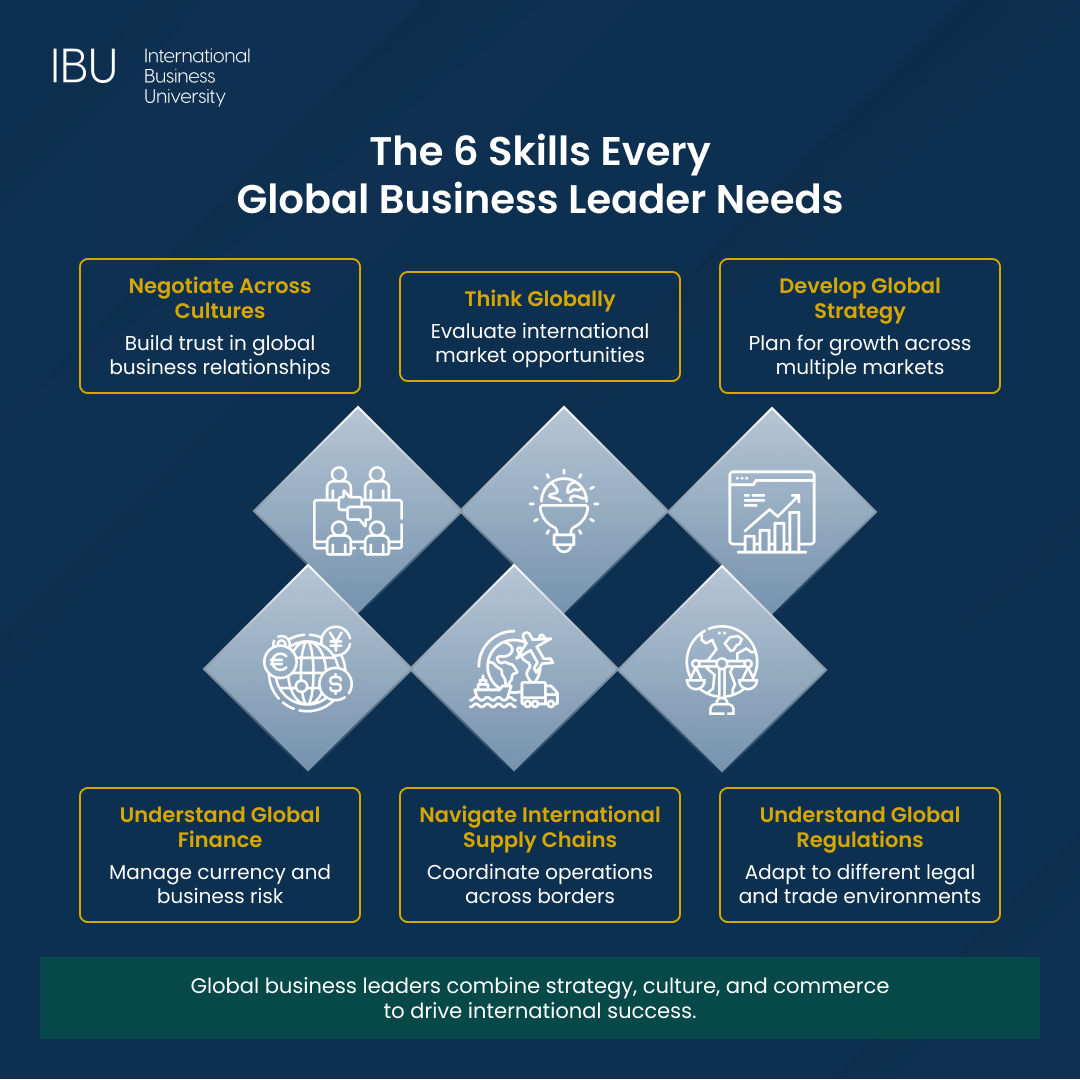
Global business leaders combine strategy, culture, and commerce to drive international success, applying all six skills as one connected capability rather than six separate ones.
How the Curriculum Builds Cross-Border Judgment
The coursework formation moves from framework to applied practice across a series of core courses.
- International business strategy: Covers market entry models, competitive positioning across regions, and how companies formulate decisions across multiple regulatory environments.
- Global negotiation: Builds practiced skill in cross-cultural negotiation through applied exercises and simulated cross-border deal scenarios, not lecture alone.
- International finance: Covers currency exposure, cross-border capital decisions, and financial risk management.
- Applied capstone: Requires students to build a market entry or expansion recommendation for a live business scenario.
The capstone project gives graduates a concrete example of applied cross-border strategy to reference directly in interviews.
How This Differs From International Business Electives
A single international business elective introduces concepts without the applied practice that builds working fluency. A full specialization repeats and layers these skills across multiple courses, which is what separates surface familiarity from working competence.
Employers hiring for cross-border roles can usually tell the difference between the two during an interview.
Prepare for Leadership Roles That Cross Borders
IBU’s MBA in Global Business Management builds cross-border strategy and negotiation directly into coursework.
What Employers Look For in Global Business Management Graduates
Hiring managers for international roles screen for specific evidence beyond the degree title itself, since the specialization name alone does not confirm applied skill.
- Language exposure: Fluency or working proficiency in a second language strengthens a candidate’s profile for most cross-border roles.
- Cross-cultural project experience: Any project involving international teams or markets, academic or professional, demonstrates applied readiness.
- Regulatory literacy: Familiarity with how trade regulation and compliance differ across the regions a company operates in, including tariff structures and local labour law.
Candidates who can speak to a specific cross-border project stand out clearly from candidates who only list the specialization on a resume.
Industries Where This Specialization Carries the Most Weight
Cross-border training matters more in some sectors than others, and candidates benefit from targeting these industries directly.
- Manufacturing and logistics: Companies with multi-country supply chains value candidates who understand cross-border regulatory complexity firsthand.
- Financial services: International banks and investment firms need managers fluent in cross-border capital and currency decisions.
- Consulting: Firms advising on international expansion hire directly for the market entry and negotiation skills this specialization builds.
Graduates targeting these sectors can point to the specialization as a direct match rather than a general credential.
Key Takeaways

Built for cross-border work: the specialization concentrates coursework in trade regulation, negotiation, and currency risk that a general MBA only touches briefly.
Career paths are specific: international business development, global supply chain management, and cross-border consulting roles reward this training directly.
Applied practice matters: a capstone project gives graduates a concrete cross-border case to reference in interviews.
Fit depends on goals: professionals targeting international or multinational roles benefit most, more than those planning to stay in a single domestic market.
Frequently Asked Questions
What is the difference between an MBA in global business management and a general MBA?
Global business management concentrates coursework in cross-border strategy, cultural negotiation, and currency risk. A general MBA covers management theory that applies broadly without this international focus.
Who should consider a global business management specialization?
Professionals targeting international assignments, cross-border roles, or multinational employers benefit most directly. Founders planning international expansion also gain direct value from this specialization.
What careers can I pursue with a global business management MBA?
Common paths include international business development, global supply chain management, and cross-border strategy consulting. Each role rewards the specific cross-cultural and regulatory fluency this specialization builds.
Does this specialization require fluency in another language?
A second language is not required, but working proficiency strengthens a candidate’s profile for most cross-border roles. Employers view language exposure as one signal of cross-cultural readiness among several.
Is IBU's Global Business Management MBA available fully online?
The specialization is delivered fully online with structured academic support throughout the program.
Which industries value a global business management MBA most?
Manufacturing, logistics, financial services, and consulting firms with international operations value this specialization most directly. These industries regularly hire for the market entry and cross-border negotiation skills the program builds.
How is this specialization different from a standard international business elective?
A single elective introduces concepts without the applied practice this specialization repeats across multiple courses. That repetition is what separates surface familiarity from working competence employers can evaluate directly.
Can this specialization be combined with a finance or technology focus?
Some programs allow cross-border electives alongside a finance or technology concentration, though the core global business management sequence typically remains fixed. Confirm elective flexibility directly with the program before enrolling.
Where Global Business Management Leads Next
Global business management adds a specific cross-border layer that a general MBA does not cover in depth. Graduates who pair this specialization with a concrete cross-border project enter the job market with evidence employers in international roles are actively looking for.
The specialization works best as a deliberate choice tied to a specific career direction, not a general interest in international business.
Build the Cross-Border Skill Set Global Employers Look For
Learn how IBU’s MBA in Global Business Management prepares graduates for international roles.