

Canadian manufacturers are adopting artificial intelligence in manufacturing systems at a pace that has outrun the supply of engineers who can implement and manage them.
The result is a hiring gap that is particularly visible in three areas: quality inspection automation, predictive maintenance systems, and production optimization using real-time data. These are not experimental deployments; they are operational systems running in production facilities across Ontario, Quebec, Alberta, and British Columbia that need qualified engineers to operate, maintain, and continuously improve them.
The Canadian Manufacturers and Exporters Association’s reporting on AI in manufacturing identifies artificial intelligence adoption as one of the most significant transformations underway in the sector, and the shortage of professionals who can bridge traditional manufacturing knowledge and AI implementation capability as one of the primary constraints on that adoption.
What Artificial Intelligence in Manufacturing Looks Like as a Day Job
The day-to-day reality of an AI role in a manufacturing environment is different from both the software industry AI job and the research lab AI job that most graduate students imagine.
Production Floor Data Acquisition
AI systems in manufacturing depend on reliable, clean data from the production environment, sensor readings from equipment, vision system outputs, quality measurement data, and environmental conditions. A significant portion of applied AI work in manufacturing involves ensuring that this data is collected correctly, transmitted reliably, and processed in a format that models can use. This data engineering dimension of the role is unglamorous but essential.
Model Deployment and Monitoring
Machine learning models deployed in production manufacturing environments need continuous monitoring. Model performance degrades as conditions change, equipment wears, materials vary, and environmental conditions shift. MSc graduates working in AI manufacturing roles spend meaningful time on model monitoring, retraining, and validation, not just on initial model development.
Cross-Functional Communication
Manufacturing AI roles require constant communication between the AI team, the maintenance team, the quality team, and production management. MSc graduates who can explain what an anomaly detection model is actually detecting to a maintenance supervisor, or why a computer vision system is generating false positives to a quality manager, are significantly more effective than those who communicate only in technical terms that the operations team cannot interpret.
The Industrial Automation Roles Canadian Manufacturers Cannot Fill Fast Enough
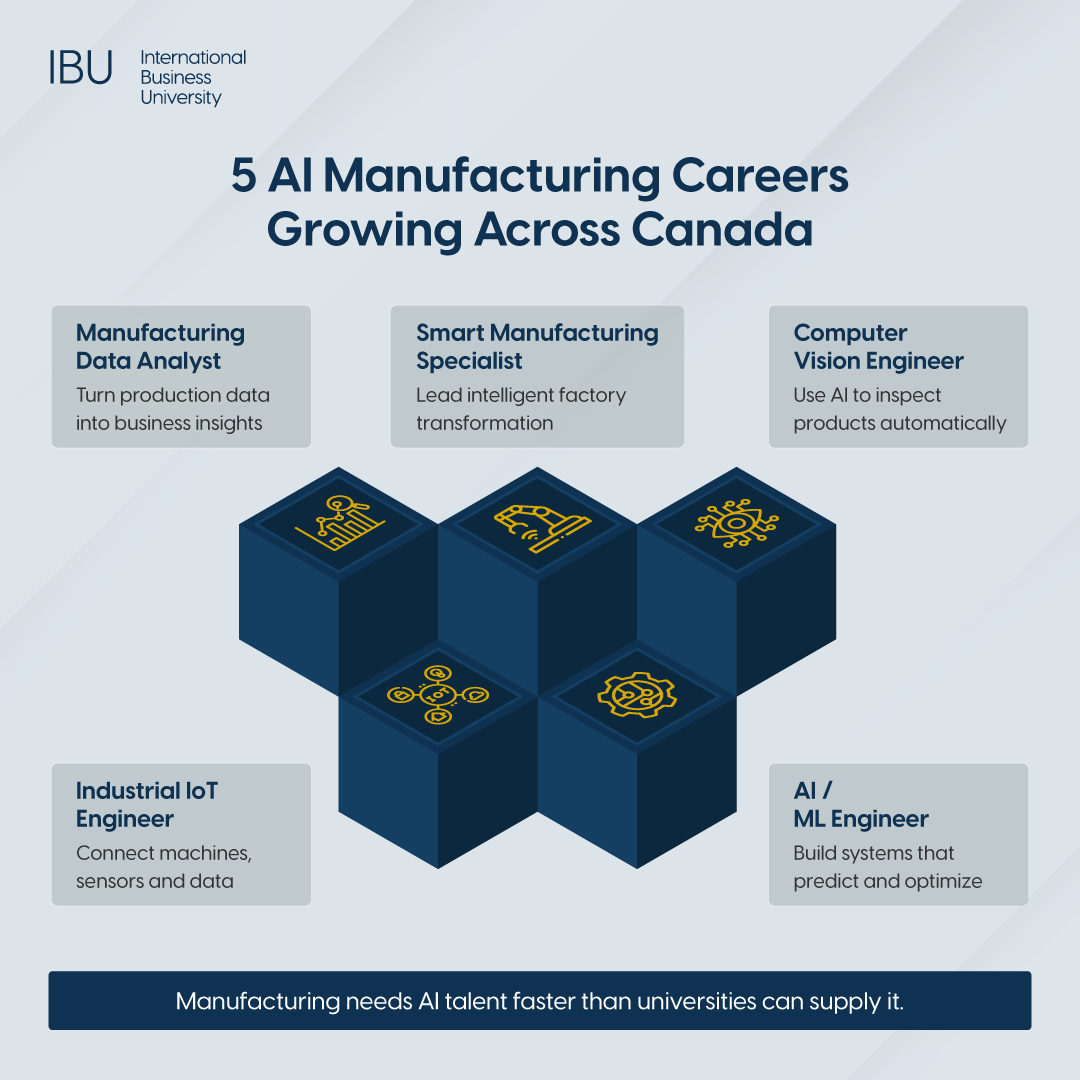
The specific role titles that Canadian manufacturers are actively hiring for at the intersection of AI and industrial automation include:
- Manufacturing Data Analyst: Analyzes production data to identify efficiency opportunities, quality patterns, and operational anomalies. Typically, the entry point for MSc graduates in manufacturing environments.
- AI/ML Engineer, Manufacturing: Builds and deploys machine learning models for predictive maintenance, quality inspection, and production optimization. Requires both ML model development skills and understanding of manufacturing operational contexts.
- Computer Vision Engineer: Specializes in vision-based quality inspection and object detection systems. High demand across food processing, automotive, and electronics manufacturing.
- Industrial IoT Engineer: Manages the sensor networks, data acquisition infrastructure, and edge computing systems that feed AI models in manufacturing environments.
- Smart Manufacturing Specialist: A broader integration role managing the full technology stack of an intelligent manufacturing environment, automation systems, AI models, data infrastructure, and MES integration.
How AI in Production Differs From What Most Engineering Programs Teach
Traditional mechanical and electrical engineering programs teach students to design, build, and maintain production systems. They do not typically teach students to build the AI layers that modern intelligent manufacturing systems require.
Traditional computer science and data science programs teach machine learning theory and tool skills. They do not typically teach students to operate in the physical, regulatory, and safety-constrained environment of a production facility.
The gap between these two educational traditions is exactly where applied AI manufacturing roles sit, and it is why graduates who bridge both worlds through programs like IBU’s MSc in Applied AI (Industrial Innovation) are more competitive than those coming from either side alone.
What MSc in Applied AI Students Are Trained to Build and Deploy in This Field
IBU’s MSc in Applied AI (Industrial Innovation) builds the specific technical and applied capabilities that manufacturing AI roles require.
- Real-time data pipeline design for sensor and production system data
- Computer vision model development for quality inspection applications
- Predictive maintenance model building using equipment sensor time series data
- Edge computing deployment for AI inference in bandwidth-constrained production environments
- Integration of AI model outputs with manufacturing execution systems (MES) and ERP platforms
The program’s applied project structure means students build these capabilities in simulated and real production contexts, not in purely academic settings. The portfolio of work produced during the program is directly relevant to the technical screening process at Canadian manufacturing employers.
Smart Manufacturing: The Capstone Projects IBU Students Take Into Industry
The Next Generation Manufacturing Canada (NGen) smart manufacturing program provides a useful frame for understanding the scope of intelligent manufacturing in Canada. NGen has funded over 100 smart manufacturing projects across the Canadian industry, covering AI-based quality inspection, autonomous guided vehicles, digital twin implementation, and predictive maintenance systems.
IBU’s capstone projects in the Industrial Innovation stream are designed around the same categories of implementation challenge that NGen and Canadian manufacturers are actively investing in. Students who complete these capstone projects graduate with demonstrated capability in areas that are directly aligned with open Canadian manufacturing roles.
See If You Qualify for an Applied AI MSc
Review admission requirements before choosing your AI pathway.
Why a Manufacturing Data Analyst Role Is Where Most MSc Grads Start
The manufacturing data analyst role is the most accessible entry point for MSc graduates without direct manufacturing industry experience. It requires strong data skills, enough manufacturing process understanding to interpret production data meaningfully, and the communication skills to present analytical findings to operational teams who are not technically oriented.
Most manufacturing data analyst roles convert into broader AI engineering roles within 12 to 24 months as the graduate builds manufacturing operational knowledge and demonstrates their ability to build and deploy models that produce measurable production improvements.
The career trajectory from manufacturing data analyst to AI/ML engineer to senior AI engineer or smart manufacturing lead is well-established at most major Canadian manufacturers and typically takes four to seven years for graduates who progress consistently.
Key Takeaways

Canadian manufacturing has an AI talent gap: The pace of AI adoption in manufacturing has outpaced the supply of graduates who can implement and manage production AI systems.
Roles are operational, not research-oriented: AI manufacturing jobs involve deploying, monitoring, and maintaining production systems, not building novel research algorithms.
Cross-functional communication is as important as technical skill: MSc graduates who can explain AI system behavior to non-technical manufacturing teams are significantly more effective than those who communicate only in technical terms.
Manufacturing data analyst is the most accessible entry point: This role builds the production context understanding that more senior AI engineering roles require, and typically converts within 12 to 24 months.
Frequently Asked Questions
Do I need manufacturing experience to get an AI job in manufacturing?
Entry-level manufacturing data analyst and junior AI engineer roles usually do not require direct manufacturing experience. It’s because they focus more on strong technical skills and relevant MSc projects. They also need the ability to learn the manufacturing context on the job, while operational experience becomes more important for mid-senior roles.
What is the salary range for AI roles in Canadian manufacturing?
Entry-level manufacturing data analyst and junior AI engineer roles in Canadian manufacturing typically start at $70,000 to $90,000. Senior AI/ML engineer roles command $95,000 to $130,000. Smart manufacturing leads and AI program managers at major manufacturers earn $120,000 to $160,000 or more, depending on the organization’s scale and the program’s complexity.
Which Canadian cities have the most manufacturing AI jobs?
Ontario, particularly the Windsor-London-Toronto corridor, has the highest concentration of manufacturing AI jobs driven by the automotive sector. The Greater Vancouver area has significant food processing and electronics manufacturing AI hiring. Calgary and Edmonton have active mining and energy sector AI roles with industrial automation components. Quebec’s aerospace and pharmaceutical manufacturing base generates AI hiring in Montreal and the surrounding industrial regions.
Manufacturing Is Where AI Produces Measurable Industrial Impact
Artificial intelligence in manufacturing is not a future aspiration for Canadian industry. It is a current operational reality that is generating consistent hiring demand for graduates who combine AI technical capability with industrial context understanding.
The MSc graduates who enter this field early, while the talent gap is widest and the career trajectory most open, build careers that compound in value as manufacturing AI adoption deepens and the organizational knowledge they accumulate becomes increasingly differentiated.
Build AI Skills for Smart Manufacturing Roles
Prepare for industrial AI and automation careers.