
Delegation means assigning ownership of a task, along with the power to make decisions about it, to someone else. It is different from simply handing off work. A manager who delegates a task but still makes every decision within it has not actually delegated anything. They have created extra reporting overhead for themselves.
Learning how to delegate effectively starts here: new managers consistently underuse this skill, often because letting go of control feels riskier than doing the work themselves. The cost shows up later, in the form of a manager who cannot take on more responsibility because their calendar is already full of tasks someone else could have owned.
Key Takeaways
Here is what separates delegation that works from delegation that creates more problems than it solves.

Effective delegation transfers both the task and the authority to make decisions about it, not just the labor involved.
Most new managers delegate too late and too little, which limits their own capacity to take on higher-value work.
BCOM and MBA programs build delegation capability through project-based learning, where students must assign roles and trust teammates to deliver.
Why Delegation Is the Management Skill Most Leaders Develop Too Late
Most professionals are promoted into management because they were excellent individual contributors. That same instinct, doing the work well themselves, becomes a liability once their job is to lead a team rather than complete tasks personally.
New managers often delay delegation for a few predictable reasons, all of which feel reasonable in the moment and become costly over time.
- Explaining feels slower than doing: It genuinely does take longer to explain a task than to complete it once, which makes delegation look like the wrong trade-off in the short term.
- The short-term math is misleading: That time comparison only holds for a single instance of the task, not for the tenth or twentieth time someone else could have owned it instead.
- Every kept task caps future capacity: A task a manager keeps for themselves is a task their team never learns to own, which limits how much responsibility that manager can take on later.
- The cost is invisible until it compounds: None of this shows up as a problem in any single week, which is exactly why it goes unaddressed until a manager’s calendar is already full of work someone else should own.
What Effective Delegation Actually Looks Like in a Canadian Workplace
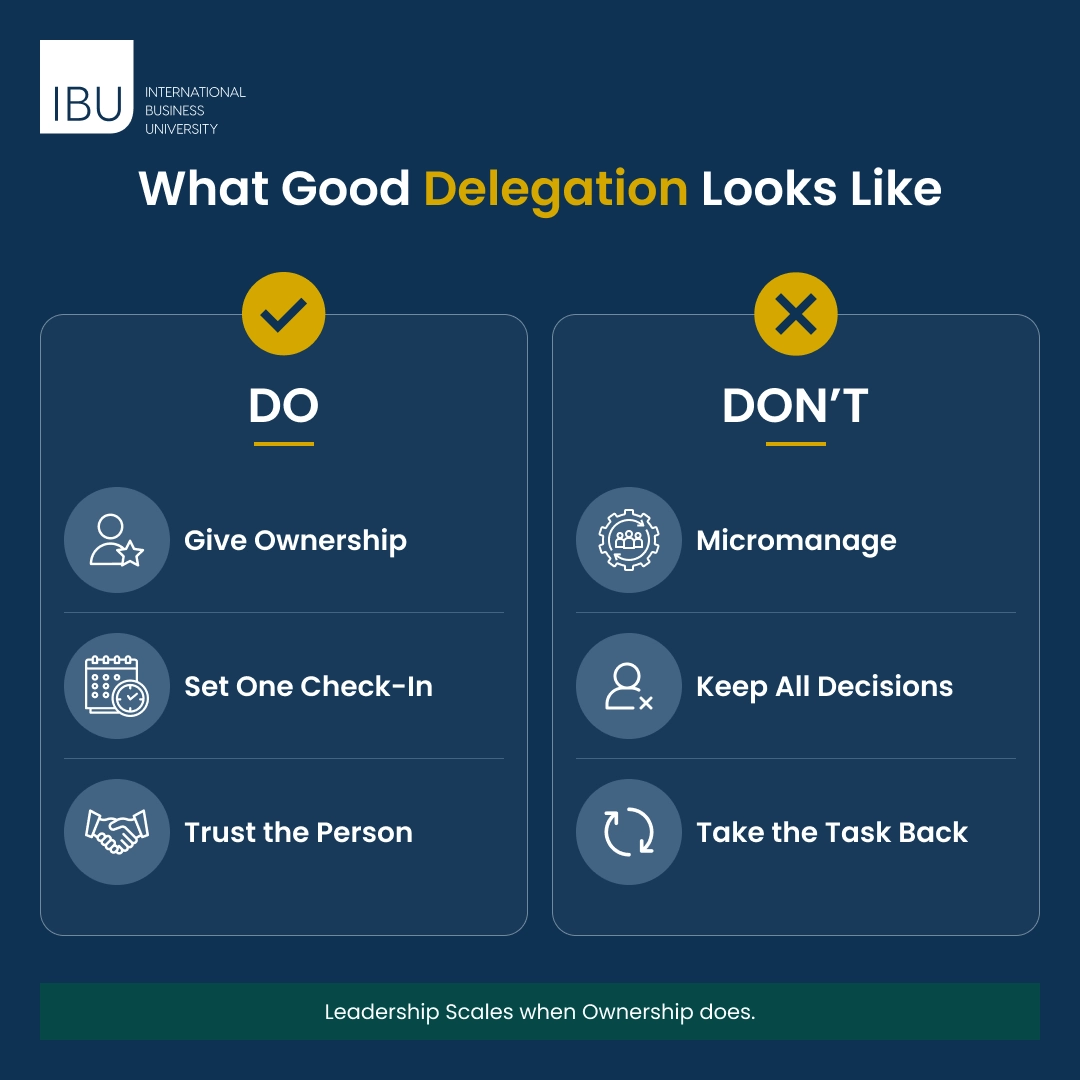
The delegation examples below follow a consistent pattern regardless of industry. A manager identifies a task suited to a specific team member’s skill level, explains the desired outcome clearly, sets a check-in point, and then steps back from the details. The failure pattern looks different, and it is worth naming both side by side.
- Match the task to the person: Effective delegation starts with a task suited to the team member’s current skill level, not just whoever happens to be available.
- Explain the outcome, not just the ask: A manager who delegates well describes what success looks like and leaves room for the person to decide how to get there.
- Set one check-in, then step back: A single agreed check-in point replaces the need for constant monitoring, which is what actually frees up a manager’s time.
- Handing off without context fails quietly: The failure pattern starts the same way, a task changes hands, but without the outcome or the reasoning behind it.
- Anxious check-ins undo the delegation: Constant, unscheduled check-ins signal a lack of trust and often end with the manager doing half the work through correction anyway.
- Employees notice the difference: This second pattern is common enough that many employees describe it as “delegation in name only,” and it damages trust on both sides faster than simply keeping the task in the first place.
5-Step Delegation Framework BCOM and MBA Graduates Are Taught to Use
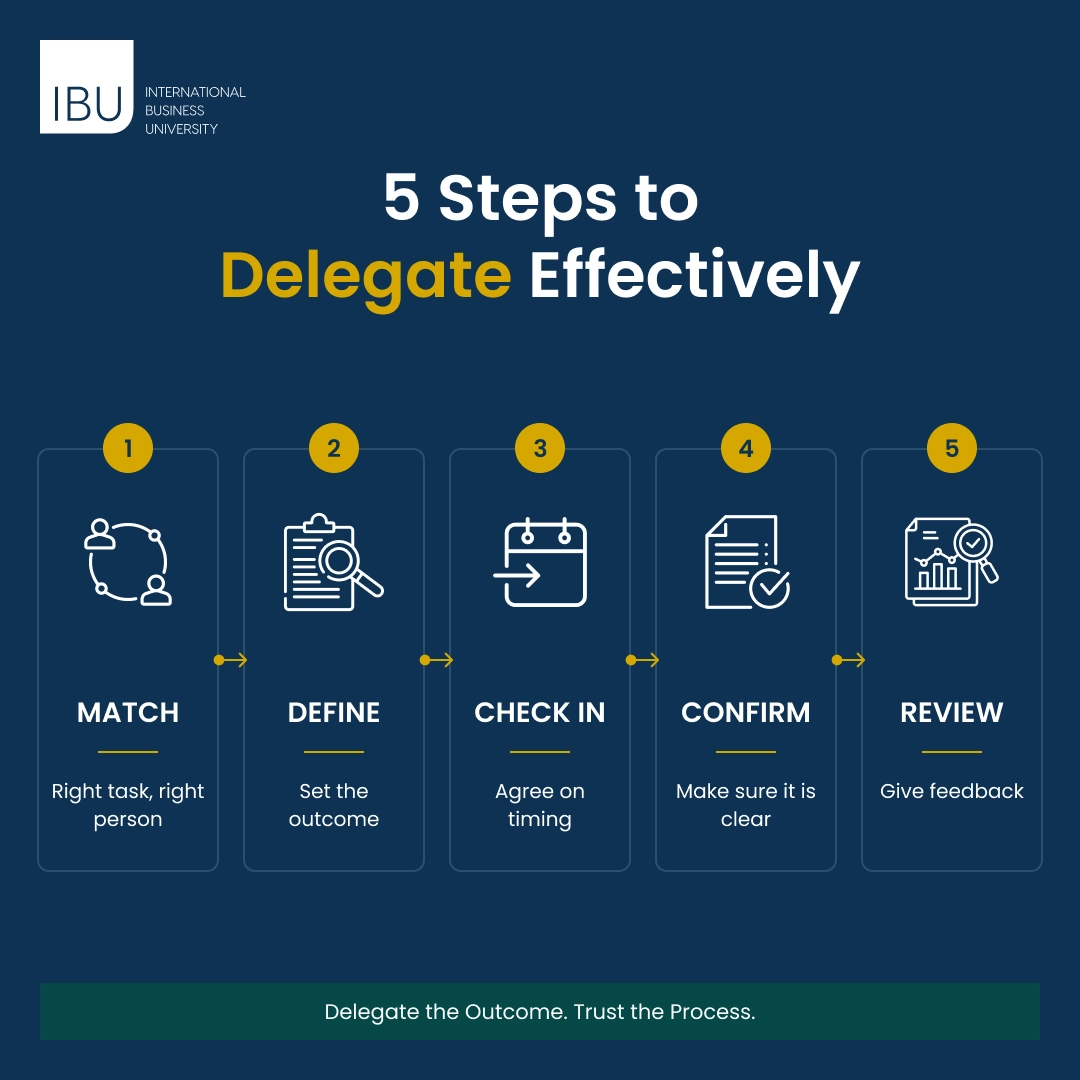
The pattern above is recognizable in practice; IBU’s business curriculum breaks it down into a defined five-step sequence rather than treating it as instinct.
- Match the task to skill level. Assign work that stretches the person slightly, rather than tasks that are either trivial or far beyond their current ability.
- Define the outcome, not the method. State what success looks like and leave the approach to the person doing the work.
- Set a check-in cadence in advance. Agree on when support will be provided so oversight doesn’t become constant or arbitrary.
- Confirm understanding before work begins. Ask the person to restate the task in their own words to catch gaps early.
- Review the result against the original outcome. Give feedback on what was achieved, not just on process choices made along the way.
Build Practical Management Skills Early
Learn delegation, teamwork, and leadership through applied projects.
Common Delegation Mistakes New Managers Make and How to Avoid Them
In delegation and management, a few mistakes appear so often they are worth naming directly.
- Delegating only the tasks nobody wants, which teaches the team that delegation means being handed the least valuable work.
- Micromanaging after delegating, which erases the time savings delegation was supposed to create.
- Failing to delegate authority along with the task, leaving the person unable to make necessary decisions without approval.
- Assuming delegation failed after one attempt, rather than adjusting the framework and trying again with better instructions.
Each of these mistakes is fixable with awareness, which is why delegation training focuses heavily on recognizing these patterns before they become habits. Many of these mistakes also trace back to emotional intelligence in leadership, since managing the discomfort of letting go requires the same self-awareness that emotional intelligence training builds.
How IBU Programs Use Project-Based Learning to Build Delegation Capability
Group projects create a low-risk environment to practice delegation, because students must assign roles, trust teammates with legitimate deliverables, and manage the outcome without doing every part themselves. Students who try to control every element of a group project typically produce worse results than those who divide the work according to each teammate’s strength.
This practical exposure connects directly to the broader set of management skills for BCOM and MBA graduates, and it pairs closely with adaptability at work, since both skills require a manager to let go of a single fixed approach and trust a process instead.
Frequently Asked Questions
Why do managers struggle with delegation even when they know they should do it?
Most managers struggle because delegation feels slower and riskier in the short term than completing a task themselves. The discomfort comes from losing direct control over how the work gets done, not from a lack of understanding that delegation is valuable. Building trust in a team’s ability takes deliberate practice, not just awareness of the concept.
What is the difference between delegation and assignment in management?
Assignment typically means handing someone a task with fixed instructions on exactly how to complete it. Delegation includes transferring the authority to decide how the task gets done, within a defined outcome. This difference in authority is what makes delegation in management more effective for developing a team’s capability over time.
How do you know what to delegate and what to keep?
Tasks that require your specific expertise, involve sensitive decisions, or develop someone else’s skills when handed off are good candidates for delegation. Tasks that are urgent, high-stakes, and require your unique authority are better kept, at least initially. A useful test is asking if someone else completing this task with reasonable guidance would meet the standard required.
Does an MBA actually teach you how to delegate or is it just theory?
Strong MBA programs teach delegation through applied group projects and leadership case studies, not just lecture-based theory. Students practice assigning roles, managing team dynamics, and evaluating outcomes under deadline pressure. This applied practice is what makes the skill transferable to an actual workplace.
Turning Delegation Into a Leadership Multiplier
Leadership delegation stops being a weakness the moment a manager treats it as a repeatable skill rather than a personal risk. Start with one task this week that you have been holding onto out of habit, and hand it off using a clear outcome and a defined check-in point. Check if the result meets the standard you expected, and adjust your instructions rather than your willingness to delegate again. Managers who build this habit early free up the time that eventually lets them take on bigger responsibility.
Start Building Leadership Skills That Scale
Apply to IBU and practice management skills through real business projects.