
Applied AI takes existing machine learning and AI methods and deploys them inside an authentic operational context: a fraud detection system at a bank, a diagnostic support tool at a hospital, or a predictive maintenance system at a manufacturing plant. The discipline is defined by its outcome, a working system that delivers a concrete business result, rather than by novel research.
This distinction matters for anyone choosing a graduate program. A theoretical AI research path suits someone aiming for an academic or research lab career. An applied AI path suits someone who wants to build and deploy systems inside industry, and most artificial intelligence careers Canada currently offers are concentrated exactly there.
Key Takeaways
Here is where applied AI creates the most career opportunity in Canada right now.

Applied AI focuses on deploying AI systems inside legitimate business operations, distinct from theoretical AI research aimed at academic contribution.
Financial services and healthcare are among the fastest-growing sectors for applied AI hiring in Canada, each with distinct use cases and skill requirements.
An MSc in Applied AI differs from a computer science or data science degree by combining technical depth with industry-specific application training.
What Applied AI Means as a Discipline Versus Pure Research AI
Pure research AI advances the underlying methods behind machine learning applications: new model architectures, new training techniques, new theoretical understanding of how these systems work. It is typically conducted in universities, national research labs, or the research divisions of major technology companies, and success is measured through publications and academic recognition.
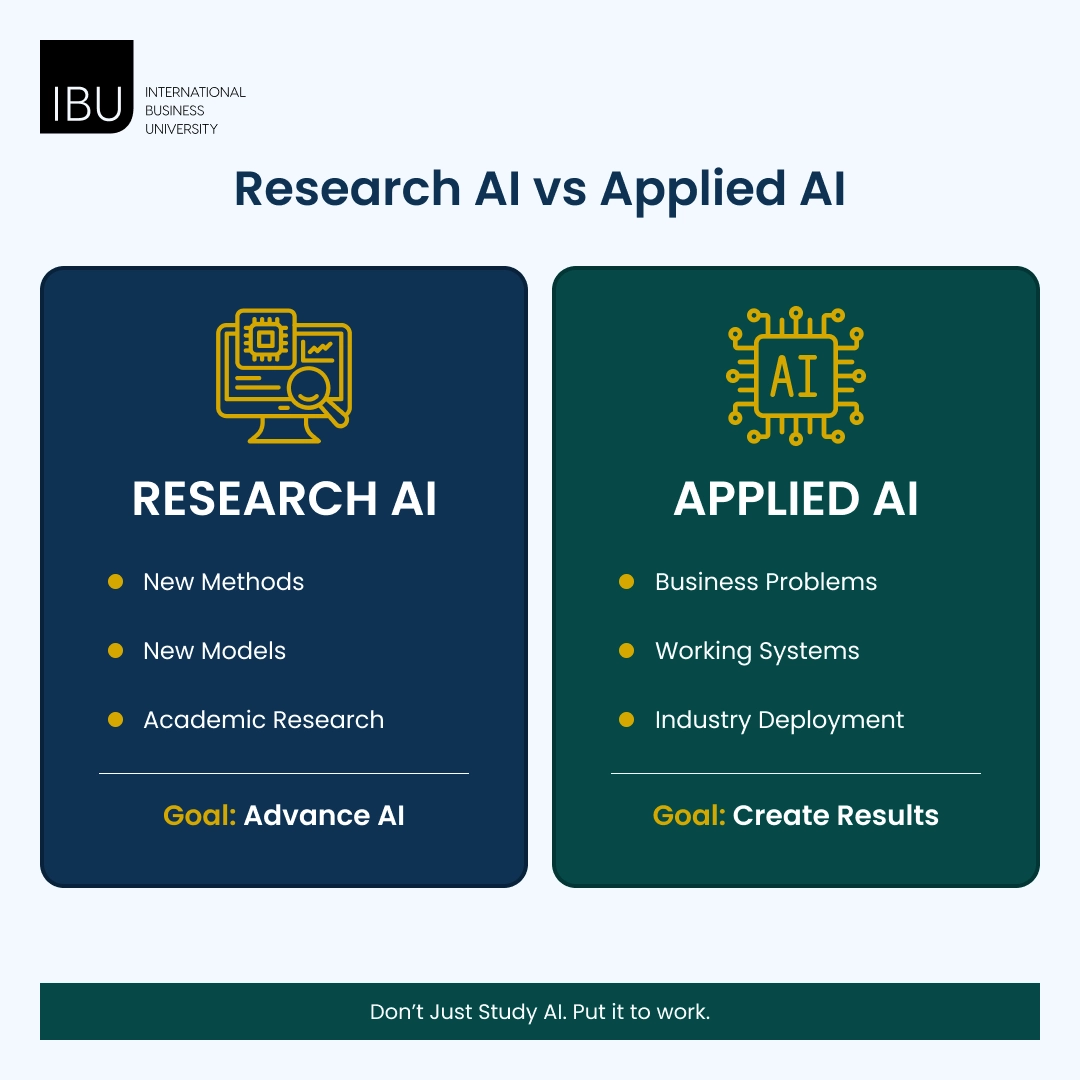
The two disciplines diverge across several dimensions of the work itself:
- Starting point: Pure research begins with an open question about how a model or algorithm behaves. Applied AI begins with a business constraint, such as a process that is too slow, too costly, or too inconsistent to scale.
- Validation method: Pure research is validated through peer review, benchmark performance, and citation by other researchers. Applied AI is validated through uptime, error rate, cost per transaction, and use by the people the system was built for.
- Institutional home: Pure research is concentrated in university labs, national research institutes, and the research divisions of large technology companies. Applied AI work is distributed across nearly every industry, including finance, healthcare, logistics, and retail.
- Public investment pattern: Canada funded pure research first, through CIFAR and its national institutes, then built a second, larger funding stream aimed at commercialization and industry adoption once the research base was established.
- Time horizon: Pure research can take years to move from a published paper to a working tool. Applied AI operates on shorter cycles, often months, because it answers to a production deadline or a budget.
- Core skill set: Pure research depends on advanced mathematical and statistical training and the ability to construct new experiments. Applied AI depends on systems thinking, integration with existing infrastructure, and the ability to translate a technical result into a decision a business can act on.
Build Skills for Applied AI Roles
Learn how AI systems solve legitimate business and industry problems.
Most AI-related hiring outside dedicated research labs falls into the applied category, since organizations need staff who can put existing models to work inside a specific operational context.
That distinction explains why applied AI programs are created around industry casework rather than pure theory: the discipline is defined by adapting known methods to a problem, not by inventing new ones.
Canada’s own funding shift, from a decade of research investment toward a decade of commercialization investment, tracks the same distinction at a national scale. These are the skills a research career requires and the skills an applied career requires are different enough that the country funds them as two separate phases of the same strategy.
The Canadian Industries Deploying Applied AI at the Highest Rate Right Now
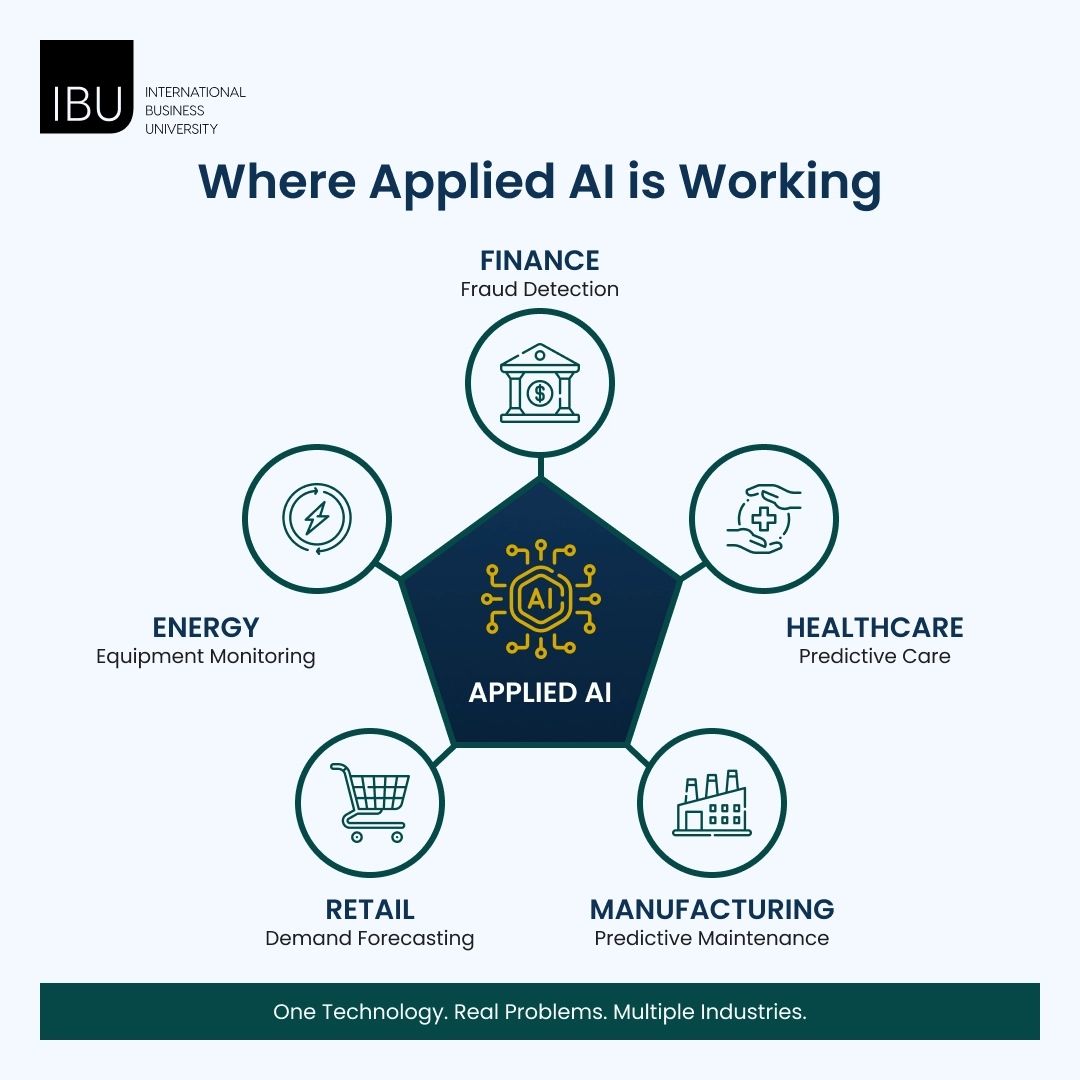
Several sectors in Canada have moved well past AI experimentation into active deployment. Statistics Canada reports that AI use among Canadian businesses nearly tripled between the second quarter of 2024 and the second quarter of 2026, climbing from 6.1 percent to 19.2 percent, with finance and insurance among the sectors posting the highest adoption rate at 40.4 percent.
- Financial services: Fraud detection, credit risk modeling, and algorithmic trading support.
- Healthcare: Diagnostic support tools, predictive analytics for patient risk, and administrative automation.
- Manufacturing and logistics: Predictive maintenance, supply chain forecasting, and quality control automation.
- Retail and e-commerce: Demand forecasting, recommendation systems, and dynamic pricing.
- Natural resources and energy: Equipment monitoring and predictive maintenance in remote or high-cost operating environments.
AI industry applications vary widely, and each of these sectors hires applied AI specialists for a different reason, but the underlying skill set, translating a business problem into a data problem and back again, remains consistent across all of them.
Financial Services and AI: The Roles MSc Graduates Are Being Hired For
Financial services remains one of the most active hiring sectors for applied AI in Canada, driven by fraud detection, credit modeling, and regulatory reporting demands. Regulatory oversight adds a layer most applied AI work doesn’t face: OSFI’s Guideline E-23 sets out a principles-based model risk management framework covering both traditional and AI-driven models, with federally regulated banks and insurers expected to comply by May 2027.
- Data scientist: Builds and tests the fraud detection and credit risk models a bank’s risk division relies on, typically working from transaction-level data to flag anomalies or score default risk.
- Quantitative analyst: Develops and validates the statistical models behind credit decisions and trading strategies, with documentation built to hold up under regulatory review.
- Machine learning engineer: Moves a validated model from a research environment into a production system that runs against live transactions, then maintains it once deployed.
Across all three roles, the technical build sits inside a governance structure. MSc graduates work alongside compliance and risk management teams from the outset, since regulator-facing documentation is part of the deliverable rather than an afterthought.
Choose Your Applied AI Specialization
Focus your graduate study around data systems or industrial AI.
Healthcare AI: Where MSc Applied AI Graduates Are Closing a Significant Talent Gap
Healthcare has been slower to adopt AI at scale than financial services, held back by data privacy requirements, the higher stakes of clinical error, and a formal regulatory review step: Health Canada’s pre-market guidance classifies and reviews machine learning-enabled medical devices before clinical use. That combination has left a shortage of graduates who understand AI methods alongside the clinical and regulatory context healthcare requires.
- Diagnostic support tools: Graduates build models that flag findings in imaging or lab data for a clinician to review, working within Health Canada’s software-as-a-medical-device classification rather than deploying a model directly to patients.
- Administrative automation: Graduates apply AI to scheduling, records processing, and claims workflows, where the stakes are operational rather than clinical and adoption has moved faster as a result.
- Predictive analytics for patient outcomes: Graduates build risk models that flag patients likely to need earlier intervention, developed alongside clinical staff who validate the model’s output against patient histories before it is trusted in practice.
- Data governance and integration: Graduates work on the pipelines connecting hospital, laboratory, and administrative data sources, a task made harder by the jurisdictional inconsistencies the Pan-Canadian Health Data Strategy was created to address.
The gap is also a data problem before it is an AI problem. The Public Health Agency of Canada’s Pan-Canadian Health Data Strategy identifies restrictive access to health data, inconsistent data standards across provinces, and a lack of shared identifiers as barriers that keep health data from being converted into usable analytics. Closing the talent gap means training graduates who can work inside those constraints rather than around them, building pipelines that hold up across jurisdictions with different privacy rules and different data formats.
Each of these paths depends on data infrastructure built before any model is trained. That progression follows directly from the data engineering work covered in a data engineering roadmap in an MSc AI program, which prepares graduates to build the systems healthcare AI depends on before a model can be trained reliably.
What Makes IBU’s MSc in Applied AI Different From a CS or Data Science Degree
A traditional computer science degree builds broad software engineering skills, with AI as one specialization among many. A data science degree focuses heavily on statistical modeling and analysis, often with less emphasis on deployment and system integration.
IBU’s MSc in Applied AI is built around two focused pathways spanning industrial AI and data infrastructure work, Industrial Innovation and Data Engineering, so students develop depth in a specific career direction rather than a broad, general AI foundation.
- Industrial Innovation pathway: Focuses on applying AI methods inside an existing business or industrial process, from problem framing through to a deployed solution a partner organization can use.
- Data Engineering pathway: Focuses on the infrastructure AI systems depend on: pipelines, data quality, and the systems work required before a model can be trained or deployed at all.
- Applied project work: Both pathways are built around industry partnerships and applied projects rather than a traditional thesis, so the capstone experience produces a working system rather than a paper.
The two-pathway design mirrors a broader hiring trend documented across the AI solutions architect career path for MSc graduates, where employers increasingly prefer specialists who can own a specific part of the AI deployment pipeline rather than generalists with surface-level exposure to every technique.
A computer science graduate typically leaves with broad exposure to systems, networking, and software design, of which AI is one unit among several. A data science graduate typically leaves with strong statistical training but limited exposure to production systems, deployment infrastructure, or the industry constraints a business problem introduces.
IBU’s applied structure is built to close that gap directly, so graduates move into a specific applied role rather than needing additional training once hired.
Frequently Asked Questions
What is the difference between applied AI and theoretical AI research as a career?
Applied AI careers focus on deploying existing AI methods to solve specific business problems inside an organization. Theoretical AI research careers focus on advancing the underlying science, typically within academic or dedicated research settings. Most industry hiring in Canada falls into the applied category.
Is an MSc in Applied AI worth it in Canada or is self-learning sufficient?
Self-learning can build technical skill, but a proper MSc program adds credential recognition, applied project experience, and direct exposure to industry casework that is harder to replicate independently. An MSc in applied AI in Canada combines a recognized credential with demonstrated project experience, which is what most hiring managers value in applied AI roles
What industries in Canada are hiring applied AI specialists most aggressively?
Among AI jobs Canada currently supports, financial services, healthcare, manufacturing, and logistics show the strongest and most consistent applied AI hiring activity. Each sector has distinct use cases, from fraud detection in finance to predictive maintenance in manufacturing. Retail and energy are also growing steadily as adoption expands.
Can someone with a business background get into applied AI roles in Canada?
This is most achievable in roles that combine AI oversight with business strategy, such as AI product management or AI-focused business analysis. A graduate program that builds technical AI literacy alongside a business background can open these hybrid roles. Fully technical roles, such as machine learning engineering, typically still require deeper technical training.
Choosing the Industry Path That Fits Your Applied AI Career
Applied AI offers a wide enough range of industry applications that the right career path depends heavily on which sector’s problems interest you most, not just which technical skills you want to build. Financial services offers a proper, well-resourced entry point, while healthcare offers a clearer talent gap and mission-driven work with slower but steady adoption. Before choosing a specialization, research the specific use cases within your target industry and confirm the program you choose builds skills aligned to that direction. Graduates who enter the job market with a clear industry focus consistently move through interviews faster than those presenting themselves as AI generalists.
Start Your Applied AI Career Path
Apply to IBU and build graduate skills for AI roles in Canada.