

A healthcare project manager plans, coordinates, and delivers complex initiatives inside hospitals, clinics, health systems, and life sciences organizations, guided by the project management in healthcare best practices that define how those initiatives succeed. This role combines structured project execution with deep healthcare knowledge, regulatory awareness, and stakeholder coordination. If you want a career that blends healthcare and project management while creating measurable impact, this guide explains how to become a healthcare project manager step by step.
Key Takeaways
- Healthcare project managers combine formal project management training with healthcare system knowledge.
- Education, certifications, and hands-on experience shape long-term career growth.
- Strong technical skills and people skills determine success in healthcare project management roles.
Basic Educational Requirements
Education builds the foundation for a healthcare project manager by developing analytical thinking, communication discipline, and systems awareness. While no single degree guarantees entry, structured education improves credibility, mobility, and long-term earning potential.
Bachelor’s Degree in Relevant Fields
Most professionals begin with a bachelor’s degree in healthcare administration, business management, public health, information systems, or nursing. These programs develop baseline skills in operations, communication, finance, and organizational structure.
A bachelor’s degree supports entry into project management careers in healthcare by demonstrating readiness for structured work, documentation, and stakeholder coordination.
Master’s in Healthcare Administration
A master’s degree deepens understanding of healthcare operations, policy, finance, and leadership. Programs in healthcare administration help bridge clinical environments with management systems.
Many healthcare project managers pursue graduate education to accelerate advancement into senior roles and system-wide initiatives.
Build leadership foundations for healthcare management
Healthcare leadership demands structured thinking, operational clarity, and execution discipline. Undergraduate business education supports early career growth in healthcare and project management roles.
PMP Certification Prerequisites
The Project Management Professional credential represents an advanced standard for managing complex initiatives. It requires documented project leadership experience, formal education hours, and successful completion of a rigorous exam. These prerequisites make sure that candidates understand not only frameworks, yet also real-world execution under constraints.
For a healthcare project manager, PMP preparation builds capability across areas that directly affect care environments:
- Documented project experience
Candidates must show experience leading projects through initiation, planning, execution, monitoring, and closure, which mirrors how healthcare initiatives move from concept to implementation. - Formal project management education hours
Training hours reinforce standardized practices for scope definition, scheduling, budgeting, and risk control that healthcare organizations expect during audits and reviews. - Exam readiness focused on decision discipline
The PMP exam emphasizes judgment under pressure, trade-off evaluation, and stakeholder coordination, all of which align with healthcare delivery realities.
Healthcare organizations value PMP credentials because they demonstrate readiness to manage cross-functional initiatives, regulatory exposure, and clinical dependencies without constant escalation.
Healthcare-Specific Certifications
Healthcare-specific certifications complement general project credentials by adding domain fluency. These programs focus on compliance, clinical operations, data governance, and care delivery workflows that general project training does not cover deeply.
Healthcare certifications strengthen professional credibility through:
- Regulatory understanding
Programs covering healthcare compliance prepare project managers to plan initiatives that respect privacy rules, accreditation standards, and patient safety expectations. - Operational awareness
Certifications tied to healthcare operations build familiarity with clinical workflows, staffing models, and care coordination realities. - Technology alignment
Informatics-focused credentials help project managers work effectively with electronic health record systems, data integration projects, and digital health platforms.
These credentials ease the transition from general project roles into a project manager in healthcare environment by reducing the learning curve and increasing trust among clinical stakeholders.
Continuing Education Credits
Healthcare changes continuously through regulation updates, technology adoption, and evolving care models, and clearing the misconceptions around big data in healthcare is part of staying effective as a project manager in a data-driven system. and clearing the misconceptions around big data in healthcare is part of staying effective as a project manager in a data-driven system. Continuing education credits guarantee that knowledge remains current rather than static. For healthcare project management professionals, learning does not stop after certification.
Continuing education supports long-term effectiveness by:
- Keeping regulatory knowledge current: Ongoing education addresses updates in privacy requirements, accreditation standards, and reporting obligations that affect project planning.
- Supporting technology adaptation: New systems, analytics tools, and digital care platforms require updated skills to manage implementation successfully.
- Strengthening leadership capability: Courses in change management, communication, and systems thinking improve influence across clinical and administrative teams.
Consistent learning sustains relevance, supports advancement, and positions you to handle increasingly complex healthcare initiatives with confidence.
Healthcare Industry Knowledge
Healthcare project management operates inside one of the most regulated, risk-sensitive environments in any industry. A healthcare project manager does not manage tasks in isolation. Every decision touches patient safety, compliance posture, clinical workflow, and organizational credibility. Industry knowledge turns project plans into safe, executable initiatives that align with how healthcare systems actually function.
Without this knowledge, even strong project execution skills struggle to translate into outcomes that healthcare leaders trust.
HIPAA Compliance Fundamentals
HIPAA defines how patient data must be protected across systems, processes, and people. Healthcare project managers encounter protected health information in technology upgrades, reporting initiatives, workflow redesigns, and vendor integrations. Compliance understanding shapes how projects are designed before work begins.
HIPAA awareness supports projects through:
- Data handling discipline: Ensuring access controls, audit trails, and data storage rules remain intact during system changes.
- Workflow design alignment: Structuring processes that limit unnecessary exposure of patient information.
- Risk prevention: Reducing the chance of breaches that trigger fines, audits, and loss of trust.
HIPAA knowledge signals credibility with compliance officers, legal teams, and clinical leadership.
FDA Regulations and Approvals
Projects involving medical devices, diagnostics, pharmaceuticals, and clinical trials operate within FDA oversight. Approval pathways influence timelines, documentation standards, testing requirements, and launch sequencing. Project managers must account for regulatory dependencies long before execution begins.
FDA awareness improves project delivery through:
- Realistic scheduling: Accounting for review cycles that affect go-live dates and resource planning.
- Documentation readiness: Maintaining traceability, validation records, and controlled changes.
- Execution stability: Preventing rework caused by misaligned regulatory assumptions.
Understanding FDA processes protects budgets, timelines, and stakeholder confidence.
Joint Commission Standards
Joint Commission accreditation shapes how healthcare organizations deliver and measure care. Projects that affect patient interaction, facilities, workflows, or documentation must align with these standards. Accreditation gaps can delay initiatives and expose organizations to corrective actions.
Joint Commission fluency supports project success by:
- Compliance-aligned design: Ensuring new processes reflect approved care and safety standards.
- Audit preparedness: Maintaining documentation that withstands external review.
- Operational continuity: Avoiding last-minute changes that disrupt care delivery.
Accreditation knowledge keeps implementation predictable and defensible.
Patient Safety Protocols
Patient safety governs every healthcare initiative, regardless of scope. Projects can introduce risk through system downtime, workflow disruption, training gaps, or process changes. Healthcare project managers must anticipate how execution affects care at every stage.
Patient safety awareness informs planning through:
- Risk anticipation: Identifying points where errors may occur during transitions.
- Continuity safeguards: Designing rollout plans that protect uninterrupted care delivery.
- Error prevention controls: Embedding checks and escalation paths into processes.
Safety awareness distinguishes responsible execution from surface-level delivery.
Electronic Health Records Systems
Electronic health records systems such as Epic and Cerner form the backbone of clinical operations. Many healthcare projects involve upgrades, integrations, data migration, optimization, or workflow redesign. Project managers must understand how clinicians use these systems daily.
EHR fluency strengthens healthcare project management by:
- Reducing disruption: Aligning technical changes with real clinical workflows.
- Improving collaboration: Communicating effectively with IT, informatics, and clinical teams.
- Supporting adoption: Designing training and rollout plans that reflect actual usage patterns.
Understanding digital workflows improves outcomes across technology initiatives.
Value-Based Care Models
Healthcare reimbursement increasingly links payment to outcomes, quality metrics, and cost efficiency. Projects now support care coordination, population health, analytics, and performance measurement. Project managers must understand how initiatives connect to these models.
Value-based care knowledge shapes project priorities through:
- Outcome alignment: Designing initiatives that improve measurable patient results.
- Cost discipline: Supporting efficiency without compromising care quality.
- Cross-functional coordination: Aligning finance, operations, and clinical teams around shared metrics.
These models influence how healthcare and project management intersect strategically.
Gaining Relevant Experience
Healthcare organizations rely heavily on applied experience. Credentials open doors, yet experience builds trust. Exposure to real clinical environments teaches what no framework alone can capture, including pace, pressure, and interdisciplinary dynamics.
Relevant experience demonstrates readiness to operate inside healthcare systems rather than around them.
Entry-Level Healthcare Roles
Early roles in healthcare operations, administration, IT support, or quality teams provide foundational exposure. These positions introduce terminology, workflows, compliance culture, and organizational structure.
Entry-level experience builds readiness through:
- System familiarity: Understanding how departments depend on one another.
- Cultural fluency: Learning how decisions move through healthcare organizations.
- Professional credibility: Showing commitment to healthcare environments.
Early exposure accelerates progression into project roles.
Clinical Project Coordinator Positions
Project coordinator roles support scheduling, documentation, tracking, and communication. These positions sit close to execution and expose professionals to real project cadence.
Coordinator roles develop capability through:
- Execution discipline: Managing timelines, deliverables, and updates consistently.
- Stakeholder communication: Coordinating across clinical and administrative teams.
- Process exposure: Learning project standards used inside healthcare settings.
These roles commonly bridge entry positions and healthcare project management careers.
Volunteering for Hospital Committees
Hospital committees influence policy, quality improvement, and operational change. Participation provides insight into governance and interdisciplinary decision-making.
Committee involvement builds value by:
- Exposure to leadership thinking: Observing how priorities are evaluated.
- Network development: Building relationships with clinical and administrative leaders.
- Demonstrated initiative: Showing engagement beyond assigned duties.
This experience strengthens internal visibility and credibility.
Shadowing Experienced PMs
Shadowing allows observation of healthcare project managers navigating complexity in real time. It reveals how decisions unfold under pressure.
Shadowing accelerates learning through:
- Stakeholder observation: Watching influence and negotiation techniques.
- Risk handling: Seeing how issues surface and get resolved.
- Context awareness: Understanding informal dynamics within healthcare settings.
Observation shortens the transition from theory to practice.
Cross-Functional Team Leadership
Healthcare projects span clinical, IT, finance, compliance, and operations groups. Leading across functions builds influence without relying on hierarchy.
Cross-functional leadership strengthens advancement by:
- Translation ability: Converting priorities across disciplines.
- Alignment creation: Keeping teams focused on shared outcomes.
- Execution ownership: Driving results through coordination rather than authority.
This experience prepares professionals for senior healthcare project management roles.
Obtaining Key Certifications
Certifications formalize skill, signal seriousness, and standardize language across organizations. In healthcare, credentials often determine access to larger initiatives and leadership trust. Choosing certifications strategically supports career momentum rather than checklist accumulation.
Project Management Professional
The PMP credential validates advanced capability in managing scope, risk, stakeholders, and delivery. Healthcare employers recognize its rigor and practical orientation.
PMP certification supports growth through:
- Leadership credibility: Demonstrating readiness for complex initiatives.
- Framework consistency: Applying standardized practices across projects.
- Role eligibility: Meeting requirements for senior healthcare project roles.
This credential aligns with long-term advancement.
Certified Associate in Project Management
CAPM serves professionals building early experience. It establishes a shared foundation in terminology and methodology.
CAPM benefits include:
- Structured learning: Introducing formal project processes.
- Entry-level signaling: Showing commitment to the discipline.
- Progression readiness: Preparing candidates for future PMP pursuit.
CAPM supports career entry into project management in healthcare.
Healthcare Information Management Certification
Healthcare information management certifications focus on data governance and digital systems. These credentials align with healthcare technology initiatives.
They strengthen informatics capability through:
- Data literacy: Understanding how information flows across systems.
- Compliance awareness: Supporting governance and security requirements.
- IT collaboration: Improving coordination with technical teams.
These certifications support digitally focused roles.
Lean Six Sigma Green Belt
Lean Six Sigma emphasizes efficiency, quality, and waste reduction. Healthcare organizations value these skills for process improvement initiatives.
Green Belt certification supports execution by:
- Process analysis: Identifying inefficiencies in care delivery.
- Measurement discipline: Using data to guide improvement.
- Quality focus: Supporting patient safety and consistency.
This credential supports operational improvement roles.
Agile Certified Practitioner
Agile methods support adaptive delivery in technology and innovation projects. Healthcare environments increasingly adopt iterative approaches.
Agile certification adds value through:
- Flexibility: Adjusting plans as conditions change.
- Incremental delivery: Reducing risk through phased execution.
- Team engagement: Encouraging collaboration and feedback.
Agile capability supports modern healthcare initiatives.
Certification Exam Preparation Tips
Certification exams test applied understanding rather than memorization. Preparation must reflect real project conditions.
Effective preparation includes:
- Structured study plans: Maintaining consistent progress.
- Practice scenarios: Applying concepts to realistic situations.
- Experience linkage: Connecting theory to hands-on work.
Discipline improves pass rates and retention.
FAQ
What does a project manager do in healthcare
A project manager in healthcare plans, coordinates, and delivers initiatives that improve operations, technology, or patient care. Responsibilities include scheduling, risk management, stakeholder coordination, and compliance alignment. This role connects strategy with execution. Impact spans clinical and administrative outcomes.
How much do healthcare project managers make
Salaries vary by region, experience, and organization size. Many professionals ask how much do healthcare project managers make as they advance. Compensation increases with certification and leadership scope. Senior roles command strong earning potential.
How does someone stand out in healthcare project management
Strong candidates combine technical skill, healthcare knowledge, and communication discipline. Practical experience matters. Clear documentation and leadership presence improve credibility.
Success Roadmap for Healthcare PM Excellence
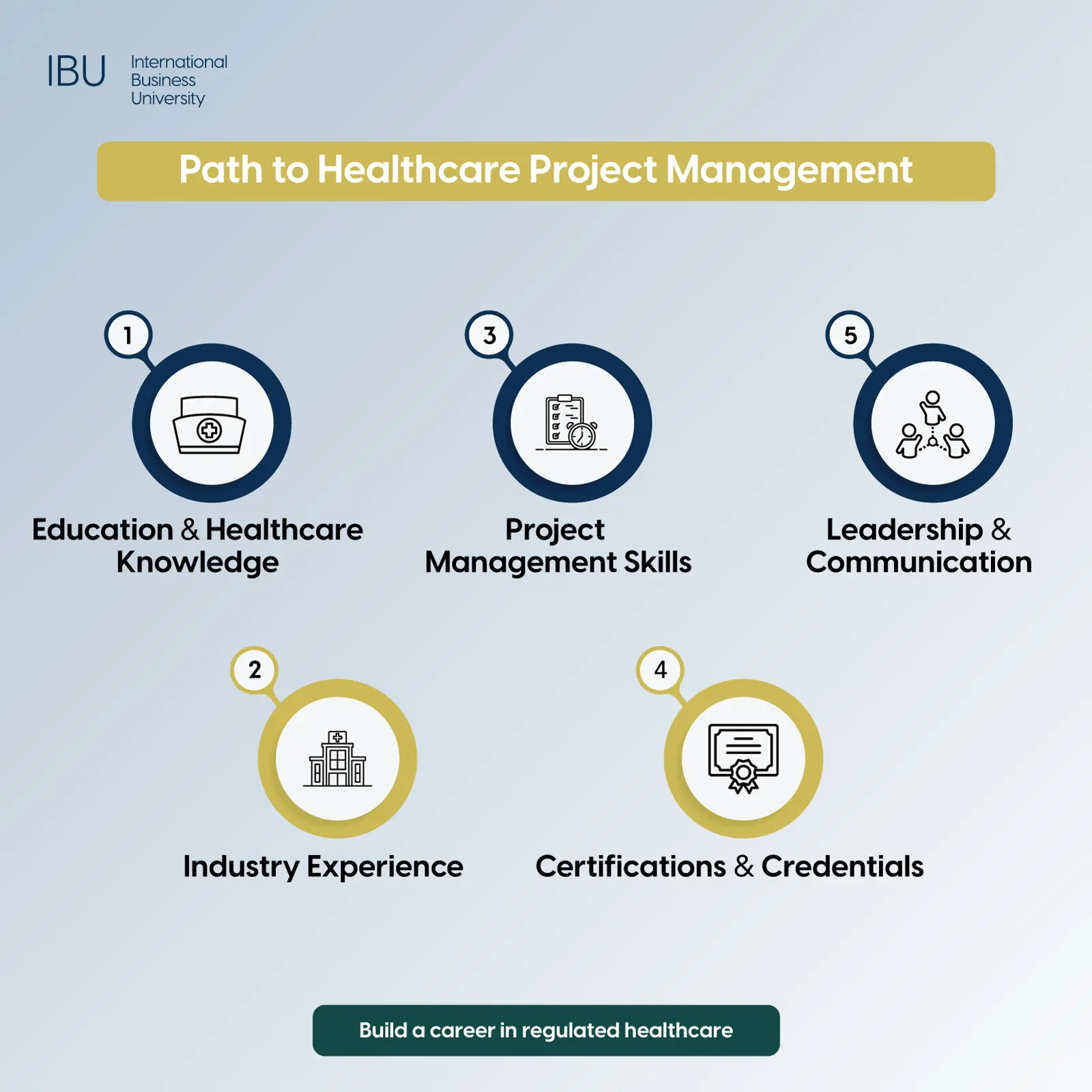
A healthcare project manager builds value through structured execution, regulatory awareness, and people leadership. This role sits at the intersection of care delivery and operational excellence. Success comes from education, experience, certification, and continuous growth. Healthcare organizations rely on professionals who translate complexity into outcomes. When you pursue healthcare project management with discipline and intention, you position yourself for a durable, respected career as a healthcare project manager.
Advance into healthcare leadership roles
Graduate education strengthens strategic thinking, analytics, and system-level leadership required for healthcare project management success.