
Written communication skills affect how well you express ideas, argue positions, and present work in academic and professional settings. Most students focus on the ideas themselves and underestimate how much the writing around those ideas determines how they are received. A clear, well-structured email carries more weight than a vague one with the same content. Developing written communication skills is a process, and the seven approaches in this article are practical starting points.
Key Takeaways
- Writing improves through consistent practice, not talent: Students who write regularly across different formats develop flexibility and confidence that occasional writing cannot produce.
- Clarity and structure are the foundation: Effective written communication depends on organizing ideas logically before worrying about style or vocabulary.
- Editing is a skill as important as writing: Reviewing and refining your own work consistently produces stronger writing than any single first draft will.
Why Written Communication Skills Matter for Students
Written communication skills affect academic performance, professional credibility, and career progression. Every assignment, email, report, and application a student writes is evaluated on how clearly it communicates. The quality of the writing signals how well the student thinks, not just what they know. Employers, professors, and admissions reviewers all draw conclusions from writing quality before they engage with the content.
According to the NACE Job Outlook survey, written communication is ranked among the top three skills employers look for in new graduates. This finding held even as technical skills requirements increased across industries. Employers consistently report that strong writing separates candidates who stand out from those who blend in.
The importance of written communication skills extends well beyond job applications. A Grammarly report cited by Boterview’s workplace communication statistics analysis found that knowledge workers spend approximately 19.93 hours per week on written communication. That means nearly half of a working week involves writing of some kind. Students who develop strong writing skills before entering the workforce have a practical head start.
University is the clearest opportunity students have to build these skills in a structured environment. Every essay, case study, group report, and presentation script is a writing exercise. Students who treat these as writing development opportunities rather than just graded tasks improve faster. IBU’s BCOM in Business Management and MBA programs integrate written communication across courses precisely because employers expect graduates to arrive with this skill developed.
7 Written Communication Skills
Strong written communication is built from a set of skills that work together. No single approach produces a strong writer on its own. The seven practices below address the most common gaps students have and explain specifically how to close them.
1. Focus on Clarity and Simplicity
Clarity is the most important quality in effective written communication. A sentence that requires two readings to understand has already failed its purpose. Students often write longer, more complex sentences to appear thorough or academic. The effect is usually the opposite: the writing becomes harder to follow. Short, direct sentences carry ideas more reliably than long compound ones. Before submitting any written work, ask one question: Would this make sense to someone reading it once?
Simplicity in writing does not mean shallow thinking. It means presenting complex thinking in an accessible language. The strongest academic and business writers can explain difficult ideas without using jargon as a substitute for precision. Students who practice writing one clear sentence per idea build clarity faster than those who focus on word count. Every extra word that adds no meaning weakens the sentence it sits in.
2. Improve Your Grammar and Vocabulary
Grammar errors in written work reduce professional credibility immediately. Readers notice errors before they engage with the argument. For students in business programs, grammar in written communication is not optional; it is a baseline. A poorly punctuated report or email signals inattention, regardless of the content quality. Grammar improvement happens most effectively through reading and deliberate correction of your own mistakes.
Vocabulary development works differently from grammar improvement. It is not about using rare or sophisticated words. It is about having specific words available when generic ones are not precise enough. A larger vocabulary means you can match the right word to the right context. Reading across genres, subjects, and formats is the most reliable way to expand working vocabulary. Students who read analytically, paying attention to word choice, absorb vocabulary faster than those who read passively.
3. Practice Writing Regularly
Regular practice is the clearest predictor of writing improvement over time. Writing for students in academic programs should happen in more formats than assignments alone. Journals, blog posts, opinion pieces, and professional emails are all practice formats.
Each format develops a different aspect of communication skills in writing. A student who writes daily in short bursts develops fluency that occasional long assignments do not produce.
The format matters less than the regularity. Writing a 200-word daily summary of what you learned forces clarity and structure. Responding thoughtfully to discussion forums builds argument skills.
Drafting professional emails carefully develops audience awareness. All of these habits feed back into stronger academic writing because they train the same underlying skills in different contexts.
4. Structure Your Writing Properly
A well-structured piece of writing communicates twice as effectively as an unstructured one with the same ideas. Structure tells the reader where you are going before they have to figure it out themselves.
In academic writing, structure typically means introduction, body, and conclusion with clear transitions. In professional writing, structure means placing the most important information first. Learning to structure your writing properly is one of the fastest ways to improve writing skills for students.
One practical approach is to outline before writing. A rough outline of three to five points takes five minutes and prevents structural problems later. Students who outline tend to write more concisely because they know what each section needs to do.
Students who skip outlining often write themselves into tangents that require cutting later. The time spent on structure before writing reduces total writing time and improves the final result.
5. Read More to Write Better
Reading is the most direct input into writing improvement. Writers absorb sentence patterns, argument structures, and vocabulary from the material they read. Students who read widely across business, academic, and journalistic formats develop a broader writing range.
Each format has different norms for tone, structure, and precision. Exposure to all of them gives students more options when they write for different audiences.
Reading analytically is different from reading for comprehension. Analytical reading means noticing how a paragraph is constructed. It means asking why the writer chose a particular sentence length or transition.
Also, it is identifying when writing is clear and when it is not, and working out why. This kind of reading directly feeds better ways to improve writing skills because it builds an internal model of what effective writing looks like.
6. Edit and Proofread Your Work
Editing and proofreading are separate skills, and both are part of effective written communication. Editing means reviewing the structure, logic, and clarity of what you have written.
Proofreading means checking for grammar, spelling, and punctuation errors after the content is final. Students who confuse the two often submit work that reads well in isolation but contains surface errors that reduce the overall impression.
Reading your own writing out loud is one of the most effective editing techniques available. Awkward sentences become obvious when heard rather than seen. Missing words, repeated phrases, and unclear transitions surface faster through audio than through silent reading.
Students who build a review step into their writing process consistently produce stronger final submissions. Rushing to submit without reviewing is one of the most common mistakes in student-written communication.
7. Adapt Your Writing for Different Situations
Effective written communication requires adapting your style to the situation and audience. An essay written for a professor needs a different tone than an email written to a client.
A group project report reads differently from a personal reflection or a case analysis. Students who write in one register for every situation limit how effectively they communicate in each.
Audience awareness is the underlying skill that makes adaptation possible. Before writing, ask who will read this, what they already know, and what they need from the document.
The answers shape every decision from vocabulary to sentence length to level of formality. Students who develop this habit early produce professional-quality communication in university. It is one of the writing skills for students that transfers most directly into career settings.
How to Practice Written Communication Skills Daily
Daily practice is the single most effective way to improve written communication skills over time. It does not require large blocks of time or formal writing assignments. Short, consistent writing habits produce more improvement than occasional intensive sessions.
One of the most accessible daily practices is journaling with a specific focus. Rather than writing freely, set a specific constraint for each entry. Write today’s entry using only short sentences.
In the next entry, write an argument with three clearly separated points. In another, describe a business scenario to a non-expert audience. These micro-constraints train specific writing skills far more efficiently than open-ended journaling.
Email offers another daily practice opportunity that most students overlook. Treating every professional email as a writing exercise builds habits around clarity and tone. Before sending, review the opening sentence: Does it state the purpose immediately?
Review the closing: does it specify what action is expected and by when? These small review habits translate directly into stronger professional written communication in the workplace.
- Morning summaries: Writing a three-sentence summary of what you plan to do or have learned each morning builds clarity and concision habits.
- Peer feedback exchanges: Sharing writing with a classmate weekly and giving structured feedback develops both writing and editing skills simultaneously.
- Reading response notes: After reading an article or chapter, write a paragraph summarizing the argument in your own words without looking at the source.
- Rewriting bad examples: Taking a poorly written paragraph and rewriting it for clarity is one of the fastest ways to sharpen communication skills in writing.
- Timed writing exercises: Setting a five-minute timer and writing one clear paragraph on any topic builds speed and confidence in students’ written communication.
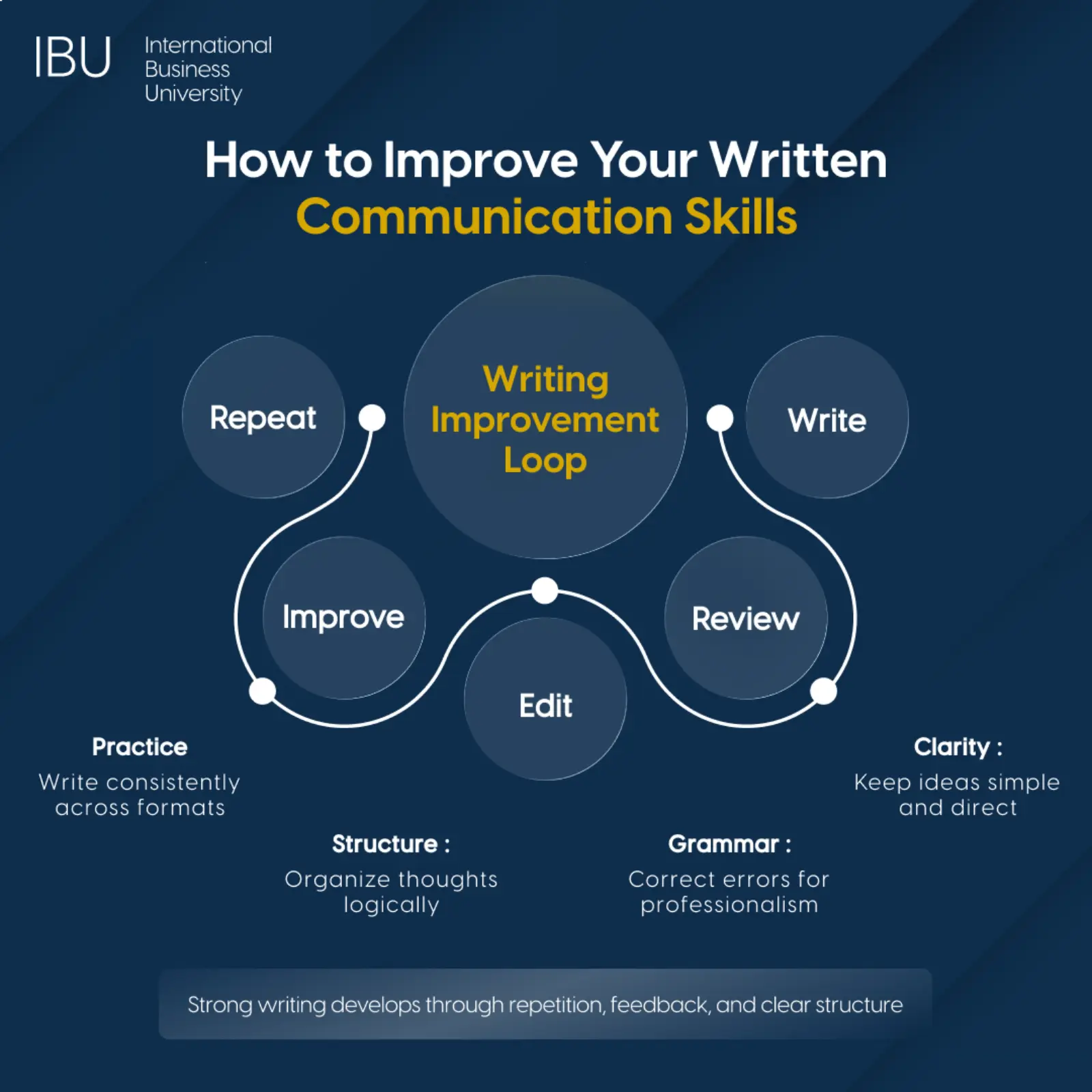
Writing improvement is a cycle, not a checklist. The IBU Writing Improvement Loop above makes this clear. It moves through five connected stages: Write, Review, Edit, Improve, and Repeat.
None of these stages produces results in isolation; each one feeds the next. Surrounding the loop are four specific inputs that make the cycle work. Clarity means keeping ideas simple and direct at every stage.
Grammar means correcting errors for professionalism before anything is sent or submitted. Structure means organizing thoughts logically so readers can follow without effort. Practice means writing consistently across formats so the loop becomes a habit, not an occasional event.
How Universities Help Improve Written Communication Skills
Universities play a key role in developing strong written communication skills. Through consistent writing tasks and guided feedback, students gradually improve their ability to express ideas clearly. The structure of coursework and quality of instruction make a significant difference in this growth.
- Structured practice: Regular writing assignments across courses help students continuously develop their skills.
- Variety of formats: Writing case analyses, reflection papers, and research reports builds versatility.
- Broader skill development: Exposure to different writing types prevents a narrow skill set.
- Quality feedback: Specific comments on clarity, structure, and arguments are more effective than general grades.
- Small class advantage: Smaller classes allow instructors to give more detailed, personalized feedback.
- IBU approach: Small class sizes are built into the system, ensuring consistent feedback quality.
- Practical application: IBU MBA in Business Management and Financial Management includes writing tasks like case analysis, strategic reports, and stakeholder communication.
- Career readiness: Students graduate with a strong writing portfolio that employers can evaluate before interviews.
Common Mistakes Students Make in Written Communication
Most written communication mistakes come from a few predictable habits. Identifying them early gives students a significant advantage in academic and professional writing. The patterns below appear across student work in business programs at every level.
A 2023 survey by the Association of American Colleges and Universities, cited by Lumen Learning’s writing skills resources, found that 64% of employers consider written communication skills very important for new hires. Yet only 34% believe recent graduates arrive well-prepared in this area. That gap points directly to the kinds of mistakes students make consistently before they enter the workforce.
- Overwriting sentences: Long sentences packed with clauses force readers to track multiple ideas at once, reducing clarity and impact.
- Skipping the outline: Writing without a structure plan produces paragraphs that wander and conclusions that restate the opening.
- Ignoring the audience: Using academic language in professional emails or casual language in formal reports signals poor audience awareness.
- Submitting first drafts: First drafts are working documents; submitting them without editing is one of the most common and costly student writing mistakes.
- Overusing passive voice: Passive constructions make sentences longer and the subject of the action unclear, which weakens the writing overall.
- Padding with filler phrases: Phrases like “it is important to note” or “this shows that” add length without adding meaning to any sentence.
- Inconsistent formatting: Switching between heading styles, font sizes, or citation formats within a single document reduces credibility immediately.
Write Better at IBU
IBU programs build written communication skills that employers value.
Frequently Asked Questions
How long does it take to improve written communication skills?
Noticeable improvement typically develops within three to six months of consistent daily practice. The rate of improvement depends on how often you write, how actively you review your work, and even if you are receiving specific feedback rather than just grades. Students in programs like IBU’s BCOM in Business Management, which integrates writing across multiple course formats, often report noticeable gains within a single semester when they approach assignments as writing development opportunities rather than grade-completion tasks.
What is the difference between written and verbal communication skills?
Verbal communication happens immediately and allows for immediate clarification through tone, expression, and follow-up. Written communication is permanent, asynchronous, and often reaches audiences who cannot ask questions directly, which means clarity and structure carry more of the burden. Developing both is important, but written communication skills for students often need more deliberate attention because university programs provide more informal practice in verbal communication through classroom discussion than they do in structured writing across diverse formats.
Do MBA programs specifically help develop written communication skills?
Yes, MBA programs develop written communication skills through the variety and volume of written deliverables they require. Strategic reports, case analyses, financial summaries, and stakeholder presentations all develop different aspects of professional writing across the program. IBU’s MBA programs, including the MBA in Financial and Management Analytics, are structured so that written communication development happens across multiple contexts, not just in a dedicated writing course, which produces more versatile and confident professional writers.
Good Writing Is a Skill You Build, Not a Gift You Either Have or Don’t
Written communication skills develop through the same process as any other skill: consistent practice, honest review, and deliberate improvement applied across different situations. The seven approaches in this article address the most common gaps students face, from clarity and structure to grammar and audience awareness. Students who approach every writing task as a development opportunity, not just a grade requirement, build the kind of professional written communication skills that follow them through their entire career.
Build Communication Skills
IBU graduates leave with writing skills that global employers actively seek.