

Healthcare organizations generate massive amounts of data every day, but data alone does not improve outcomes. What matters is how that data is analyzed and applied to legitimate decisions. Business analytics in healthcare provides the tools to turn raw information into actionable insights that improve patient care, reduce costs, and streamline operations. Understanding the four key types of analytics – descriptive, diagnostic, predictive, and prescriptive – gives healthcare leaders a clear framework for using data effectively across clinical and administrative settings
Key Takeaways
- Descriptive analytics provides the historical baseline that all other types of healthcare data analytics build from.
- Predictive analytics identifies patterns in patient data to flag risks before they become clinical emergencies.
- Prescriptive analytics translates those risk signals into specific, recommended courses of action for clinical and administrative teams.
What Is Business Analytics in Healthcare?
Hospitals operate on data. Every admission, discharge, billing cycle, and clinical intervention generates information that, when analyzed correctly, tells administrators and clinicians exactly where a system is failing or holding. Business analytics in healthcare is the structured application of that data: using statistical methods, quantitative models, and reporting systems to support operational, financial, and clinical decisions, though big data in healthcare myths often prevent health managers from acting on the insights these systems produce. though big data in healthcare myths often prevent health managers from acting on the insights these systems produce. The global healthcare data analytics market was valued at USD 52.98 billion in 2024 and is projected to reach USD 198.79 billion by 2033 (Grand View Research, 2024). Organizations that lack analytics capacity cannot see those failure points until they become costly or patient-facing.
The 4 Key Types of Business Analytics Used in Healthcare
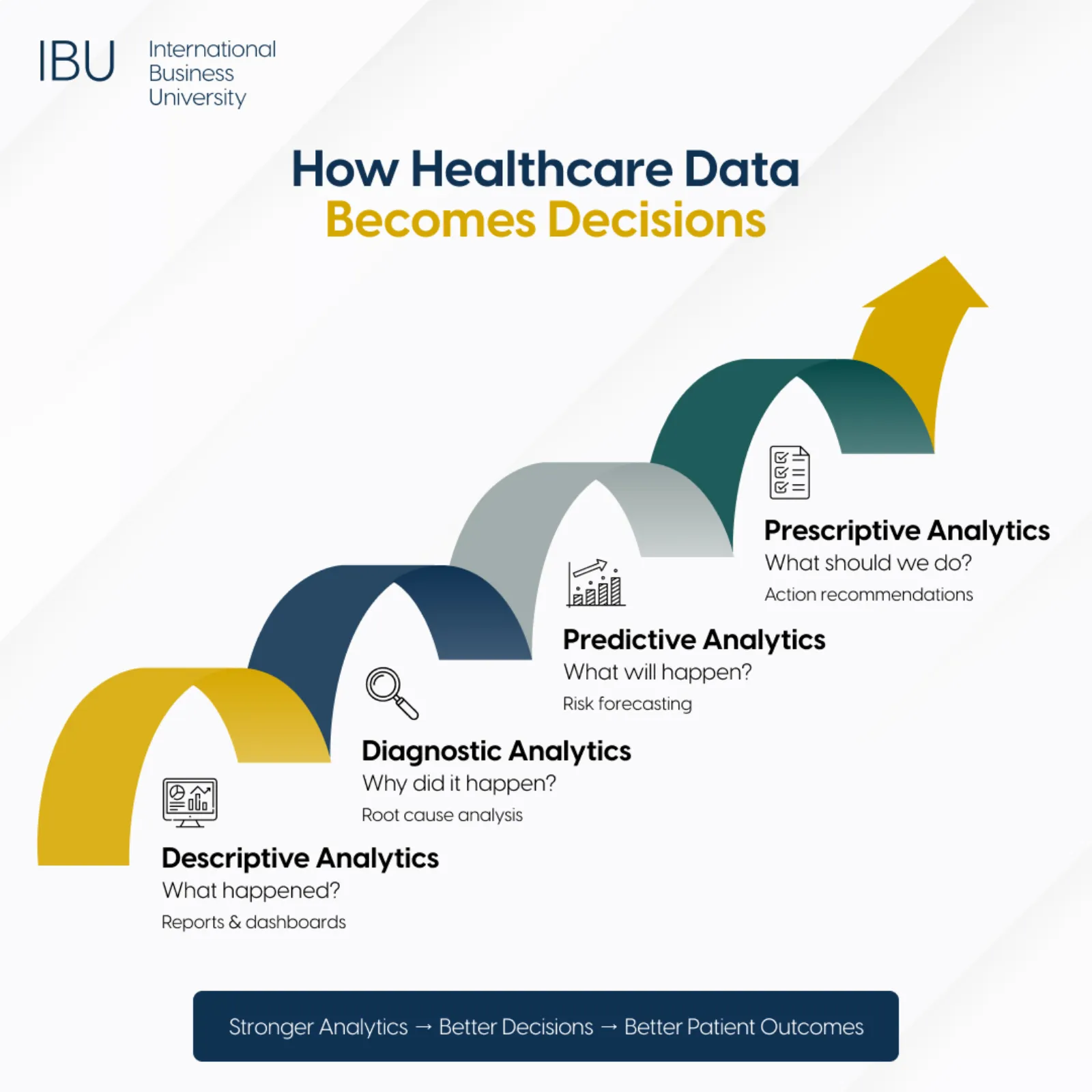
Healthcare organizations generate data from multiple sources simultaneously: electronic health records, billing systems, pharmacy logs, clinical notes, and patient monitoring devices. Each of the four types of healthcare analytics addresses a different stage of turning that data into actionable information. Understanding each type helps healthcare managers and MBA graduates identify where analytics applies within a given operational or clinical challenge.
1. Descriptive Analytics in Healthcare
Descriptive analytics answers the question: what happened? It organizes and summarizes historical data into readable reports, dashboards, and performance metrics. In healthcare, it powers the monitoring of patient admission rates, average length of stay, readmission frequencies, and billing accuracy. Descriptive analytics held the largest market share in the healthcare analytics sector at 45.9% in 2024, reflecting how foundational it remains across all types of health organizations (Grand View Research, 2024).
Healthcare administrators use descriptive analytics tools such as business intelligence dashboards and EHR-integrated reporting systems to establish performance baselines. Without those baselines, there is no context for identifying what has gone wrong or where improvement is possible.
2. Diagnostic Analytics in Healthcare
Diagnostic analytics goes one step further: it examines why something happened. Once descriptive analytics identifies a pattern, diagnostic tools drill into root causes. A hospital might notice a spike in 30-day readmission rates through descriptive reporting; diagnostic analytics then determines even if that spike correlates with discharge timing, staffing ratios, or specific patient demographics.
In practice, this type of healthcare data analytics uses data segmentation, correlation analysis, and filtering techniques to isolate contributing variables. It is especially useful in quality improvement programs and compliance audits, where organizations must document not just outcomes but the factors behind them.
3. Predictive Analytics in Healthcare
Predictive analytics uses statistical models and machine learning to forecast future outcomes based on historical patterns. It answers the question: what is likely to happen next? In clinical settings, predictive models assess patient risk scores for conditions like sepsis, hospital-acquired infections, or chronic disease progression. In operations, they forecast patient volumes, equipment maintenance schedules, and staff demand.
The healthcare predictive analytics market is expected to grow from USD 18.13 billion in 2024 to USD 156.36 billion by 2034, at a compound annual growth rate of 24.04% (Towards Healthcare, 2024). That trajectory reflects the expanding role predictive tools play in both clinical safety and resource planning. Hospitals using predictive analytics have been able to reduce preventable adverse events by identifying high-risk patients days before complications arise.
4. Prescriptive Analytics in Healthcare
Prescriptive analytics is the most advanced of the four types of business analytics. It not only forecasts what might happen but also recommends specific actions to influence outcomes. Where predictive analytics flags a patient as high-risk for readmission, prescriptive analytics recommends a structured follow-up protocol, adjusted discharge criteria, or specific intervention timing.
This type of healthcare data analytics integrates optimization algorithms, simulation models, and clinical decision rules. It supports pharmacy management, surgical scheduling, staffing allocation, and treatment pathway creation. Its adoption is growing in health systems that have already established strong descriptive and predictive infrastructure, making it the capstone capability in a mature analytics program.
Lead Health With Data
Build analytics fluency within an accredited healthcare MBA program.
Why Business Analytics Is Important in Healthcare
Healthcare organizations face structural pressures that analytics directly addresses: rising treatment costs, aging patient populations, regulatory reporting obligations, and staffing constraints. Healthcare data analytics provides the operational visibility and forecasting capacity that allows organizations to manage those pressures with documented evidence rather than assumptions.
Operational Efficiency
Analytics identifies bottlenecks across clinical workflows, from emergency department wait times to surgical scheduling gaps. Organizations use this data to reallocate resources before backlogs develop.
Cost Containment
Financial analytics flags claims anomalies, billing errors, and high-cost care pathways. Health systems that apply diagnostic and prescriptive analytics to cost management have shown measurable reductions in administrative waste and unnecessary procedures.
Patient Safety and Quality of Care
Predictive models trained on patient history and vital sign data flag deterioration risk earlier. This shifts clinical response from reactive to proactive, reducing adverse events and improving patient outcomes.
Regulatory Compliance and Reporting
Healthcare organizations must comply with reporting requirements from multiple regulatory bodies. Descriptive analytics automates much of the data collection and formatting required for those submissions.
Population Health Management
By aggregating and analyzing data across patient cohorts, healthcare data analytics helps public health administrators and clinical planners identify high-risk population segments, geographic disease concentration, and gaps in preventive care access.
Strategic Planning and Resource Allocation
Long-range capacity planning for hospital infrastructure, staffing models, and technology investment depends on robust analytics. Prescriptive and predictive tools allow health system executives to model future scenarios before committing capital resources.
Why MBA Students Should Learn Business Analytics in Healthcare
An MBA with a focus in healthcare management places graduates at the intersection of business strategy and clinical operations. Employers across hospital networks, insurance firms, public health agencies, and health technology companies require leaders who can interpret analytics outputs, commission studies, and translate findings into organizational decisions. Understanding the six factors shaping data analytics in healthcare today gives MBA graduates a working framework for that role.
- Analytical fluency: Positions with hospitals and health systems increasingly require managers who can read dashboards, interpret model outputs, and challenge faulty assumptions in analytics reports.
- Operational credibility: Healthcare executives who understand how diagnostic and prescriptive analytics work are better positioned to lead improvement initiatives without over-relying on technical staff for interpretation.
- Competitive positioning: Employers across health administration, consulting, and health technology prefer candidates who arrive with applied knowledge of healthcare data analytics tools rather than generic business training.
- Policy and planning applications: Public health leadership roles use population-level analytics to support funding decisions, resource deployment, and program evaluation across government and nonprofit settings.
- Cross-functional leadership: Understanding all four types of business analytics allows managers to collaborate effectively with data science, IT, clinical, and finance teams without operating in functional silos.
IBU’s MBA in Healthcare Management and MBA in Digital Health and Data Analytics both integrate applied analytics training within their curricula, preparing graduates for leadership roles where these competencies are standard requirements.
Study Online. Lead Hospitals.
IBU’s online MBA in healthcare is fully accredited and flexible.
Frequently Asked Questions
What is the difference between predictive and prescriptive analytics in healthcare?
Predictive analytics uses historical data and statistical models to identify the probability of future events, such as patient readmission or disease progression. Prescriptive analytics builds on those predictions by recommending specific actions to influence those outcomes, such as adjusted care protocols or optimized staffing schedules. The two types of analytics work together in mature healthcare data analytics programs, with predictive models feeding the decision logic that prescriptive systems act on..
What are common healthcare analytics tools used in hospitals?
Hospitals commonly use tools like Tableau, Power BI, Epic’s reporting suite, Oracle Health Analytics, SAS Health, and IBM Watson Health for various stages of healthcare data analytics. Tool selection depends on integration requirements with existing EHR systems, volume of data processed, and the specific analytics type: descriptive, diagnostic, predictive, or prescriptive. The most effective implementations layer multiple tools across different operational and clinical functions.
How does an MBA prepare someone for a career in healthcare analytics?
An MBA in Healthcare Management or Digital Health and Data Analytics provides structured training in quantitative methods, financial modeling, healthcare operations, and strategic management. Graduates gain the analytical and leadership frameworks needed to work in healthcare data analytics without necessarily being data scientists themselves. The role most MBA graduates fill is one of analytical leadership: commissioning studies, interpreting outputs, coordinating between clinical and technical teams, and applying findings to organizational strategy.
Apply Healthcare Data Analytics to Legitimate Organizational Challenges
The four types of business analytics in healthcare form a connected framework, each building on the last. Descriptive analytics establishes the operational baseline. Diagnostic tools explain deviations from that baseline. Predictive models identify future risks based on patterns in the data. Prescriptive systems convert those risk signals into recommended organizational responses. Professionals who understand how each type functions and how they connect are better positioned to lead analytics-driven initiatives across health systems, consulting firms, and public health agencies. IBU’s healthcare-focused MBA programs provide the academic foundation and applied curriculum to develop that capacity in a structured, professionally recognized format.