
Healthcare consulting applies business strategy, operations analysis, and financial planning directly to hospitals, health authorities, and healthcare companies across Canada. Most MBA graduates default to general management or finance consulting without realizing healthcare consulting draws on the same core skills. The increasing and consistent demand for consultants who understand both business strategy and how health systems actually operate.
What Healthcare Consulting Actually Involves in a Canadian Context
The work centers on operational and financial problems inside health systems, not clinical decisions.
- Operational efficiency: Analyzing patient flow, staffing models, and resource allocation inside hospitals and clinics.
- Financial strategy: Advising health authorities on budget planning, funding models, and cost reduction without compromising care quality.
- Policy and compliance: Helping organizations adapt to provincial health policy changes and funding structure shifts.
None of this work requires a clinical background, though familiarity with how health systems function speeds up the learning curve considerably.
Where This Work Happens
Consultants in this space work across hospitals, regional health authorities, long-term care operators, and private healthcare companies. Some roles sit inside dedicated consulting firms, while others are embedded directly inside a health system’s strategy office.
Both paths draw on the same core skill set, though embedded roles typically involve deeper, longer-term relationships with a single organization.
The Difference Between Healthcare Consulting and Clinical Advisory Work
These two paths are frequently confused, despite requiring different backgrounds and skill sets.
- Business focus vs clinical focus: Healthcare consulting addresses operations, finance, and strategy, while clinical advisory work addresses treatment protocols and patient care standards.
- Background requirements: Clinical advisory roles typically require a clinical license, while healthcare consulting roles prioritize business training and health sector familiarity.
- Client relationships: Healthcare consultants report to hospital administrators and health authority executives, not clinical department heads.
Candidates targeting healthcare consulting should be clear about this distinction early, since the two paths require different coursework and credentials.
Why Canadian Health Systems Hire for This Role
Health authorities and hospital networks face budget and capacity pressure that internal teams often lack the bandwidth to address.
- Capacity constraints: Internal teams are frequently stretched thin managing daily operations, leaving little time for strategic analysis.
- Outside perspective: External consultants bring cross-organization benchmarking that internal staff cannot access as easily.
- Specialized project scope: Funding model transitions and major operational changes often require dedicated project resourcing beyond existing staff capacity.
That combination keeps demand for healthcare consulting talent consistent even as the healthcare sector faces overall labour shortages.
Where Demand Concentrates Regionally
Ontario represents more than a third of all healthcare and social assistance employment in Canada, with the sector recording a job vacancy rate of 5.0 percent in 2024, well above the 2.9 percent average across all industries. That gap between demand and available staff extends into strategy and consulting roles supporting these organizations.
Consultants who understand regional funding structures and workforce pressure points bring more immediate value to a health authority than generalists without that context.
Risk Management in Healthcare: The Consulting Competency Most Clients Pay For
Risk management sits at the center of most healthcare consulting engagements, more than any other single competency.
- Financial risk: Identifying budget exposure before a funding shortfall affects patient services.
- Operational risk: Flagging capacity or staffing gaps before they compromise care delivery.
- Regulatory risk: Helping organizations stay ahead of provincial policy changes rather than reacting after they take effect.
Consultants who can quantify these risks clearly, not just identify them, are the ones health authorities bring back for repeat engagements.
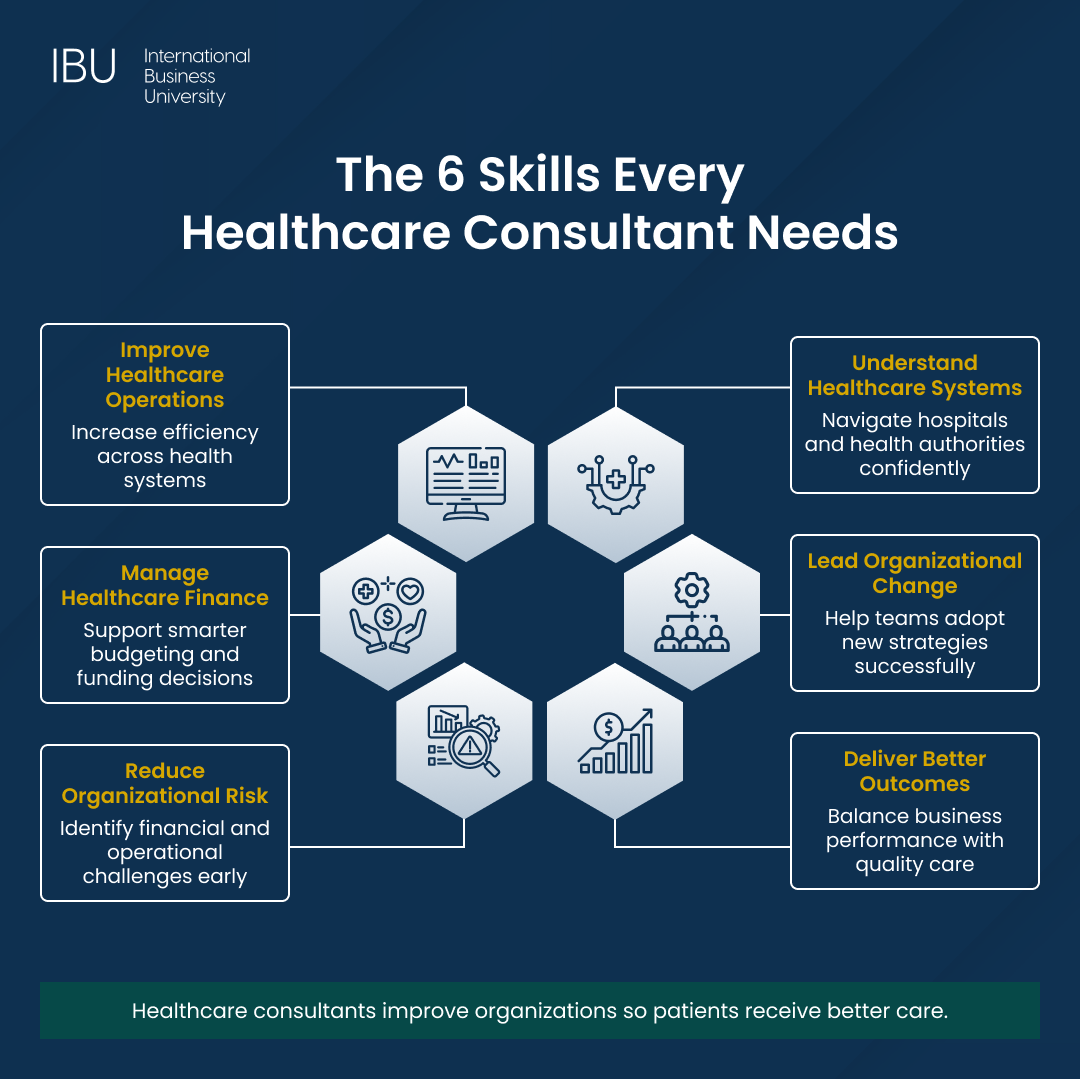
The 6 Skills Every Healthcare Consultant Needs
Healthcare consulting draws on a specific combination of operational, financial, and change management skill, and six capabilities show up consistently across strong consultants in this field.
- Improve healthcare operations: Increase efficiency across health systems by identifying where process and workflow changes actually move the needle.
- Manage healthcare finance: Support smarter budgeting and funding decisions inside organizations working under public and private funding constraints.
- Reduce organizational risk: Identify financial and operational challenges early, before they affect patient services or organizational stability.
- Understand healthcare systems: Navigate hospitals and health authorities confidently, knowing how these organizations actually function day to day.
- Lead organizational change: Help teams adopt new strategies successfully instead of stalling at the recommendation stage.
- Deliver better outcomes: Balance business performance with quality care, so a recommendation improves the numbers without compromising patient care.
Why Risk and Change Management Separate Strong Consultants From the Rest
Most healthcare consultants can identify a problem. Fewer can quantify the financial and operational risk behind it clearly enough for a health authority to act, and fewer still can lead the organization through the change that follows without losing staff buy-in along the way.
Healthcare consultants improve organizations so patients receive better care, which is why the strongest consultants treat operational, financial, and change management skill as one connected capability rather than separate specialties.
How an MBA in Healthcare Management Builds the Right Foundation
The specialization pairs core business training with healthcare-specific context most general MBA programs skip entirely.
- Healthcare finance: Covers funding models specific to public and private health systems, not generic corporate finance.
- Health systems operations: Builds familiarity with how hospitals and health authorities actually function day to day.
- Applied capstone: Requires students to complete a consulting-style project for a healthcare organization, mirroring actual client work.
Graduates leave with a concrete healthcare project to reference in interviews, not just general business coursework.
Build Healthcare Consulting Skills Into Your MBA
Learn how IBU’s Healthcare Management specialization prepares graduates for consulting and health system leadership roles.
How IBU Prepares Students for Healthcare Consulting Roles
The program structure is built around applied practice rather than healthcare theory alone.
IBU’s guide on leadership in healthcare and the skills that get you hired covers several of the same competencies healthcare consulting firms screen for directly.
Students also connect with mentors working inside Canadian health authorities and consulting firms, giving them direct exposure to the client relationships this career depends on.
Key Takeaways

Business skills transfer directly: healthcare consulting rewards the same operations, finance, and strategy skills a general MBA builds, applied to a specific sector.
No clinical background required: the role centers on business problems inside health systems, not clinical decisions.
Risk management is the core skill: consultants who can quantify financial, operational, and regulatory risk clearly earn repeat client engagements.
Demand stays consistent: sustained hiring pressure across Canada’s healthcare sector keeps consulting demand steady even during broader labour shortages.
Frequently Asked Questions
Do I need a clinical background to work in healthcare consulting?
A clinical background is not required for most healthcare consulting roles. Business training and familiarity with how health systems operate matter more than clinical credentials.
What is the difference between healthcare consulting and clinical advisory work?
Healthcare consulting addresses operations, finance, and strategy, while clinical advisory work addresses treatment protocols and patient care standards. The two paths require different backgrounds and typically report to different stakeholders.
Why do Canadian health systems hire external consultants?
Internal teams are often stretched thin managing daily operations, leaving limited time for strategic analysis. External consultants also bring cross-organization benchmarking that internal staff cannot access as easily.
What makes risk management important in healthcare consulting?
Risk management sits at the center of most healthcare consulting engagements, covering financial, operational, and regulatory exposure. Consultants who quantify these risks clearly tend to earn repeat client engagements.
How does an MBA in healthcare management prepare graduates for consulting?
The specialization pairs core business training with healthcare-specific finance and operations coursework. An applied capstone project gives graduates a concrete healthcare consulting example to reference in interviews.
Is healthcare consulting a stable career path in Canada?
Demand has stayed consistent given sustained hiring pressure across Canada’s healthcare sector, including elevated job vacancy rates in provinces like Ontario. This pressure creates ongoing need for consultants who understand both business strategy and health system operations.
Why This Path Deserves a Second Look
Healthcare consulting rewards the exact business skills an MBA is built to develop, applied to a sector with sustained hiring demand across Canada. Graduates who pair a healthcare management specialization with an applied consulting project enter the job market with direct evidence of the skills this field screens for.
Prepare for a Healthcare Consulting Career With an MBA
IBU’s Online MBA in Healthcare Management builds the operational and financial skills healthcare consulting firms hire for.