
Crisis communication is the difference between a leader who steadies a team during a disruption and one who loses their confidence at the exact moment it matters most. Every organization eventually faces a moment, a product failure, a data breach, a public complaint, a sudden departure, where communication quality determines the outcome as much as the underlying problem does.
Most managers have not practiced this skill before they need it, since crises are infrequent by nature. That gap between rare occurrence and high stakes is exactly why crisis communication deserves deliberate preparation rather than improvisation.
What Crisis Communication Actually Demands From Business Leaders
Crisis communication asks something different of a leader than day-to-day management communication does. The information available is incomplete, the timeline is compressed to hours or minutes instead of weeks, and every stakeholder in the room is reading the leader’s response for signs of competence or evasion. Three demands tend to separate leaders who handle this well from those who don’t.
- Speed with accuracy: A slow response leaves room for speculation to fill the gap, so leaders who confirm the basic facts first and then move quickly earn more trust than those who move fast and have to walk statements back later.
- Consistent messaging: Staff, customers, media, and partners often hear about the same event through different channels within the same hour, and any inconsistency between those channels becomes its own story separate from the original problem.
- Visible ownership: Audiences notice quickly when a leader points to another department or an external circumstance instead of standing behind the organization’s response, and taking public responsibility tends to preserve credibility better than any explanation that reads as deflection.
Leaders who treat these three demands as a working checklist, rather than something they figure out in the moment, consistently perform better than those encountering a crisis for the first time under real pressure.
The Three Stages of a Crisis and What Communication Looks Like at Each One
A single statement rarely covers an entire crisis from start to finish. Crisis communication shifts in tone, content, and frequency across three distinct stages as a situation develops and, eventually, resolves.
Stage 1: Initial Response
The first statement should be short and factual, confirming that the organization is aware of the issue and is already working on it. This stage isn’t the place for full explanations or long-term commitments. Its purpose is to close the information gap before rumor does.
Stage 2: Ongoing Management
This is the stage most organizations underuse. Regular updates, even ones that simply confirm no material change has occurred since the last communication, keep stakeholders anchored to the organization’s account of events rather than to outside speculation.
Stage 3: Resolution and Review
Once the situation has settled, the organization needs a clear statement of what happened and what is changing internally to reduce the chance of a repeat. Skipping this stage, or rushing through it, leaves audiences with an open question the organization never actually answered.
Silence during the ongoing management stage is the single most common failure point. To most audiences, a gap between the initial response and the resolution statement reads as avoidance, regardless of how much work is actually happening behind the scenes.
Why Most Managers Fail at Crisis Communication and How to Avoid That
Failure in this area rarely comes from a lack of intelligence or good intention. It comes from specific, predictable habits that surface under pressure and that most managers have never had to correct.
- Over-promising early: Committing to a timeline or outcome before enough information is available to support the claim.
- Going silent under pressure: Avoiding communication entirely while working the problem, which reads as concealment to anyone watching from outside.
- Defensive language: Framing a response around blame or justification instead of the facts and the next step.
Each of these habits is correctable with practice, which is exactly why simulated crisis exercises produce better outcomes than reading about communication theory alone. These habits also reinforce the importance of mastering the 7Cs of communication, which help leaders communicate with clarity, accuracy, completeness, and consideration under pressure.
Crisis Communication: The Framework That Separates Calm Leaders From Reactive Ones
Calm leaders tend to follow a repeatable structure rather than improvising a response from scratch each time. The framework below covers the core sequence most experienced communicators default to under pressure.
- Gather before speaking: Confirming the basic facts internally before any external statement, even if that confirmation takes a few extra minutes.
- Lead with what is known: Stating clearly what has been confirmed, followed by what is still being investigated, rather than guessing at either.
- Commit to a next update: Naming a specific time for the next communication, which reduces anxiety even when the news itself has not changed.
Reactive leaders typically skip the first step, speaking before the facts are confirmed, which creates a correction cycle that damages trust more than the original issue did.
Learn the Communication Framework Executives Rely On
IBU’s business programs build leadership communication skills through applied practice, not theory alone.
Leadership Communication in a Crisis: What Executives Do Differently
Senior executives who handle crises well share a set of behaviors distinct from what most first-time managers do under the same pressure. These behaviors come from repeated exposure, not innate talent.
- They centralize the message: Designating one clear source of information rather than letting multiple managers speak independently and risk contradiction.
- They over-communicate internally: Briefing staff before external stakeholders, since employees who feel informed communicate more confidently with customers and partners.
- They document the response: Keeping a written record of decisions and rationale, which supports both accountability and later organizational learning.
Executives who have not developed these habits tend to default to defensive posturing, which is precisely the behavior audiences read as dishonest.
The 6-Step Crisis Communication Framework Leaders Can Follow
A crisis rarely unfolds in a straight line, but the response to it can. IBU’s six-step framework gives leaders a repeatable sequence to follow when pressure and incomplete information make improvising the message too risky.
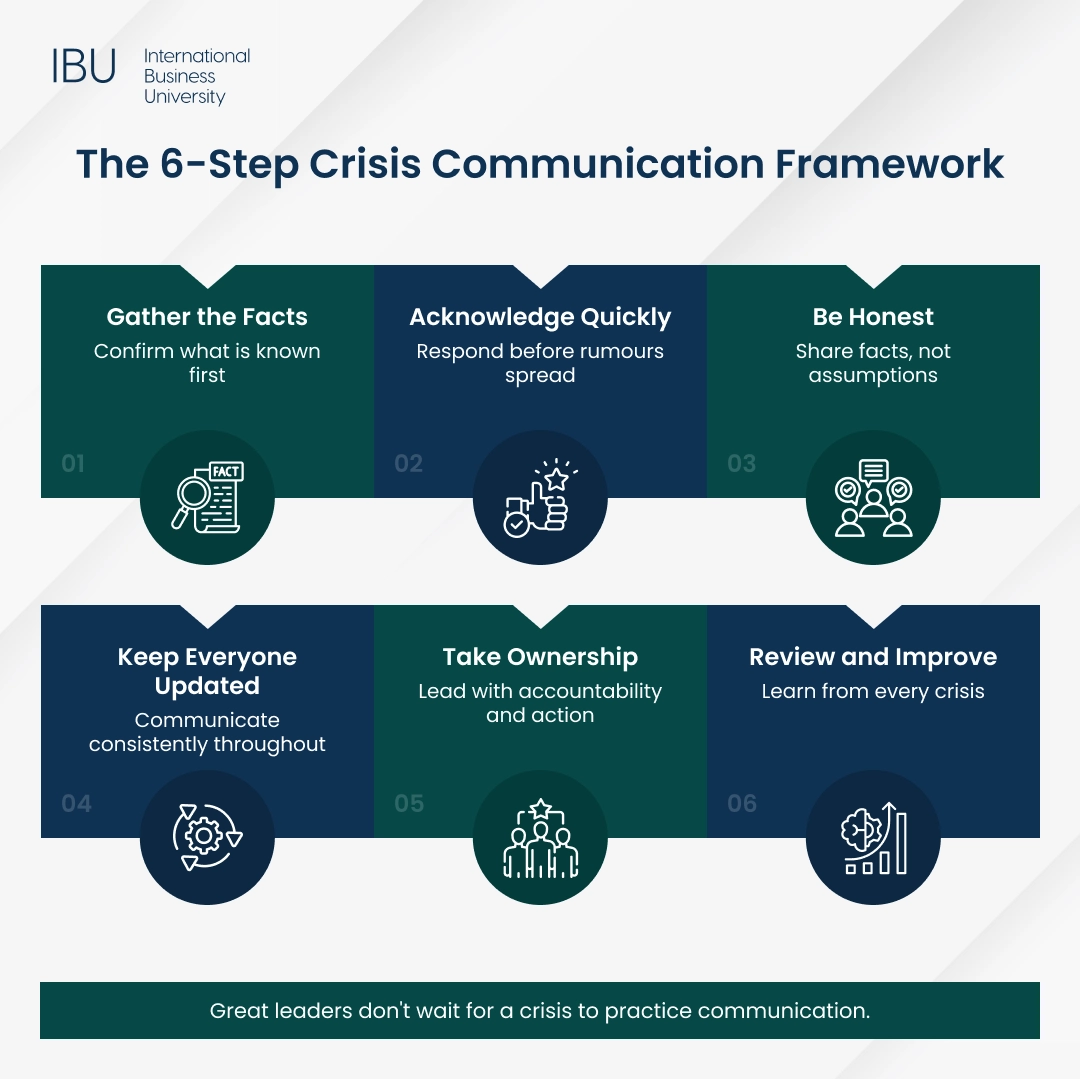
- Gather the facts: Confirm what is actually known before saying anything publicly, even if that confirmation takes a few extra minutes.
- Acknowledge quickly: Respond before rumors fill the silence, since a delayed statement reads as evasion regardless of intent.
- Be honest: Share confirmed facts, not assumptions or premature reassurances that may not hold up later.
- Keep everyone updated: Communicate consistently throughout the situation, even when the update is that nothing has changed yet.
- Take ownership: Lead with accountability and action instead of shifting responsibility toward other departments or circumstances.
- Review and improve: Treat every crisis as evidence to refine the next response, not an event to move past and forget.
Why the Order of These Steps Matters
Leaders who skip ahead, taking ownership before confirming the facts, or reviewing lessons before keeping people updated, tend to create a second problem on top of the original one. Each step depends on the one before it holding up under scrutiny, which is what makes the sequence worth practicing before a real situation forces the issue.
Great leaders do not wait for a crisis to practice communication. The organizations that rehearse this framework in calm conditions are the ones that execute it cleanly when conditions are not.
How the IBU Signal Validates Crisis Communication Skills for Employers
The IBU Signal, IBU’s new institutional skills record, was built to close that exact gap by giving employers validated evidence of what a graduate can actually do under pressure, not just what they sat through in a classroom.
The Signal was developed with direct input from IBU’s Industry Advisory Council and the Future Talent Research Institute, after the university surveyed 78 employers on the skills they most needed from new hires. Communication, critical thinking, problem-solving, and adaptability under pressure ranked among the top priorities, the same capabilities crisis communication training is built to develop.
- Performance over completion: The Signal is grounded in assessed performance during simulated exercises, including crisis-style scenarios, rather than a record of courses finished.
- Higher-order skills made visible: Communication under ambiguity and time pressure is exactly the kind of human, higher-order skill the Signal was designed to measure and surface to employers.
- Employer-informed design: The framework reflects what Ontario businesses said they needed, not an assumption made inside the classroom.
This changes what a credential can show a hiring manager. Because for a skill like crisis communication, where the real test only comes under pressure and incomplete information, this kind of validated record gives graduates something more concrete to point to than a transcript line. It tells an employer the skill was demonstrated, observed, and assessed before the graduate ever walks in the door.
Notable Crisis Communication Examples Every Business Student Should Study
Studying past organizational responses, both strong and weak, gives students a reference library to draw on before they ever face a live situation themselves. Patterns repeat across industries even when the specific crisis differs.
- Fast, transparent responses: Organizations that acknowledged an issue within hours, even without a full resolution, generally preserved more public trust than those that stayed silent.
- Delayed or defensive responses: Organizations that waited for complete information before saying anything typically faced harsher public reaction once they finally spoke.
IBU’s guide on ways to improve your communication skills at work and its companion piece on leadership and authority cover related communication patterns in more depth.
Key Takeaways
Four points summarize what separates strong crisis communication from a weak response

Speed and accuracy matter together: acknowledging an issue quickly, without overstating what is known, preserves more trust than either silence or overconfidence.
The middle phase gets skipped most often: silence between the first response and the resolution reads as avoidance to most audiences.
Habits are correctable: over-promising, going silent, and defensive language are predictable and trainable, not fixed traits.
Practice builds the skill: IBU’s simulated crisis exercises give students practiced experience before they face a live situation.
Frequently Asked Questions
What is the difference between crisis communication and regular business communication?
Crisis communication operates under compressed timelines, incomplete information, and heightened audience scrutiny. Regular business communication rarely carries the same immediate stakes or visibility.
What is the biggest mistake leaders make during a crisis?
Going silent while working the problem is one of the most common and damaging mistakes. Silence between updates reads as concealment even when the organization is actively addressing the issue.
Can crisis communication skills be trained, or do they only come from experience?
Simulated crisis exercises can build this skill before a leader ever faces an actual disruption. Waiting for on-the-job experience alone is a slower and higher-risk way to develop the same competence.
How is leadership communication different from crisis communication specifically?
Leadership communication is the broader skill of directing and influencing others clearly. Crisis communication applies that broader skill under compressed time and heightened scrutiny.
How does IBU teach crisis communication in its BCOM and MBA programs?
IBU uses simulated crisis exercises with incomplete information, reviewed for clarity, tone, and ownership. This training is integrated into core communication and leadership coursework rather than taught as an isolated unit.
Building Crisis Communication Before the Crisis Arrives
Crisis communication rewards preparation over instinct, and the leaders who practice this skill in advance consistently outperform those encountering it for the first time under pressure. Programs that build simulated crisis practice into coursework give graduates a rehearsed starting point instead of a first attempt during an actual disruption.
Build Crisis Communication Skills Before You Need Them
IBU embeds crisis and leadership communication training directly into BCOM and MBA coursework.