

A data analyst in healthcare interprets patient data to make better decisions. They examine clinical records, operational reports, and health system outcomes. Every hospital, insurer, and public health agency needs this work done. For students entering the field, this role sits at a powerful intersection of business and human impact.
Key Takeaways
- Healthcare analytics is one of Canada’s fastest-growing career fields: According to McMaster Continuing Education’s healthcare analytics report, the average health analyst salary in Canada is $73,593 per year, rising to $94,756 for experienced professionals. Canada is also positioning itself as one of the world’s top three healthcare hubs.
- The healthcare analytics market is growing at 21% annually: The healthcare data analytics market is projected to grow at a CAGR of 21% over the next several years, making it one of the most resilient and high-demand data analytics jobs available to graduates today.
- Top earners in this field exceed $110,000 per year in Canada: Senior healthcare data analysts in Canada earn up to CA$110,588 annually per Glassdoor’s 2025 healthcare data analyst salary data, with the highest salaries concentrated in Ontario and Alberta.
What Does a Data Analyst in Healthcare Do?
A data analyst in healthcare collects, cleans, and interprets health-related data. They identify patterns that help organizations improve patient care. They also reduce costs, streamline operations, and support clinical decisions. IBU’s MBA in Healthcare Management builds the analytical and strategic skills this role requires.
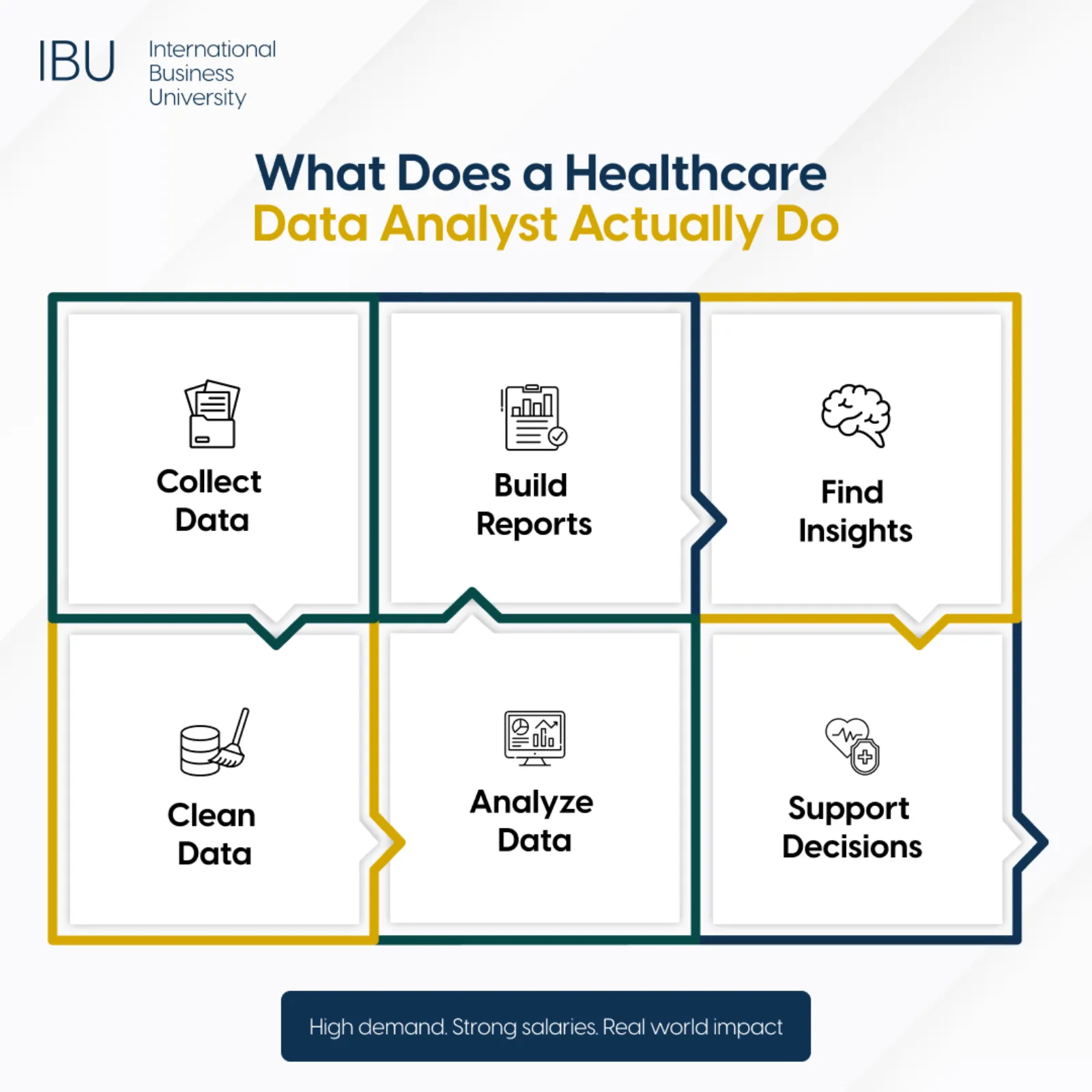
- Data collection: Healthcare data analysts gather records from EHRs, claims databases, and clinical systems.
- Data cleaning: Raw health data contains errors and inconsistencies that analysts must resolve before analysis.
- Statistical analysis: Analysts apply statistical methods to find patterns across patient populations.
- Reporting and dashboards: They present findings through visual reports that clinical and executive teams can act on.
- Decision support: The core output of data analysis in healthcare is actionable insight, not just numbers.
Where Do Healthcare Data Analysts Work?
A healthcare data analyst can work across many types of organizations. The role is not limited to hospitals or clinical settings. Any organization that handles health data has a need for this expertise. The variety of settings makes this data analyst’s career highly versatile.
- Hospitals and health systems: Hospital data analyst roles focus on patient flow, readmissions, and quality metrics.
- Government health agencies: Federal and provincial agencies use analysts to track population health outcomes.
- Insurance companies: Health insurers rely on data analysts to assess claims, risk, and cost patterns.
- Pharmaceutical companies: Drug manufacturers analyze clinical trial data and market access information.
- Consulting firms: Health consulting firms hire analysts to advise multiple healthcare clients at once.
- Health technology companies: Digital health platforms need analysts to interpret user and outcomes data continuously.
A Typical Day for a Data Analyst in Healthcare
No two days look identical for a data analyst in healthcare. The work shifts between technical analysis and collaborative team communication. Below is a walk-through of how a typical workday is structured. Understanding this rhythm helps students set authentic career expectations early.
Morning: Data Review and Preparation
Most days begin with reviewing incoming data feeds and system reports. Analysts check for errors, missing values, or flagged anomalies in datasets. This data cleaning work is foundational to everything that follows. Even experienced analysts spend a significant part of their morning on this task.
Midday: Analysis and Model Building
Midday is typically when deep analytical work happens. Analysts run queries in SQL, build models in Python, or analyze in Excel. They may work on predictive models or performance benchmark comparisons. This is the core of what data analyst tasks look like in practice.
Afternoon: Reporting and Stakeholder Collaboration
Afternoons often involve translating analysis into reports or presentations. Analysts meet with clinical leaders, operations managers, or executives. They explain findings in plain language, not technical jargon. Strong communication is as important as strong analytical ability in this role.
End of Day: Documentation and Planning
Before the day closes, analysts document their methodology and findings. They also plan the next steps for ongoing projects and flag blockers. Good documentation ensures continuity when projects span multiple weeks. This discipline distinguishes competent analysts from truly excellent ones.
Analyze Healthcare. Lead Change.
IBU’s Healthcare MBA builds analytics skills for legitimate roles.
Key Responsibilities of a Data Analyst in Healthcare
The data analyst job duties in healthcare span both technical and strategic areas. Responsibilities vary by employer, but core functions remain consistent across settings. These are responsibilities that appear across most job postings. Knowing these expectations helps students prepare the right skill set in advance.
Building and Maintaining Data Pipelines
Data pipelines move raw information from source systems to analytical tools. Analysts build, monitor, and fix these pipelines as a regular responsibility. A broken pipeline delays everything downstream in the organization. Pipeline maintenance is one of the most technically demanding data analyst tasks in healthcare.
Producing Performance and Quality Reports
Healthcare organizations track dozens of quality and performance indicators. Analysts compile and update these reports on regular schedules. Reports cover patient safety scores, wait times, readmission rates, and costs. These outputs directly influence resource allocation and accreditation outcomes.
Supporting Clinical and Operational Decisions
Decisions in healthcare carry direct consequences for patient well-being. A data analyst in healthcare provides the evidence behind clinical and operational choices. This may include staffing models, supply chain projections, or care pathway changes. The analyst’s role is to reduce guesswork and replace it with reliable insight.
Ensuring Data Quality and Governance
Data quality governance is a regulatory and operational responsibility. Analysts enforce data standards, resolve discrepancies, and audit data accuracy. Poor data quality leads to incorrect clinical conclusions and compliance failures. Every healthcare data analyst must take this responsibility seriously from day one.
Types of Data Healthcare Analysts Work With
Data analysis in healthcare involves several distinct types of structured information. Each type has unique characteristics, collection methods, and analytical challenges. Knowing these categories helps students understand the breadth of the role.
- Clinical data: This includes diagnoses, lab results, medications, and treatment outcomes from EHRs.
- Administrative data: Billing codes, patient demographics, and service utilization records fall into this category.
- Financial data: Cost per procedure, budget variance, and revenue cycle data are common analytical inputs.
- Population health data: Community-level health statistics inform public health programs and resource planning.
- Claims data: Insurance claims reveal patterns in how patients use and access care over time.
Practical Examples of Data Analysis in Hospitals
Data analysis in hospitals solves concrete, measurable operational problems. These examples show how the role creates direct value for organizations. Each one connects a specific analytical method to an authentic outcome. They are also the kinds of projects that appear in healthcare data analyst portfolios.
- Reducing readmission rates: Analysts identify patient risk factors that predict which patients will return within 30 days.
- Optimizing staff scheduling: Predictive models help hospitals match staffing levels to patient admission patterns.
- Tracking infection rates: Hospital data analyst teams monitor pathogen spread to trigger timely infection control responses.
- Reducing surgery wait times: Analysis of booking patterns reveals bottlenecks that extend surgical queue timelines.
- Monitoring medication errors: Automated dashboards flag prescription anomalies before they reach patients.
Why Healthcare Organizations Need Data Analysts
Healthcare generates more data than any other sector today. Electronic records, wearables, genomics, and claims all produce continuous data streams. Without trained analysts, that data accumulates without producing insight. The demand for data analytics jobs in healthcare reflects how urgent this gap is.
- Value-based care requirements: Payers now fund outcomes, and proving outcomes requires structured data analysis.
- Regulatory compliance: Health organizations must track and report dozens of quality indicators to accreditation bodies.
- Cost pressure: Healthcare systems under budget pressure use data to find savings without harming care quality.
- Patient safety: Predictive analytics catches error patterns before they produce patient harm events.
- Population aging: Canada’s aging population is generating more complex health data than prior systems can manage.
How MBA Students Can Start a Career as a Data Analyst in Healthcare
An MBA in Healthcare Management or Financial Analytics provides a strong foundation. It combines health sector knowledge with the data skills employers request. Below outlines the practical steps that move students toward this career. Each step builds on the previous, creating a clear data analyst career progression.
Build Core Analytical Competencies
SQL, Excel, Python, and Tableau are the entry-level tools for this role. Proficiency in at least two of these tools is expected at the interview stage. MBA programs like IBU’s MBA in Financial and Management Analytics develop these skills directly through applied coursework.
Develop Healthcare Domain Knowledge
Technical skills alone are not enough in healthcare analytics. Analysts must understand clinical workflows, billing codes, and care pathways. This domain knowledge allows analysts to ask the right questions of the data. It also makes their findings credible to clinical stakeholders.
Pursue Relevant Certifications and Projects
Healthcare analytics certifications add credibility to a student’s resume. Look for programs that combine health informatics with data analysis training. Capstone projects with legitimate health datasets are especially valuable for portfolios. Employers consistently ask for demonstrated experience, not just technical knowledge.
Understand Data Privacy and Governance
Every data analyst in healthcare works within strict privacy frameworks. In Canada, this means PHIPA, PIPEDA, and provincial health data regulations. Understanding governance before entering the field builds instant employer trust. It also reduces compliance risk for the hiring organization from day one.
Master Healthcare Analytics
IBU’s Financial Analytics MBA prepares you for this exact role.
Frequently Asked Questions
What qualifications do I need to become a data analyst in healthcare?
A bachelor’s degree in business, health informatics, or statistics is a common starting point. Graduate programs that combine analytics with a healthcare management context are increasingly preferred by employers. Programs like IBU’s MBA in Healthcare Management and the MBA in Financial and Management Analytics develop both the technical and contextual knowledge that healthcare data analyst roles require, giving graduates a distinct hiring advantage over candidates with only technical training.
What tools does a data analyst in healthcare typically use?
SQL is the most fundamental tool across all healthcare data analyst roles. Python and R are used for statistical modeling and predictive analytics work. Tableau and Power BI are the dominant visualization platforms for presenting findings to healthcare executives and clinical leaders, while Epic and Cerner provide the primary EHR environments from which most raw clinical data is extracted.
Is a data analyst career in healthcare different from other industries?
Yes, the stakes are higher in healthcare than in most other sectors. Errors in data analysis can influence clinical decisions with direct patient consequences. This makes data governance, source verification, and communication clarity non-negotiable standards, skills that are built into graduate programs like those at IBU through applied case work, project-based learning, and healthcare-specific curriculum creation.
Start Your Data Analyst Career in Healthcare With the Right Foundation
A data analyst in healthcare sits at the most consequential intersection in modern organizations. The work directly affects how care is delivered, funded, and improved. The data analyst career path in this field is both technically demanding and deeply meaningful. Students who invest in the right education access opportunities cannot.
IBU’s MBA programs are built for exactly this kind of career transition. They combine analytics depth with practical healthcare management applications. Explore the MBA in Healthcare Management or the MBA in Financial and Management Analytics to find the program that sets your data analyst in healthcare career in motion.